Silver Dollars & Trade Dollars of the United States - A Complete Encyclopedia
Q. David Bowers
1800. BB-194
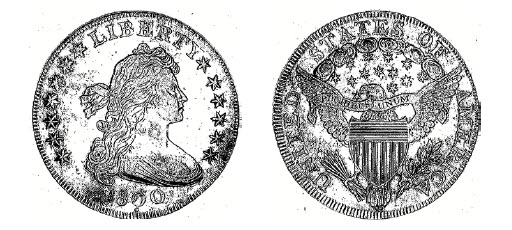
Dotted Date (B-14. H-14.)
• OBVERSE 10: Dotted date, that is, curious die breaks or cracks are visible inside and above first o in date. Tiny dot-like die breaks appear in many other places, particularly between L and I, under nose, before chin, below first star, and under the 6th and 7th stars. The steel used to make this die must have been defective. Star 8 is closer to the Y than star 13 is from the bust. Star 7 is a little farther from L, and star 1 is very distant from hair, over 3 mm. On the left, stars 2 and 3 are closer together than are any others; 1-2 and 3-4 are farther apart than are any others and are also misaligned in relation to each other. On the right, stars 8-9 are farther apart than are any others.
Obverse die used to strike 1800 BB-194 only.
• REVERSE I: Only 13th arrows show plainly; the 13th arrow is much smaller and almost hidden, and appears faintly as the 3rd shaft from the left. Leaf points to center of I in AMERICA. Point of star touches point of lower part of eagle' s beak, and point of upper part of beak shuts down on top side of same star point. All upper stars touch clouds decidedly, except that under cloud 7 which barely misses. Die dot between second and third upper stars from right. ME touch at base. A over cloud 3 and area between clouds 3 and 4. Tip of arrowhead under right side of right upright of U in UNITED.
Reverse die used to strike 1800 BB-194 only.
• DIE STATES:
Die State I: Perfect obverse die without breaks (dots). May not exist.
Die State II: Dies for BB-194 as described by Bolender. (Does an even earlier state, without flaws, exist) The die state usually seen. LIBERTY usually weakly struck, especially at the tops of ERTY .
Die State III: As preceding, but with hairline crack on obverse from border up through star 1 to' a short distance in
field. Die breaks (dots) at date enlarge. Crack on reverse from D through wing to S. Raised clash marks at OF from drapery creases on obverse. Scarce.
Die State IV: Bolender-14a. As preceding, but now with the following die cracks. Heavy die crack under first 0 in date, up through left top of second 0 to bust. Crack through right side of last 0 from milling to bust. Crack from lower part of last 0, bust, and ending in right field. Light cracks in first 3 stars. Reverse die cracks also appear from border, through right top of N into field. A crack from milling to right top of E, base of D, left wing, lower part of clouds, continues in several cracks up through OF. Another crack from top of D through left wing to S. Scarcer than either of the preceding.
Die State V: Later state than III, now with die rust on the obverse, and with failure at the rim above LIBERTY.
• AUCTION POPULATION SURVEY: Good: 2, Very Good: 4, Fine: 17, Very Fine: 41, Extremely Fine: 31, About Uncirculated: 3, Mint State-60 or better: 1. Total: 99. Average grade: VF-25.
• COLLECTING NOTES: 1800 BB-194 is another plentiful variety. About 500 to 900 are believed to survive in all grades combined. As the case with the AMERICAI variety, the value of the Dotted Date is enhanced by die flaws, a curious situation from the viewpoint of logic. Ever since Richard S. Yeoman listed it in the Guide Book as a "major variety," it has been inordinately popular. Actually, there are numerous varieties of early dollars more significant than this that are not listed in the Guide Book.
Most known specimens of 1800 BB-194 are in lower grades. In Mint State, the issue is a major rarity. Who knows what the Boyd coin would grade today? I have arbitrarily assigned the grade of MS-63 to it.
• NOTABLE SPECIMENS:
Boyd Specimen. MS-63 .• Numismatic Gallery, World's Greatest Collection, F.C.C. Boyd, 1945: 100, Haseltine-14. "An Unc. gem, with brilliance of original mint lustre. Nick on chin."
NASC Convention Sale Specimen. AU-50. • Kagin's, 1979: 536, Bolender-14a, Dotted Date. "AU-50, with natural gray toning, some original lustre present, sharp strike, some old light hairline scratches obscured by the toning."
Buss Specimen. AU-50 .. Superior Galleries, Dr. Jerry Buss Collection, 1985: 1334. "AU-50. Well struck with plenty of mint lustre still adhering to the surfaces; all overlaid with light grayish toning and with some electric blue iridescence about the borders. A wonderful defect-free specimen, with just a few minute marks about the rims."
Boyd, Brand and Ryder Collections Specimen. AU-50 .• Bowers and Merena Galleries, 1990: 2462, AU-50. "Largely brilliant with some exceedingly faint blushes of aureate coloration. Much satiny mint lustre survives in the fields of both surfaces. Virtually all of Miss Liberty's hair strands are nicely delineated except for those directly behind her temple. All of the breast feathers on the eagle are visible. Some faint hairlines on the obverse indicate that this piece may have been carefully cleaned long ago."
Helfenstein Sale Specimen. EF-45 .• Lester Merkin, 1968: 280. "EF-AU, deeply toned. a couple of minute rim nicks."
River Oaks Specimen. EF-45 .• Bowers and Ruddy Galleries, 1976: 704. "Nice EF-AU grade with some vestigial mint lustre."
Seller Specimen. EF-45. • Bowers and Ruddy Galleries, 1980: 3276. "Choice EF-45, considerable mint lustre overlaid by bright silvery gray toning. The familiar Dotted Date variety, from a badly rusted and pitted obverse die. First and second clouds defective at bottom."
Matlock Specimen. EF-45. . Bowers and Merena Galleries, 1991: 477, EF-45. "Light silver gray in the fields with areas of golden brown around the central devices and elsewhere. Original mint lustre can be seen around the stars on the obverse, and across much of the reverse surface. Well struck, with nicely separated hair strands and bodice lines on the obverse, most breast and tail feathers on the reverse visible without the aid of magnification. "
Brilliant and Sieck Collections Specimen. EF-45 .• Bowers and Merena, 1992: 1275, EF-45 to AU-50. "Obverse highly attractive, light silver gray with areas of darker gray on the high points, lighter gray on the fields, with pale champagne hues visible on most portions of the field. A very light rim bump above F on reverse is noted."
• POPULATION DISTRIBUTION:
Approximate population MS-65 or better: 0 (URS-0)
Approximate population MS-64: 0 (URS-0)
Approximate population MS-63: 1 or 2 (URS-1)
Approximate population MS-60 to 62: 0 (URS-0)
Approximate population AU-50 to 58: 4 to 8 (URS-3)
Approximate population VF-20 to EF45: 375 to 700 (URS-10)
Approximate population G-4 to F-15: 125 to 200 (URS-9)
Approximate population for all grades combined: 500 to 900 (URS-11)
• CONDITION CENSUS: 63-55-50-50-50-45 (multiples)