Silver Dollars & Trade Dollars of the United States - A Complete Encyclopedia
Q. David Bowers
1800. BB-191.
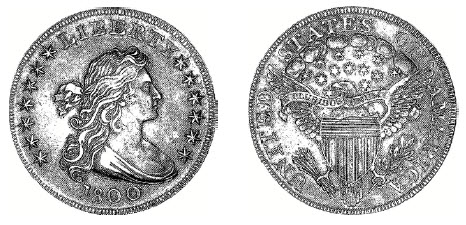
AMERICAI Reverse (B-11. H-11.)
• OBVERSE 7: See description under 1800 BB-190. All coins seen have been from relapped die.
Obverse die used to strike 1800 BB-190 and BB-191.
• REVERSE G: AMERICAI variety (one of two AMERICAI varieties, the other, which shares this reverse, is BB-192). After the word AMERICA, an almost vertical line, a stray mark (apparently, not a die crack), perhaps from a punch or from a stray piece of metal during the die making process, appears more or less like an "I" added. There are no serifs to the stray mark, and it takes some imagination to call it an I, but the nomenclature has been with us for a long time, and "AMERICAI" it is. Nowhere else in the silver dollar series has a stray die mark done so much for a coin's value and desirability in the eyes of collectors.
Other characteristics: Star enters eagle's mouth; point of lower part of beak touches star lightly below point. Upper part of beak does not quite touch. Point of leaf slightly right of being under left upright of I in AMERICA. Middle berry is small and joined to a leaf point by what seems to be a die scratch. A touches 3rd feather only, and ME almost join at bottom. Center of A over cloud 3. Tip of arrowhead under left side of left serif of N in UNITED. Usually (always?) weakly struck at the reverse center and on the stars above the eagle's head.
Reverse die used to strike BB-191 (earlier use) and BB-192 (later use).
• DIE STATES:
Die State I:. Perfect obverse die, without relapping. Reverse die without cracks. May not exist with obverse not showing relapping. .
Die State II: Obverse die relapped. No die cracks. Reverse without cracks, The usual die state seen.
• AUCTION POPULATION SURVEY: Good: 2, Very Good: 4, Fine: 13, Very Fine: 13, Extremely Fine: 8, About Uncirculated: 2, Mint State-60 or better: 1. Total: 43. Average grade: VF-22.
• COLLECTING NOTES: 1800 BB-191 dollars survive to the extent of an estimated 200 to 350 coins, ranking it among the scarcer issues of a year with many elusive varieties. The desirability of BB-191 is greatly increased by the AMERICAI feature on the reverse, a stray mark from a punch that is in the right position to make it appear (with some imagination) as the letter I, hence AMERICAI.
Bolender called it "excessively rare" and noted that it took him 35 years to find a specimen! He went on to say that several times he found "R-11" coins (equivalent to BB-191 today), but upon inspection they invariably proved to be the plentiful R-19 (BB-192) variety struck from the same reverse die.
• NOTABLE SPECIMENS:
Carter Specimen. MS-60. Stack's, Amon Carter. Jr. Collection, 1984: 228, "Brilliant Unc., with just a tiny rub or two on the high points. Full mint lustre with delicate peripheral toning."
University of Rochester Specimen. AU-50 .• Bowers and Ruddy Galleries, University of Rochester Collection, 1980: 3285. "AU-50, gorgeous antique gold toning over fully lustrous surfaces. Included in the University of Rochester holdings unattributed, therefore a new discovery."
Ostheimer Specimen. EF-45 • R.J. Lathrop Collection ANA Convention Sale, 1952: 1270 .• Lester Merkin, AJ. Ostheimer, 3rd Collection, 1968): 303. "Where struck up, this is nearer AU than EF, with considerable mint brilliance. Central weakness on both sides as almost always, but mint frost even in some weak areas. Small but deep obverse planchet defect (split) above. Faint traces of old cleaning."
Gilhousen Specimen. EF-45. • M.H. Bolender. • Dr. Charles' Ruby Collection. • Superior Galleries, Gilhousen Collection, 1973: 1269. "EF, lustrous, richly toned, manyareas suggesting AU."
Stack's Auction '84 Specimen. EF-45. Stack's, 1984: 1187. "EF with lustre in the devices. Pale steel and iridescent."
Brooks Specimen. EF-45 • Bowers and Merena Galleries, Brooks Collection, 1989: 255. "EF-45. Quite sharply struck with most of Miss Liberty's hair details boldly rendered. Both surfaces are warmly toned in blue and coppery golden hues. The obverse is very well centered."
1976 ANA Specimen. EF-40 • Stack's, ANA Convention Sale, 1976: 1340, "EF, russet toning."
Boyd Specimen.EF-40 • Numismatic Gallery, World's Greatest Collection, F.C.C. Boyd, 1945: 97. EF.
Davis Specimen. EF-40 .• Stack's, Davis-Graves Garnes Davis) Collection, 1954: 1316. "Lustrous, well struck and centered specimen, showing little or no handling defects or wear of any sort. EF. Mr. James Davis purchased this piece prior to 1890, and it has remained untouched for the last 64 years. "
Shore Specimen. EF-40 • Superior, A. Bernard Shore Collection, 1988: 2223. ·"EF-40. Deep silvery gray with bright orange-gold undertones in the fields. Mostly well struck and original with some lustre in the protected areas."
Stack Specimen. EF-40 • Stack's, James A. Stack Collection, 1990: 419. "EF, pale gray with russet and iridescent toning."
• POPULATION DISTRIBUTION:
Approximate population MS-65 or better: 0 (URS-0)
Approximate population MS-64: 0 (URS-0)
Approximate population MS-63: 0 (URS-0)
Approximate population MS-60 to 62: 1 or 2 (URS-2)
Approximate population AU-50 to 58: 4 to 8 (URS-3)
Approximate population VF-20 to EF-45: 125 to 215 (URS-8)
Approximate population G-4 to F-15: 70 to 125 (URS-8)
Approximate population for all grades combined: 200 to 350 (URS-9)
• CONDITION CENSUS: 60-55-50-50-50-45 (multiples)