Silver Dollars & Trade Dollars of the United States - A Complete Encyclopedia
Q. David Bowers
1799/8 and 1799 Silver Dollars
Mintage
Calendar year, Mint report: 423,515
Coins bearing date, author's estimate: 395,000
Coinage Context
(For all 1799 varieties)
Record mintage: During calendar year 1799, the quantity of silver dollars minted reached an unprecedented 423,515. I believe many of these were dated 1798. At the time, little attention was paid to the use of dies in the year they were dated. The net coinage of 1799-dated dollars amounted to an estimated 395,000 (within 10%). Some of these may have been minted in calendar year 1800.
Among the production of 1799-dated dollars were some coined from an obverse die overdated 1799/8, although these were not the first struck.
Die making: Working dies for 1799 dollars were prepared as follows:
Obverse dies: The bust of Miss Liberty was punched into the die, after which the letters of LIBERTY, the stars, and the digits in 1799 were all added with individual punches. There were two sets of numeral punches used, each with Pointed 9:
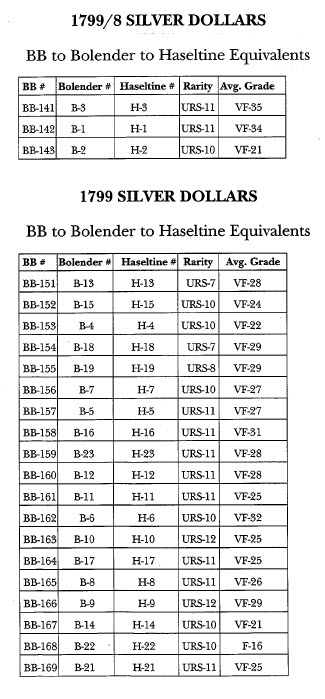
Early style with narrow 7 and with spur at bottom of top curve of 9. Used on most obverses of 1798. Used on these 1799 varieties: BB-141, BB-142, BB- 143, BB-154, BB-155, BB-156, BB-157, BB-159, BB- 160, BB-161, BB-162, BB-163, BB-164, BB-166, BB- 167, BB-168, BB-169.
Later style with wider 7 and without spur at bottom of top curve of 9. Space in opening at top of 9 slightly larger than on preceding. Used sparingly on 1798 varieties. Used on these 1799 varieties: BB-151, BB-152, BB-153, BB-158, BB-165.
Reverse dies: The Heraldic Eagle motif was punched into the master die. The master die included the eagle, clouds above the eagle, the upper part of the olive branch, olive leaves, and arrows. (Earlier, arrow details were added by hand, but in 1799 they were punched as a group, and are thus similar from coin to coin, unlike the situation in 1798). Working dies were copied from this master die. Added separately to the working die were the letters of UNITED STATES OF AMERICA, the stars above the eagle, the lower part of the olive branch, and the berries. (The manner in which the motto, E PLURIBUS UNUM, was introduced to the die is uncertain. Possibilities include the letters being individually punched in the master die or a complete ribbon punch containing the letters being added directly to the working die. This is an area for further research.)
The elements on obverse and reverse that were punched in separately differ minutely in their placement from one another, and are a guide to attribution. On 1799 dies, the workmanship was of a higher order than previously. Star spacing, letter alignment, and other variables are less obvious, and the attribution of certain varieties becomes more difficult.
The letters in E PLURIBUS UNUM vary in their apparent size (caused by different sizes of letter punches or the depth they were punched into the ribbon) and placement on certain varieties. Points of difference include the shapes and proportions of such letters as P, R, S, and U. Placement differences to note are the position of the U and S in PLURIBUS with regard to the edge of the eagle's neck on the left, and the placement of the N in UNUM in relation to the edge of the eagle's neck on the right, In general, letters Were smaller in 1798 and 1799, and-larger from 1800 onward.
The letters in E PLU RIBUS UNUM seem larger and for some letters differently proportioned on the reverses of 1799 BB-162 and BB-164, in comparison to the other reverses of the year.