Silver Dollars & Trade Dollars of the United States - A Complete Encyclopedia
Q. David Bowers
1802/1 and 1802 Silver Dollars
Mintage (all varieties)
Calendar year, Mint report: 41,650
Coins bearing date, author's estimate: 80,000
Coinage Context
Mintage figures: Only 41,650 silver dollars were reported as having been coined in calendar year 1802. However, the proportionately large number of extant specimens indicates that many more than that must have been coined bearing the 1802 date, in 1803 and/or 1804.
Numismatic Information
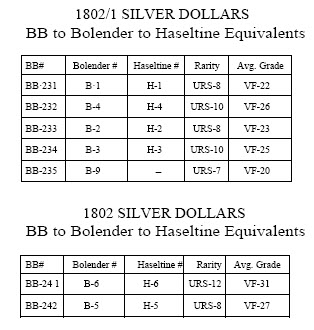
Commentary: Overdates exist in narrow date and wide date form. The close date varieties are BB-231, 232, and 235, while the wide dates are BB-233 and 234. While wide-date and close-date terminology has been popular, these adjectives are quite arbitrary and, on their own, do little to help with identification. However, on BB-231, 232, and 235, the 0 and 2 in the date are closer together than on BB-233 and 234. None of the five 1801 undertype dies used for the overdates was ever employed for 1801-dated coinage; this can be easily ascertained by observing the position of star 13 on both 1801 dies (farther from bust) and the five 1802/1 dies (closer to bust).
While there are no legendary rarities among 1802 dollars, BB-235 is considered to be quite elusive. Only a small fraction of 1802 dollars in existence have been attributed. Thus, the possibility exists not only for finding scarce issues such as BB-235 for "type" prices, but to discover a new die variety.
1802/1 dollar die varieties are fairly difficult to attribute. As most buyers seek only the overdate, not a specific Bolender variety, relatively few coins have been attributed, as noted. Because of this, I believe that the number of known specimens of the various die varieties will increase, should collecting by varieties become more popular than it is now.
In terms of availability, 1802 BB-241 overwhelms every other die variety and is many times more plentiful. As of October 1992, NGC and PCGS have designated one 1802/1 dollar as Mint State and 10 specimens of the 1802 regular date. Presumably, most of the 10 are of the BB-241 variety.
Overdates: The year 1802 is distinguished by the presence of five different varieties of 1802/1 overdates from as many obverse dies. Just why five 1801 dies were overdated with a final 2 digit is not clear, inasmuch as at least three regular 1801 varieties (1801 BB-212, 213, and 214) were struck later than 1801, quite possibly in 1802. Perhaps, the answer is that the five known dies that were overdated had not been hardened yet in the die-making process. Thus, another digit could be stamped over the final 1 without any problem. Possibly, the other 1801 dies that were not overdated (1801 BB-212, 213, and 214) were already hardened, and were not suitable for alteration.
Striking order. Attention was not paid to striking coins in the years the dies bore. I consider it highly probable that many 1802-dated dollars were struck in 1803. The production of 1801, 1802, and 1803 dollars seems to have been done with the obverse dies mixed, as evident by the primary use of just two reverse dies with a much larger number of obverses.
Bearing the 1802 date and sharing one common reverse are 1802/1 BB-231, 1802/1 BB-232, and 1802 BB-241. Apparently, BB-231 and 232 were struck before 241.
Bearing the 1802 date and sharing another common reverse are 1802/1 BB-233,1802/1 BB-234, 1802/1 BB-235, and 1802 BB-242. Die progression studies show that 1802/1 BB-233 represents the first use of this die, which was also used to coin 1801 BB-214 and 1803 BB-251 and 252, in addition to the other 1802 dollars mentioned.
If one assumes that strikings from the same reverse die occurred at the same time, this would give two "striking periods."Which one occurred first is not known. I have not had the opportunity to make detailed die studies of actual specimens of BB-235 and BB-242. If this is done at a future date, additional conclusions may be drawn. It is known that the reverse die was relapped after 1802/1 BB-233 was struck.
This would have necessitated removing the reverse die from the press. Because of this, another "striking period" could have occurred after BB-233 was produced.
FIRST STRIKING PERIOD:
1802/1 BB-231
1802/1 BB-232
1802 BB-241
SECOND STRIKING PERIOD:
1802/1 BB-233
1802/1 BB-234
1802/1 BB-235
1802 BB-242