Silver Dollars & Trade Dollars of the United States - A Complete Encyclopedia
Q. David Bowers
1803 Silver Dollars
Mintage (all varieties)
Calendar year, Mint report: 85,634
(includes 19,570 in calendar year 1804)
Coins bearing date, author's estimate: 60,000
Coinage Context
Final mintage: 1803-dated dollars were the last produced during the early nineteenth century. By this time it had become profitable to export or melt newly-minted dollars, and the continued production of them would have been an exercise in futility. Had it not been for this factor, coinage undoubtedly would have continued for many years. The existence of so many worn early dollars of the 1794-1803 years is mute testimony to their success in domestic channels of commercial circulation (other dollar-sized coins, notably the Spanish-American issues, circulated very effectively as well). After the end of the Draped Bust obverse, Heraldic Eagle reverse coinage, the mantle fell to the half dollar to be the largest silver coin of the realm, a mandate the denomination filled admirably. As discussed under 1795 silver dollars, the half dollar denomination played second fiddle to the silver dollars. When large quantities of dollars were being made, small numbers of halves Were produced. When dollars were not being minted, such as from mid-October 1794 through late spring 1795, and after early 1804, production of half dollars increased tremendously.
The Mint reported that 66,063 silver dollars were minted in calendar year 1803, and 19,570 were struck in 1804. As no original 1804-dated dollar has ever been found or reliably reported, the assumption is that these 19,570 coins bore earlier dates, probably mostly 1801, 1802, and 1803 (not necessarily all dated 1803, as some have suggested).
Numismatic Information
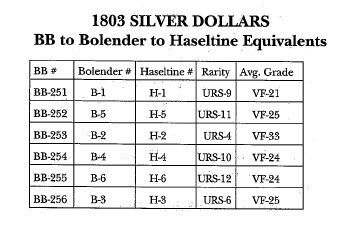
General information: Dollars dated 1803 include those of the Large 3 and Small 3 type. Walter H. Breen believes that the Large 3 type was struck in 1804. As an aid to collecting, the Guide Book of u.s.Coins helpfully divides the coinage of 1803 into the Small 3 varieties (of which there are five) and the Large 3 (just one variety, BB-255). Milferd H. Bolender referred to these as the Thin Top and Thick Top varieties.
All six varieties considered, 1803 dollars go from the very rare (BB-253, the very existence of which is doubted by some) to the very common (BB-255, the Large 3 variety, of which well over 1,000 are believed extant).