Silver Dollars & Trade Dollars of the United States - A Complete Encyclopedia
Q. David Bowers
1802/1 Overdate. BB-235.
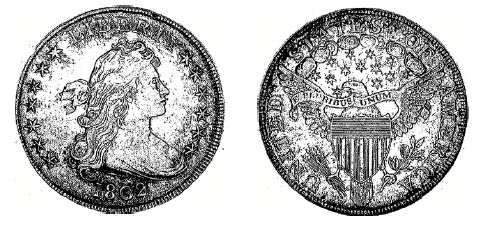
(B-9.)
• OBVERSE 5: The figures of date are small and well spaced, the 8 centered between 1 and 0 and not too low as in No.1, nor tipped to right, as in No.4. Look at the overdate 2 over 1, and observe that the left top of 1 under 2 is in line with left top and base of 2. A flaw in the die shows midway between base of B in LIBERTY and end of curl on head just beneath. Liberty has closed lips, while the mouth is open on all other overdates.
Obverse die used to strike 1802/1 BB-235 only.
• REVERSE B: See description under 1801 BB-214; repeated under 1802/1 BB-233.
Reverse die used to strike 1801 BB-214 (typically with crack from border toward cloud 6); 1802/1 BB-233 (perfect; first use of the die), BB-234 (die relapped, cloud 6 mostly missing, some arrowheads disconnected; some with clash mark from cloud 5 to border above 0), and BB-235; 1802 BB-242 (spur on D from now on); 1803 BB-251 (relapped, struck before BB-252) and BB-252 (relapped, struck after BB-251).
• DIE STATES:
Die State I: Obverse die without cracks. Reverse die relapped. Tiny crack between arrows and eagle's leg (as seen on all uses of this die). Usual state seen.
Die State II: Obverse with die cracks 5:00 rim to the drapery, and the border opposite star 13 through the center of the star 12 into the field past the inner point of star 11. The first published was the New Netherlands 51st Sale coin, VF/Fine. Rare. Reverse as preceding.
Die State III: As above, but with additional obverse crack from border through 02 of date into field above 8. Rarer than preceding.
• AUCTION POPULATION SURVEY: Fine: 1, Very Fine: 16, Extremely Fine: 1. Total: 18. Average grade: VF-20.
• COLLECTING NOTES: The 1802/1 BB-235 is the rarest overdate of the year as well as the rarest of all 1802 varieties. Only about 50 to 90 are estimated to be known. I have found no Mint State specimen, nor has an AU been reliably reported.
Unknown to Haseltine in 1881, and to other early scholars, this obverse and die combination was discovered by M.H. Bolender in the Marmaduke Fox Collection in 1950 after the plates to his book went to press, but before the text was printed. Once the variety was announced, specimens started "coming out of the woodwork," as the listing below indicates.
• NOTABLE SPECIMENS:
Baldenhofer Specimen. EF-45 .• W.G. Baldenhofer. • AJ. Ostheimer, 3rd .• Superior, Gilhousen Collection, 1973: 1279, 2 over 1. "Bolender-9b, with diagnostic die chip between curl point and B, and the crack from rim to drapery, and the second crack through 11 th and 12th stars to rim; said to be one of only two known in this final die state. Better than EF, richly toned."
Gross Specimen. EF-40, edge bruise .• Rarcoa, 1976. Surfaces not "richly toned" (thus eliminating duplication with the Baldenhofer coin). Sold to the following .. Yolanda Gross Collection.
Autumn Sale Specimen. VF-35 .• Stack's, 1978: 300. "Evenly spaced date. A strong VF, nearly EF."
Newport Specimen. VF-30 .• Bowers and Ruddy, Newport Collection, 1975: 389. "VF or better, the only flaw being a minor planchet striation near 6th star and a small edge ding on reverse."
Willasch Specimen. VF-25. . Superior Galleries, H. Roland Willasch Collection, 1990: 596. "VF-25. Mottled gold and sea green toning throughout and boldly struck. Very early die state before the obverse cracked below bust. A few minor edge marks, which show that this coin is not from any of the major collections sold in the past couple of decades. No trace of heavy crack below bust."
Fox Specimen. VF-20. • Marmaduke Fox Collection, 1950 .. M.H. Bolender Collection, 1952: 176. "A new variety which I discovered in 1950 when I purchased the Marmaduke Fox Collection of United States coins. Unknown to Haseltine, and to me also until 1950. Strictly Fine." • Lester Merkin, AJ. Ostheimer, 3rd Collection, 1968: 320. "VF, light toning. Third finest. The discovery coin, identified by Bolender in the Marmaduke Fox Collection (1950)."
Bauer Specimen. VF-20. . M.H. Bolender. • Lester Merkin, Bauer Collection, 1968: 422. "Bolender-9b. Straight cracks from rim into bust and from rim through 12th to 11th star. VF, deep toning, excellent surfaces, a couple of trivial rim nicks. Pedigree: Ex Bolender."
Spies Specimen. VF-20 .• Stack's, W. Earl Spies Collection, 1974: 226. "A new obverse with an evenly spaced die. With the die lump between the B and curl. Strictly VF." . Stack's, March Sale, 1985: 1234. VF.
Spies Specimen (another). VF-20 .• Stack's, W. Earl Spies Collection, 1974: 227. "Bolender-9a. Die cracks: From milling through the 02 into the field above the 8. Another into the bust and a third through 12th star into field. VF, small obverse edge ding."
Stack's December Sale Specimen. VF-20, net. (VF-35 , polished) .• Stack's, December Sale, 1985: 1155, Bolender-9b. "VF, close to EF. Multi-colored iridescent toning with light devices. Die breaks on obverse from rim to middle of bust tip; branching from that through star 13 through star 12 and touching left point of star 11 as it curves into field, and another from rim left of date, through base of 2, upper part of 0, and into lowest curl near shoulder. Lightly polished, later die state than the Spies coin."
Blevins Specimen. VF-20 .• Superior, H. W. Blevins Collection, 1988: 3800. "VF-20. Mottled violet and gray coloring with some lighter areas on relief details."
New Netherlands 54th Sale. Specimen. VF-20 .. New Netherlands 54th Sale, 1960: 1014, Bolender-9a. Chip in field between B and point of curl; die crack from bust to border. VF, obverse a hair's breadth off, reverse better. Tiny obverse nick on the neck." • Quality Sales auction, September 10-12, 1973; 480 .• Pine Tree, GENA Convention Sale, 1974: 1052. "Unlisted die breaks, from border opposite 13th star, through center ofl2th, and into field past inner point of 11th star; not so known to Bolender. VF, rather boldly struck up, with pleasing warm gray surfaces; unusually clean and choice for the grade, save for a pin-point nick on nape of neck." • Pine Tree, Breen III Sale, 1978: 603. (Previous description repeated.)
New Netherlands 51st Sale Specimen. F-15 .• New Netherlands 51st Sale, 1958: 700. "Close overdate; chip between curl point and B. Unpublished die break from border to bust above drapery. Obverse close to VF; reverse just Fine. A couple of minor reverse rim bruises."
ANA Centennial Sale Specimen. VF-20 .. Bowers and Merena Galleries, ANA Centennial Convention Sale, 1991: 1423, Overdate. "VF-20. Central areas are brilliant changing to intermingled golden brown and sea green shades at the borders. Traces of frosty mint lustre seen around stars, numerals, and letters. Obverse edge cut is noted at 1:00.
Lee and Shaffer Collections Specimen. F-15 net (VF-20, cleaned) .• Superior Galleries, Lee and Shaffer Collections, 1988: 3168. "Sharpness of VF-20 but lightly cleaned at one time. Surfaces are now mostly recovered and show a lilac-gray color with some lighter areas noted on the relief details. Strike is exceptionally sharp with centers showing unusually good detail."
• POPULATION DISTRIBUTION:
Approximate population MS-65 or better: 0 (URS-0)
Approximate population MS-64: 0 (URS-0)
Approximate population MS-63: 0 (URS-0)
Approximate population MS-60 to 62: 0 (URS-0)
Approximate population AU-50 to 58: 0 (URS-0)
Approximate population VF-20 to EF-45: 45 to 80 (URS-7)
Approximate population G-4 to F-15: 5 to 10 (URS-4)
Approximate population for all grades combined: 50 to 90 (URS-7)
• CONDITION CENSUS: 45-35-35-30 (multiples)