Silver Dollars & Trade Dollars of the United States - A Complete Encyclopedia
Q. David Bowers
1802/1 and 1802 Heraldic Eagle
Varieties
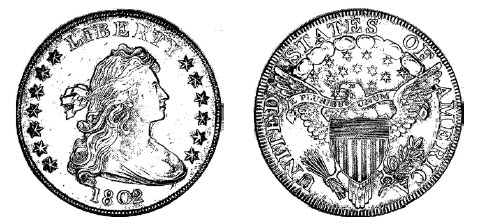
(B-1. H-1.)
• OBVERSE 1: Close date, 02 closer than other figures. The 8 centered between 1 and 0 but too low. "Pocket" at throat and "collar" at neck-line, at base on most (but not all), a product of die clashing. The 1 is very close to lowest curl, but does not quite touch. A "dot" is before upper lip, under nose (visible only on high-grade coins). On the left, star pairs 1-2 and 2-3 are closer together than are star pairs 5- 6 and 6-7.
Obverse die used to strike 1802/1 BB-231 only.
• REVERSE A: Same die used to coin 1801 BB-212, described earlier, but herewith repeated: The point of the leftmost arrowhead is under the left edge of the left serif of N in UNITED. The point of upper part of eagle's beak touches down on a point of a star slightly back from extreme star point. Only 12 arrows show plainly (13th faintly shows, but is difficult to find). First A in AMERICA touches third feather, and is connected by die crack to 4th feather. Leaf points more towards left corner of base of I in AMERICA.
Reverse die used to strike 1801 (intermediate state) BB-212; 1802/1 BB-231 (early state) and BB-232 (early state);
1802 BB-241 (slightly advanced intermediate state); and 1803 BB-253 (if it exists) and BB-254 (slightly advanced intermediate state), and BB-255 (terminal state).
• DIE STATES:
Die State I: Perfect dies. May not exist.
Die State II: Obverse with clash marks as described above under BB-231. The state usually seen.
• AUCTION POPULATION SURVEY: Good: 3, Very Good: 6, Fine: 11, Very Fine: 7, Extremely Fine: 7, About Uncirculated: 5. Total: 39. Average grade: VF-22.
• COLLECTING NOTES: The 1802/1 BB-231 is very rare in all grades. Only about 100 to 175 are estimated to survive. It and BB-233 are of about equal availability. Specimens exist mainly in the lower grades, although a few AU pieces have appeared in the literature. For this variety, EF would be a notable condition. Apparently, Mint State examples are unknown.
Curiously, in 1881 Haseltine did not mention this variety or any other 1802/1 as being an overdate; this was by implication in that he called nonoverdated varieties "perfect" dates. (The term perfect date is currently used by the Guide Book of U.S. Coins and certain other references to denote a date on a coin which is not overdated, notably repunched, or With some other distinctive feature.) H-1 (equivalent to BB-231) was called very scarce.
• NOTABLE SPECIMENS:
Bebee's. AU-50 .• Numismatist advertisement, 1953. AU. Superior Specimen. AU-50. • Superior Galleries Sale, September 1970: 1463. "Toned AU."
CSNS Specimen. AU-50 .• Kagin's, CSNS Convention Sale, 1979: 370. "Choice AU-50+, nice strike with lull stars, lovely golden bluish lustre. R-4."
Stirling Specimen. EF-45 .• B. Max Mehl, January 1954, "Proof surface Uncirculated." • Frank M. Stirling Collection, Heritage, February 1986: 1341. "EF-45. Colorful splashes of iridescence accentuate lustrous steel gray surfaces."
Blevins Specimen. EF-45 •• Superior, H. W. Blevins Collection, 1988: 4771. "Very early die state with the lower loop of the 8 sharply recut. Almost AU-50. Softly struck on upper part of obverse device but extremely well impressed on reverse. Planchet is quite large with full milling visible. A considerable amount of original mint lustre is visible below delightful golden gray and iridescent color." .
Hollinbeck Specimen. EF-40 net (AU-55, badly cleaned). • Hollinbeck Coin Co., August 1954 mail bid sale .• K.P. Austin. • AJ. Ostheimer, 3rd Collection. • Superior Galleries, ANA Convention Sale, 1975: 1015. "AU-55 sharpness with a prooflike surface obverse, but cleaned neither too wisely nor too well. Some original lustre still evident, mostly about the devices on the reverse, along with a little iridescent toning. While the obverse has handling marks, and one medium-sized rim bruise at 3:00, the reverse is virtually free from defects."
Davenport Specimen. EF-40 .• Superior Galleries, Davenport Collection, 1977: 483. "EF-45 with the surfaces somewhat prooflike. Cleaned a few years ago arid now retoning."
Bolender Specimen. EF-40 •• M.H. Bolender Collection, 1952. EF.
Herdegen Specimen. EF-40. • Herdegen Collection (Hans M.F. Schulman, 1973), EF.
• POPULATION DISTRIBUTION:
Approximate population MS-65 or better: 0 (URS-0)
Approximate population MS-64: 0 (URS-0)
Approximate population MS-63: 0 (URS-0)
Approximate population MS-60 to 62: 0 (URS-0)
Approximate population AU-50 to 58: 2 to 4 (URS-2)
Approximate population VF-20 to EF-45: 40 to 70 (URS-7)
Approximate population G-4 to F-15: 55 to 100 (URS-7)
Approximate population for all grades combined: 100 to 175 (URS-5)
• CONDITION CENSUS: 50-50-45 (multiples)