Silver Dollars & Trade Dollars of the United States - A Complete Encyclopedia
Q. David Bowers
1800. BB-187.
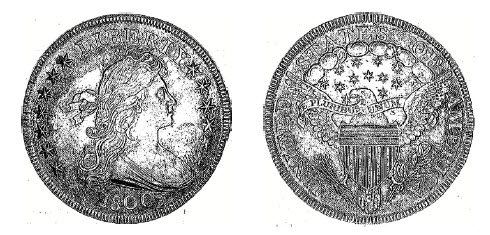
(B-16. H-16.)
• OBVERSE 5: Close date, 1 almost touches curl. The 8 is too low, and top tipped too much to right. Last 0 near bust. Die' dot just to left of highest curl on top of head. On the left, stars 1, 2 and 3 are more widely spaced from each other than are stars 5, 5, and 7. On the right, stars 9 and 10 are more widely spaced than ate any others. The ray of star 10 that is nearest to an adjacent ray of star 11 is misaligned with that ray of star 11. Die flaws between top of Rand T in LIBERTY.
Obverse die used to strike 1800 BB-187 only.
• REVERSE D: See description under 1800 BB-185. Reverse die used to strike 1800 BB-185, BB-186, and BB-187, possibly in that order.
• DIE STATES:
Die State I: Perfect obverse die without die crack. Reverse with some roughness between E and S of STATES. Does a perfect obverse die impression exist?
Die State II: Obverse with curved hairline crack up through right side of second 0 in date, through bust, point of chin, to star 10. Some light clash marks between stars 3 to 6 and the border. Roughness between E and S of STATES. This is the die state usually seen.
Die State III: As preceding, but roughness has developed into a prominent period-like crack between the tops of E and S.
Die State IV: As BB-187, but with die clash marks as "waves" along the top of the date. Stack's Auction '89: 1779 AU.
Die State V: Very late state. New die flaws form at the top of ES in STATES, the back of Miss Liberty's head, between the L and I in LIBERTY and stars 7 and 8. A new obverse crack is present along the denticles from below the 8 to just past the second o.
• AUCTION POPULATION SURVEY: Good: 1, Very Good: 10, Fine: 28, Very Fine: 34, Extremely Fine: 28, About Uncirculated: 12, Mint State-50 or better: 4. Total: 117. Average grade: VF-27.
• COLLECTING NOTES: The 1800 BB-187 is about tied with BB-193 .as the most plentiful variety of the year. About 700 to 1,200 are known to exist. This plethora of specimens in no way indicates that BB-187 is readily available in Mint State, for it is not. Why, no one knows.
• NOTABLE SPECIMENS:
1988 ANA Specimen. MS-62 •.• Auction '79, Rarcoa, 1979. • Heritage, ANA Convention Sale, 1988: 965. "Mint State (62/62). A vibrant Mint State specimen. Medium iridescent toning, in shades of gold, blue and sea green, over fully lustrous surfaces. Well struck and attractive."
Boyd Specimen, MS-60 .• Numismatic Gallery, World's Greatest Collection, F.C.C. Boyd, 1945: 102, Haseltine-16. Unc .• Abe Kosoff, ANA Convention Sale, 1949: 201. • Stack's, Harold Bareford Collection, 1981: 419. "An arc-like die crack from 10th star to the last 0 of the date. Brilliant Unc., sharply struck, with full mint lustre. Struck from dies which are beginning to buckle, showing some light mounding here and there."
DeCoppet Specimen. AU-58 .• James Kelly, Andre Defloppet Collection, 1955. "Practically Unc., well struck with lustrous prooflike surface."
December Sale Specimen. AU-55 •• Stack's, 1987: 1523. "Choice AD, soft strike at bust tip, clouds below OF, and some central details. Virtually free of marks, with lustre suggestive of a Mint State specimen."
Carter Specimen. AU-50. • Amon Carter, Jr. Collection, Stack's, 1984: 231, AD, with bifurcated letters .• Stack's Auction '86: 293.
• POPULATION DISTRIBUTION:
Approximate population MS-65 or better: 0 (URS-0)
Approximate population MS-64: 0 (URS-0)
Approximate population MS-63: 0 (URS-0)
Approximate population MS-60 to 62: 4 to 8 (URS-3)
Approximate population AU-50 to 58: 25 to 50 (URS-6)
Approximate population VF-20 to EF-45: 400 to 750 (URS-10)
Approximate population G-4 to F-15: 275 to 400 (URS-10)
Approximate population for all grades combined: 700 to 1,200 (URS-11)
• CONDITION CENSUS: 60-60-60-60-55 (multiples)