Silver Dollars & Trade Dollars of the United States - A Complete Encyclopedia
Q. David Bowers
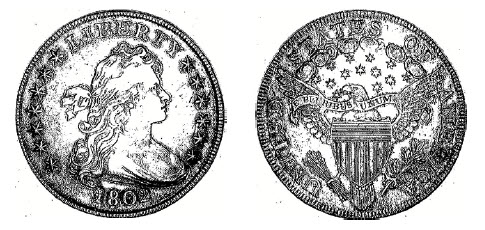
1802/1 Overdate BB-233
(B-2. H-2.)
• OBVERSE 3: Wide date, the most space between 1 and 8. The 1 farther from curl than last. Last star close to bust. Uppermost wave centered under E. On the left, star pairs 2-3 and 5-6 are closer together than are .any other stars. On the right, stars 10-11 are farther apart than any others, and stars 11-12 are the closest together
Obverse die used to strike 1802/1 BB-233 only.
• REVERSE B: Description under 1801 BB-214, herewith repeated: The point of the leftmost arrowhead is under the center of the left upright of the N in UNITED. There is a "spur" on the curved part of D. Leaf points under center of I in AMERICA. Point of a star touches the outside of upper part of eagle's beak slightly above beak's point. Called Reverse B by Bolender, this die was mated with obverses dated 1801, 1802, and 1803.
Die crack sequences reveal that 1802/1 BB-233 represents the first use of this reverse die; 1801- dated coins were struck later.
Reverse die used to strike 1801 BB-214 (typically with crack from border toward cloud 6); 1802/1 BB-233 (perfect; first use of the die), BB-234 (die relapped, cloud 6 mostly missing, some arrowheads disconnected; some with clash mark from cloud 5 to border above 0), and BB-235; 1802 BB-242 (spur on D from now on); 1803 BB-251 (relapped, struck before BB-252) and BB-252 (relapped, struck after BB-251).
• DIE STATES:
Die State I: Perfect dies.
• AUCTION POPULATION SURVEY: Less than Good: 1, Good: 1, Fine: 10, Very Fine: 14, Extremely Fine: 10, About Uncirculated: 1. Total: 37. Average grade: VF-23.
• COLLECTING NOTES: Only about 100 to 175 are known of 1802/1 BB-233. Specimens appear on the market with about the same frequency as BB-231, which isn't very often . As is the case with the preceding, specimens of BB-233 are nearly always found in lower grades. AU specimens are great rarities, and it may be the case that no Mint State coins survive.
• NOTABLE SPECIMENS:
1988 ANA Specimen. AU-50 •• Heritage, ANA Convention Sale, 1988: 968. "AU (50/50). Well struck, silvery gray example. Very clean, save for a few minor marks on Liberty's cheek and hair."
Long Beach Specimen. EF-45 .• Heritage, Long Beach Exposition Sale, 1988: 971. "EF (45/45). Untoned and very clean, save for a few minor marks on Liberty's profile."
Earle Specimen. EF-45. • George H. Earle Collection (Henry Chapman, ,1912) .• Schuyler Collection .• M.H. Bolender Collection, 1952: 170. "EF, nearly Unc., considerable lustre, sharp impressions."
New York Specimen. EF-40 .• Stack's, Metropolitan New York Convention Sale, 1967: 1179. "EF, Well centered, mint lustre."
Herdegen Specimen. EF-40 .• Hans M. F. Schulman, R.T. Herdegen Collection, 1973. "EF with some lustre and nice gray toning."
Leavitt Specimen. EF-40. . Leavitt & Co., auctioneers, 1879 .• Bowers and Ruddy, Garrett Collection, 1980: 695. "EF-40. Light gray toning overall with some darker areas among the stars and letters. A few marks on the reverse are hidden among the clouds."
Ostheimer Specimen. EF-40 net (EF-45, cleaned). • Lester Merkin, AJ. Ostheimer, 3rd Collection, 1968): 313. "EF-AU, brilliant, doubtless cleaned long ago, lightly bag marked."
Hollinbeek-Kagin Specimen. VF-35. • Hollinbeck-Kagin Sale, June 1970: 638. "Bust is VF; LIBERTY, date and stars EF, reverse EF,"
Boyd Specimen. VF-35 .• Numismatic Gallery, World's Greatest Collection, F.C.C. Boyd, 1945: 114. "A splendid, lustrous specimen, almost EF."
Holmes Specimen. VF-35 .. Stack's, Milton A. Holmes Collection, 1960: 2261. 'Just a shade from EF. Somewhat toned, nicely centered."
New Netherlands Specimen. VF-30. New Netherlands 44th Sale, 1954: 595. "Almost EF, though not bold at the fore-lock. Lustrous, the surface rather prooflike. With numerous faint, hardly visible obverse scratches on Liberty's throat, together with a few minor edge defects."
• POPULATION DISTRIBUTION:
Approximate population MS-65 or better: 0 (URS-0)
Approximate population MS-64: 0 (URS-0)
Approximate population MS-63: 0 (URS-0)
Approximate population MS-60 to 62: 0 (URS-0)
Approximate population AU-50 to 58: 1 or 2 (URS-1)
Approximate population VF-20 to EF-45: 65 to 130 (URS-8)
Approximate population G-4 to F-15: 35 to 55 (URS-7)
Approximate population for all grades combined: 100 to 175 (URS-8)
• CONDITION CENSUS: 50-45 (multiples)