Silver Dollars & Trade Dollars of the United States - A Complete Encyclopedia
Q. David Bowers
1800. BB-196.
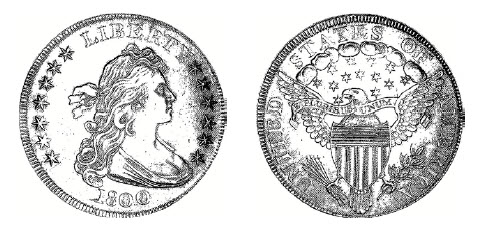
(B-17. H-17.)
• OBVERSE 12: A "collar" (clash mark) shows along neck about half the length of bust, due to clashing from the reverse die. A line extends to left from just above foot of 1 in date. Upper left star very distant from L, almost as far as first star is from hair, between 2 and 3 mm. 180 in date close, 1 originally cut too far to the left.
Obverse die used to strike 1800 BB-196 only.
• REVERSE K: Only 12 arrows. Point of star touches point of upper part of eagle's beak. Leaf point is under left side of stand of I in AMERICA. Center of A over cloud 3. Tip of arrowhead under right upright of U in UNITED.
Reverse die used to strike 1800 BB-196 only.
• DIE STATES:
Die State I: Without obverse clash mark or reverse die crack. May not exist.
Die State II: Obverse with clash marks visible as a "collar" at Miss Liberty's neck and bosom. This is the die state usually seen.
Die State III: Bolender-17a. As preceding, but now with additional die cracks as follows: Hairline crack at right of star 1 extends slightly into field. Crack from border to hair between star 1 and date. Tiny crack between stars 11 and 12. Reverse with prominent raised clash marks (from drapery folds) from S through OF and extending downward (called die breaks by Bolender). Die crack from border through top of A, lower part of M, to end of branch. Scarce.
Die State IV: As preceding, but now with obverse crack from star 6 to ribbon. Scarce.
• AUCTION POPULATION SURVEY: Very Good: 6, Fine: 12, Very Fine: 37, Extremely Fine: 21, About Uncirculated: 5, Mint State-60 or better: 5. Total: 86. Average grade: VF-27.
• COLLECTING NOTES: The 1800 BB-196 dollar is quite plentiful. About 500 to 950 survive in all grades combined. Unlike many of its contemporaries, it is not unusual to encounter in EF. AU specimens are in the rare category, and Mint State coins are exceedingly rare.
• NOTABLE SPECIMENS:
DeCoppet Specimen. MS-60 .• James Kelly, Andre DeCoppet Collection, 1955. "Unc, with original mint lustre."
Brilliant and Sieck Collections Specimen. MS-60 .• Bowers and Merena, 1992: 1277. "MS-60/62. Once dipped and lightly retoned, in attractive light golden brown shades. Frosty, sharp detail. Typical states of the dies, clear clash marks visible above the date, along Liberty's bosom, and in many places across the reverse surface. One small hairline scratch is noted in left obverse field. Some original mint lustre can be seen in protected areas of the reverse."
Hollinbeck-Kagin Specimen AU-58. • Hollinbeck-Kagin Sale, August 1970: 1094. "Bolender-17a. Unc, with lovely light golden and bluish patina, faint rubbing." • September 1970: 889. "BB-17A, Near Unc."
Boyd Specimen. AU-55 .• Numismatic Gallery, World's Greatest Collection, F.C.C. Boyd, 1945: 103, Haseltine-17. "Barely circulated."
Cohen Specimen. AU-55. - Bowers and Merena, Milton Cohen Collection, 1985: 528. "Choice AU-55 with a sizable percentage of the original mint lustre still remaining. Exceedingly sharply struck, with a wealth of needle-sharp design detail, including on the high parts of the center. Light gray fields at center are highlighted by traces of gold. Mottled light gunmetal blue and iridescent toning characterizes the borders."
Green Specimen. AU-50 .• Col. E.H.R. Green Collection. . Bolender Collection . James Kelly, Andre DeCoppet Collection, 1955. "Practically Unc." • Lester Merkin, AJ. Ostheimer, 3rd Collection, 1968: 308. "Bolender-17b. R-1. AU or so, dull gold toning, some mint lustre; reverse superior to obverse, almost full breast feathers."
Forrest Specimen. AU-50 .. Stack's, S.S. Forrest, Jr. Collection, 1972: 633. "AU, with the slightest wear on the high points. Considerable mint lustre. Dipped many years ago, now beginning to acquire a light golden hue."
• POPULATION DISTRIBUTION:
Approximate population MS-65 or better: 0 (URS-0)
Approximate population MS-64: 0 (URS-0)
Approximate population MS-63: 0 (URS-0)
Approximate population MS-60 to 62: 2 to 4 (URS-2)
Approximate population AU-50 to 58: 5 to 10 (URS-4)
Approximate population VF-20 to EF-45: 375 to 725 (URS-10)
Approximate population G-4 to F-15: 120 to 210 (URS-8)
Approximate population for all grades combined: 500 to 950 (URS-11)
• CONDITION CENSUS: 60-60-55-55-50 (multiples)