Walter Breen's Encyclopedia of United States and Colonial Proof Coins 1722-1989
Walter Breen
1889
Cent. [3336] Varies from red to brown. Microscopic positional differences only; 9 sometimes looks partly filled.
Three Cents. [3436] Some have 1 plainly recut. The extra hundred appear to mark the final issue of this denomination. Identical remarks to 1888; sometimes sold as "Unc., rarer than proof" these days.
Five Cents. [3336] Many of these come with the same dullness found on 1888's. Normal date, no recutting; at least two obverse dies with microscopic positional differences in dates. Same remarks as to 1888.
- Second 8 partly recut. Lester Merkin sale, November 1965. Rare.
Minor proof sets. [3336] A few of these are still around that can be reasonably accepted as originals rather than assembled sets. Most of these few have the dull nickels.
Dime. [711] Thin date, knob of 9 well away from loop (unlike many business strikes). Often rather carelessly made, flat heads and rounded rims being frequent.
Quarter. [711] Shield point minutely r. of upright; left base of 1 left of center. Rev. of 1888. Same remarks as to 1886-1887. Speculator activity has been evident here though not to the degree of the named earlier dates. Business strikes have date slightly below center, slanting slightly down; shield point minutely left of 8, left base of 1 slightly r. of center.
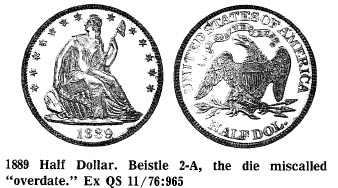
Half Dollars. [711] Only two die varieties seen. Beistle I-A has date about centered, left base of 1 almost over r. edge, some doubling on stars except 6th, 8th, and 9th. Beistle 2-A (see below) has date slanting down and no appreciable doubling on stars. Rev. of 1890, crisscross marks in first white stripe, curves in others. Same comment as to 1887 though speculator activity has been a little milder. Business strikes often have crack through 6th to 9th stars; shield point about over 8.
It is about time that someone finally exploded a superstition and exorcised the numismatic ghost giving rise to it. I am referring to the alleged overdate, "1889/88". In October 1944 a New York dealer, now retired in California, noticed that a business strike showed knob of 9 more or less joined to loop. He immediately thought "overdate!" kicked up his heels a few times and wrote an enthusiastic description of the coin. It brought a then high $62.50. What seems to be the same die appeared in WGC: 357 on a proof, its cataloguer referring to it as such and estimating it at a then fantastic $100. It brought $115. W. W. Neil was puzzled by this feature (which is not constant on 1889's) and in the sale of his collection in 1947 the proof 1889 was called 1889/88 in lot 534. The lamented Stuart Mosher, my guide and mentor, doubted the existence of any true overdate as early as 1947-48. I examined that in the Smithsonian's set (1951) and various others, and recognized the force of Mosher's argument -namely that the die defect, or whatever it is, joining the knob to the loop is not of the same curvature as any part of either of the 8's; the 9 is too narrow to conceal an 8; there is no visible recutting anywhere else on the date as would have shown hadtwo logotypes been used; there is no other sign of an 8 anywhere around the 9. Extant examples showing this peculiarity - proof and unc. -are only a little less often seen than later die states in which the extra line has been worn off or ground off the die; Beistle 2-A. And so we have heard less and less often about "1889/88" of late, even with the current hysteria for overdates, in whose development I regretfully confess I played some part by discovering a couple of dozen real ones. Even the original promoters of the alleged "1889/88" have not been making much noise about it in recent years. Let us hope that this particular error remains in deserved oblivion.
Silver Dollar. [711] VAM 1, closed 9, date slants up to r., left base of 1 r. of center.
Silver Proof sets. [711] I have seen possibly four sets, cent to dollar, which came in original mint wrappers. Others doubtless exist. The mintage figures are accepted, though monthly and quarterly coinage records are not available aside from the 300 sets struck and delivered in the first quarter.
Gold Dollar. [1779] B-1. Obv. of 1888, ERT weak; lower normal date. This is the gold dollar most often encountered in proof, many extras being made for souvenirs, possibly after announcement of intended discontinuance of the denomination. Many of them were reported melted, but the coin is available for a price. Some 825 were coined in June, no other details.