Walter Breen's Encyclopedia of United States and Colonial Proof Coins 1722-1989
Walter Breen
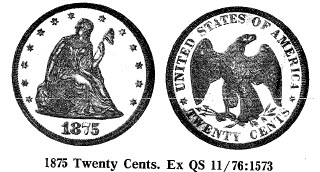
Twenty Cents. [2790] Obverse similar to the quarter, enough so as to cause confusion; reverse a small copy of the trade dollar. The only regularly issued denomination (aside from the trade dollar) designed by William Barber, and one of the most egregious failures in the history of American coinage. This denomination was coined solely to please Senator John Percival Jones of Nevada, the mine owners' fair-haired boy, in his misguided notion that it would solve the old short-changing problem. As Don Taxay has pointed out, for some years following the gold rush in the West, the inflationary price scales in effect, particularly in California, made even silver dollars into small change. Very little public use could be found there for half dimes and dimes, none at all for minor coins, prior to 1872-73. As the Mint Act of 1873 abolished the half dime, this intensified public dissatisfaction at an ancient swindle whereby venal storekeepers, pricing articles at a dime or "short bit", would allege shortage or unavailability of 5¢ or 2¢ or 1¢ pieces in making change, using that as the excuse for returning only a dime in change for a quarter, or a quarter and a dime in change for a half dollar. I suspect that Jones's real reason for introducing his bill (February 1874) was to afford more of a market for Nevada silver. Whatever the reason, Mint Director Linderman supported the Jones bill, and it was enacted March 3, 1875. There had been several patterns coined in the interim, the one finally selected being, naturally, that closest in design to the quarter dollar - to the public confusion despite the coin's plain edge.
The realistic solution to the short-changing problem would have been circulation of cents and nickels in the West and Southwest, though nobody even considered it. ("But that would have been sensible! ", as my wife so often says.)
Twenty cent pieces - a fact realized by few -have the word LIBERTY in relief on shield, a feature purporting to elminate, or at least to lessen, the confusion between them and quarters. The trouble was that common people go more by size and general appearance in making change, and they do not customarily examine coins with a magnifying glass. And relief lettering quickly wears down.
There were some 1950 proofs struck during the second quarter, beginning about May 19 (beginning of regular coinage), and 840 in the second half of the year. Of these, 1000 and 1200 were respectively delivered, leaving 590 on hand at the beginning of 1876. I recall only one die variety on proofs: Shield point minutely r. of left edge of 1; left base of lover center; scattered striae over head. In the Clapp collection as it came to Louis Eliasberg was a second 1875, this one having an unusually small date, reverse with leaves on olive branch narrow and those farthest right (about NT) much overlapping. This is a pattern, Judd 1411, AW 1453, probably about 15 being known. Possibly others have found their way into proof sets or into sets of 20¢ pieces.
Quarter Dollar. [630] No special peculiarities. Some 550 were made during the first quarter, 80 during the third; 500 were delivered during the first quarter (with sets), 200 during the third, leaving 120 on hand October 1 and remaining until the beginning of 1876. It becomes apparent that this denomination is a little rarer than the others. Were some of the 1875 proof sets favored with 1874 quarters? I have not seen any such. Were there fewer than 700, actually fewer than 600, proof sets dated 1875? No proofs seen - B. 2-Aa (should have been called 2-B). High date. Rusted die, rust pits plainest between 5 and foot, at 87, on middle of calf, etc. Rev. Perfect die. This is scarcer. LM 9/67:259.
Deliveries for the year total 700 coins: 500 sets at end of first quarter, of which some 100 were 1874's on hand Jan. 1; 200 more in third, of which 50 remained on hand Oct. 1 and were held over until the beginning of 1876.
Trade Dollar. [700 reported in all] Two types of reverse, for business strikes and proofs, discovered by Elliot Landau, 1952. Type I (1873-76): Berry below claw, wing free of second arrow shaft, ES too close, heavy leaves, the three r. of eagle's leg closer togetherfrom the "5 over small 5" obverse. Two rev. hubs: TATE close together or well apart, but no data on proof dies from them.
Half Dollar. [650] Some 450 struck during the first quarter, 200 during the third. It is tempting to identify these with the two varieties Beistle describes:
- Beistle I-A. Date above center: several small spines up from edge of calf. Rev. of 1873, with the rust pits there described; unfinished or unpolished surface between arrow heads.
- B. 2-Aa (should have been called 2-B). High date. Rusted die, rust pits plainest between 5 and foot, at 87, on middle of calf, etc. Rev. Perfect die. This is scarcer. LM 9/67:259.
Deliveries for the year total 700 coins: 500 sets at end of first quarter, of which some 100 were 1874's on hand Jan. 1; 200 more in third, of which 50 remained on hand Oct. 1 and were held over until the beginning of 1876.
Trade Dollar. [700 reported in all] Two types of reverse, for business strikes and proofs, discovered by Elliot Landau, 1952. Type I (1873-76): Berry below claw, wing free of second arrow shaft, ES too close, heavy leaves, the three r. of eagle's leg closer together than on Type II, and with the one nearest eagle pointing up and to left; berries not much heavier than their thick stems; berry extends above middle of top of E in FINE; arrow point extends between 20; zero very close to corner of T in TRADE; many other small differences from the Type II hub found on 1875-85 coins. First published by me, Numismatist, June 1953; cf, Paul Scherf's article in NSM, Oct. 1964.
-Type I proofs: Obv. High date, top of 1 below G and space to left, tip of 5 below S. Rev. Lumps on motto scroll. Extremely rare. (1) SI (must be verified; obtained Jan. 30 from Coiner). (2) T. L. Smith estate, June 1957. (3) "Gilhousen": 1459. (4) Ex W. L. Clark. (5) 1975 ANA: 1196. (6) River Oaks (Bowers 11/76) :239. Few others. One seen in copper from these dies. Judd 1430, AW 1418.
John M. Willem, in appendix I (p. 174-5) to the second or Whitman edition of his superb book on Trade Dollars, describes both types and says Type I is far rarer also in business strike form than Type II. In my experience both types of 1875 are grossly undervalued compared to other dates of Trades in all conditions.
Type I Trades probably constituted some part of the 300 delivered in Jan. 1875 (proofs) and some part of the 149,200 business strikes delivered in April-May.
- Type II (1875-85): No berry below claw, Tip of wing touches second arrow shaft, E S well apart, narrow leaves with lowest of the group of three above branch r. of leg far separated from the other two, heavy ovate berries sharply differentiated from their thin stems, berry extends over space between NE, arrow point extends above middle of 2, zero well away from T of TRADE, etc. These differences prove that a wholly new hub was created for this type.