Walter Breen's Encyclopedia of United States and Colonial Proof Coins 1722-1989
Walter Breen
*1. Overdate, 1879 over 78. As the 9 is narrower than the 8, faint traces of 8 can sometimes be seen on either side, but usually only within top and bottom. Use a microscope; the traces of 8 are always faint. Rare. 1973 GENA: 187. Later strikings show that die was repolished, most of overdate effaced.
2. Normal except for light recutting in 9, 7 about touches ball; left base of lover r. edge. ANS; and ct. NN 53:324. Scarce only; second commonest.
*(?) 3. Date plainly doubled (twice logotyped). Cf."Gilhousen" :83, Melish:632 and NN 40:761. Rare, though not so rare as the overdate.
*(?) 4. Different double date. Plain doubling on left upright of 1; triple outlines on 8, the outermost one broken at base. Rare. Landau: 279.
5. Normal date, no recutting. Majority variety. Minor sets. [3200] Apparently 2100 sold outside of silver sets. Some 34 were in the A. M. Smith estate; mostly broken up by now.
Dime. [770] Those seen in recent years appear to be all from the B-1 die, with pendant very slightly r. of serif of 7, excessively lapped with drapery incomplete near shield, polish in stripes. Hoarders have gotten to this issue (the A.M. Smith estate had 208! ), and date collectors exert much demand. Some 250 struck before March 1, there being 330 (1878's) already on hand; 1650 between then and June 30, none after; of these 1900, some 1130 were melted at the beginning of 1880, leaving net coinage 770. The commonly seen delivery figure of 1100 arises from deliveries of 200 sets (mixed dates?) prior to March 1, 250 more before June 30, 100 more in the 3rd quarter, 550 in 4th.
Quarter. [250(?!) less unknown meltage] First variety: centered date, polish on LIBERTY and drapery, and stripes; shield point over r. upright, left base of lover space. Rev. of 1878.
Second variety: Same obv., rev. similar to 1872 with same line left from border of 'shield, Which is rarer?
The low mintage has not been taken seriously (was a delivery omitted from official reports?) because many deceptive early strikes exist, some enough "to deceive even the elect." Hoards exist, or did exist. A. M. Smith had at least 26 outside his sets. Philip G. Straus (1951) had a mixed hoard including some real proofs and many early business strikes of varying degrees of deceptiveness. The 250 were all struck in the first quarter. At the beginning of January some 1,182 quarters were on hand, evidently mixed dates 1877-78 (possibly 1876 as well); deliveries were as in dimes, leaving some 332 for melting in January 1880.
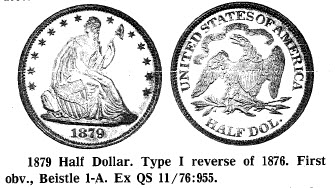
Half Dollar. [620] * First variety: Only one slender faint line of drapery at elbow (lapped die); centered date, shield point between 18, left base of lover center. Rev. of 1876, Type I, split berry, line slants down to r. in last stripe. Beistle I-A. 1974 GENA: 1620.
* Second variety: Full drapery, shield point over left edge of 8, left base of 1 above space. Rev. of 1876 as last. Beistle 2-A. LM 3/68:301 set; "Gilhousen": 1085.
Third variety: Obv. as last, rev. Type II, pointed berry above H. Claws at left separate; normal scroll. Which is rarer?
Deceptive early strikes exist with Type II reverse. Some 250 were struck in first quarter, 120 in second, 250 in fourth. The explanation for the usual delivery figures is as in the dimes. Some 480 halves of 1878 (or 1877-78?) were on hand Jan. 1879 but all were disposed of in proof deliveries during the year. Hoards did exist; A.M. Smith had 94 outside of his sets.
Silver Dollar. [650] Full breast, slanting top arrow feather. Cloud 9, left base of 1 left of center. V AM 1. Less rare than mintage figure suggests, even aside from the deceptive early strikes. Some 250 coined in first quarter, 500 in second, total 750; of these 100 were melted in Jan. 1880, leaving 650 net mintage. The usual figure of 1100 was explained under Dimes, some 450 leftover dollars being on hand Jan. 1879 to account for the difference.
*Trade Dollar. [1541] Both varieties seen to date are from an obv. withvery top of 8 imperfect. First reverse: Normal feathers. "Gilhousen": 1477.
Second reverse: Many incomplete feathers in legs and lower belly. "Gilhousen": 1478; 1974 GENA: 1181.
No apparent difference in rarity nor is it known which came first.
Nothing is revealed by the monthly coinage figures in Willem.
Silver proof sets. Number minted unknown but likely to have been around 250 or even less, given the mintage of quarter dollars. I have not seen any original sets traceable to the mint in the year of issue, probably the extant sets being assembled in later years. This is naturally aside from the complete (cent to double eagle) sets in Smithsonian and ANS.
Gold Dollar. [30] Same dies unfortunately found on proofs and business strikes - including the deceptive first strikes. BER always weak; filling sometimes visible within 8 and 9. Real proofs are very rare, probably less than 18 surviving including impaired pieces. Most are state I [20, Jan. 25]: no clash marks, no bulge below head; plain crisscross die file marks in left bow, horizontal line in r. bow. Few are state IV [10, Nov. 22], drastically repolished dies, curl ends and leaves attenuated, die file marks almost visible; no bulge below head. Nine seen in state I, four in state IV. Cf. Ullmer: 346 at $1,900.
Quarter Eagle. [30] *B-1. High date, left base of 1 over r. edge of dentil. In a rarity class with the gold dollar; same comment. Compare Gaskill-NN 48:338; 1968 ANA; "Quality Sales" 9/73:1078.