Walter Breen's Encyclopedia of United States and Colonial Proof Coins 1722-1989
Walter Breen
Mintage: Quarterly, 400, 155, 110 and 221, all going into the 886 proof sets.
Silver Dollar. [886] 1) VAM -: double cut date, first cut low, plainest below base and peak of 1 and below bases of both 8's. 1974 GENA:110. 2) VAM 4, recut 1 only. Same comments as for 1885 dollars, even to speculation and first strikes.
Mintage: Quarterly, 410, 155, 110 and 216, total 891, of which 886 went into the sets and the other 5 supposedly into the melting pot.
Silver proof sets. [886] Of these 360, 165, 100 and 261 were issued in the four quarters, total 886. Presumably the first-quarter coins went to the annual collectors, and many of the final-quarter ones went as Christmas presents, that being then an apparently common pattern. Garrett's, from Mint 2/2/1886, brought $2,700. That in LM 3/68:306 had Type I cent, 5¢ with recut second 8, and "second variety" half dollar.
Gold Dollar. [1016] B-1. Normal 6; leaf left of date normal, neither abnormally thin nor showing doubling. Second 8 wholly below L, first begins minutely left of 1. Other varieties are possible. Many survivors have been scrubbed to within an inch of their lives. I can to a certain extent understand this for silver coins kept in sulfite paper mint wrappers and suffering ugly black blotches, but gold? Who could reasonably object to the interesting orange, red, purplish, or iridescent toning? Cloudiness can normally be removed by bathing in soapy water (or mild detergent), rinsing thoroughly, then bathing in alcohol, following if necessary by another rinse and a similar treatment with ether or household ammonia or acetone or MEK (never mix solvents!), following always by additional rinsing and drying with ether or absolute alcohol. (Harry Bass uses an ultrasonic bath even on proofs; I have not enough details of solvent or timing, and do not recommend trial-and-error as the errors can be too costly.) The bathing is of course not to be done with cloth or Q-tip or any other applicator: hold the coin in the solutions by a tea strainer. Clearly, this sort of treatment is not responsible for the scrub marks marring too many of the gold dollars of the period.
On the other hand, we do have the explanation for many of the nicks and scratches, mentioned as common to many gold dollar proofs in the 1880's. The following document is self-explanatory:
Harlan P. Smith, being duly sworn, says that he resides in the City of New York and that he called on the U.S. Mint in Philadelphia in June 1886 and went to the Coin and Medal Clerk and requested to be furnished with a Proof gold dollar of the current year. The clerk opened a small writing desk and took out a round paper box which contained numerous gold Proofs. He scraped them over with his fingers and rubbed them together, upon which proceeding deponent looked with utter astonishment as it defaced the coins with pin marks and scratches. Deponent had always believed and still believes that Proof coins are struck by the government for the benefit of coin collectors who are required to pay a premium for such perfect coins, and that from the improper manner in which they were handled by this clerk they were blemished and therefore collectors ought not to be compelled to pay a premium for such ignorance and incompetence displayed by the clerk in charge of that department.
Deponent further states that the clerk informed him that there were no Proof gold dollars to be had, and that he [deponent] then requested to be furnished with two silver Proof sets and twenty minor Proof sets, and when said request was made the clerk made some remark which left the impression in deponent's mind that the clerk was conferring a great favor upon him and acted as though he owned the entire Mint and the contents thereof. Deponent therefore claims that the government should not employ. clerks unless they are fully competent for such position and said clerk, having been shown to be clearly incompetent, should be removed.
6th day of December 1886. (signed) H. P. Smith (notary's seal and notice)
The above document was furnished by Robert W. Julian; it is here reproduced courtesy of Q. David Bowers, by permission. Julian mentions that the medal clerk (presumably the same party about whom Smith was swearing out his complaint) was removed "prior to Feb. 28, 1887, as on that date someone else was applying for the position."
As for that medal clerk's claim that no proof dollars were available, it is most likely to have been a lie, or else the remainder of the March mintage was already shipped out to banks: see below.
Auction record: Garrett: 499, $1,250.
Mintage: 204, 112, 270 and 430 in the four quarters, total 1,016; of these, 25 were intended for the proof sets of February.
Quarter Eagle. [88] *B-1. Left base of 1 about over r. edge; base of 1 not recut; very little polish in stripes; extremely faint shadowy striae over MER!. Many of the survivors show nicks and scratches, like so many graduates of German university dueling clubs, most probably thanks to the above mentioned Medal Clerk. Two auction records of $3,500 (Ullmer:381, 1976 ANA:2842). Some of the survivors of the 4,000 regulars have enough mirror surface to give trouble to cataloguers, especially those who follow old Tom Elder's example and refuse to use magnifying glasses, on the ground that collectors don't use them at exhibits (no longer true, friends!). These are from B-2 dies: base of 1 faintly recut (fades), left base of 1 a little r. of center of a dentil; polish in stripes.
Mintage: 41, 10, 13 and 24 in the four quarters, total 88; of these, 25 were intended for the proof sets in February.
Three Dollars. [142] Two varieties.
*B-1. Upright of 1 below r. curves of O. Are these the 88 proofs of Feb. - Sept.?
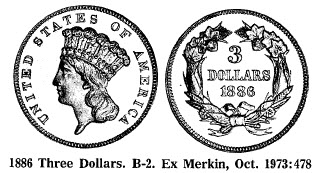
B-2. Upright of 1 between OL; date seems to slant down slightly. Gilhousen: 321, "Rio Rancho" : 131, $5,600; Texas pvt. coll.; others. The dies of the 1,000 business strikes (including, alas, some deceptive first strikes) plus a minority of proofs - the 54 of December? Auction records for unattributed examples: Pierce-Jay-Ullmer, $5,500; Garrett, $5,250, latter spotty. As with the gold dollar and quarter eagle, many survivors are nicked and scratched, probably from the same cause.
Mintage: February, 25 for the sets; March, 22; May, 13; September, 28; December, 54, total 142.