Walter Breen's Encyclopedia of United States and Colonial Proof Coins 1722-1989
Walter Breen
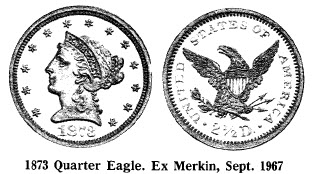
Quarter Eagle. [25] Closed 3. Low date close to border. (1) Mint, S1. (2) Brock, Morgan, ANS. (3) In proof set in cornerstone of Capitol Building, Lansing, Michigan (thanks, Harry Boosel). (4) Eliasberg. (5) In proof set in collection of Government of India. (6) Judge Thomas L. Gaskill, NN 48:324, A. M. Kagin, impaired. (7) Melish: 1279, Harry Boosel. (8) LM 9/67:350,4/70:671,6/72:393. (9) Lilly, S1. About 9 or 10 others have been playing Musical Chairs at auctions, several impaired = possibly 18 or 19 survivors in all, including the impounded ones. Early strikes are known from different dies masquerading as proofs.
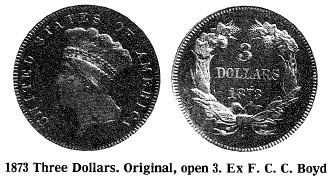
*Three Dollars. [25 originals] Open 3, the die completed after the Coiner's complaint of Jan. 18. All other denominations had been completed and coined in business strike form in January save for the gold dollar and 2¢, and the dies for these were ready then. As restrikes exist with open 3, the distinction is fairly important. Originals have obv. (later used on 1874 proofs) with faint die scratch extending from left upper serif of F to border, its bases very thin, first S perfect. Die shallowly hub bed and heavily polished. Very little of JBL shows on truncation. E of UNITED, A of STATES, lower trapezoid of first A and loop of R in AMERICA are all open. (On the restrikes, first S fills, die scratch fainter.) Rev. Open 3, knobs small and more than their own diameter apart, date placed very low. Leaf left of date shows only as an extremely thin, detached wisp, slightly thicker nearest its upper end. Right terminal tassel (top of r. wreath) shows as faint detached dots. Straight vertical scratch from left end of crossbar of A in DOLLARS to between 73. Perfect die. (On the restrikes there is much rust around parts of wreath.) Extremely rare but undervalued because restrikes have helped take off part of the date collector pressure. (1) Smithsonian. (2) ANS. (3) Omaha City Library, from Byron Reed bequest. (4) Harry Boosel. (5) Specimen in set, in cornerstone of Capitol Building, Lansing, Michigan. (6) The Government of India presumably retains its proof set containing an original. (7) Renz-Grant Pierce: 1260 at $2,600, later C. Jay: 285. (8) Wolfson: 299. (9) Golden II: 1919, EF, former Proof. (10) Melish: 1397, VF. (11) Gaylord: 246. The line of reasoning leading to the conclusion that the open 3 coins are the originals depends on the date of acquisition of the Smithsonian's proof set, which contains an open 3 specimen: from the Coiner, February 11, 1873, for $49.70 currency. In the $3 monograph I surmised that this date might have been the day of purchase order rather than the day of delivery, but in any event the three-dollar piece in the Smithsonian is clearly a February 1873 product. So, too, the coins in the R. C. W. Brock, J. Pierpont Morgan, ANS proof set, obtained directly from the Mint in 1873. There may be as many as 14 or 15 survivors.
Leaving aside the restrikes from the original (open 3) dies showing rust, the other three-dollar gold pieces dated 1873, and showing closed 3, are restrikes and vice versa. Curiously, quite a number of them were later mishandled, some apparently spent. The copper and aluminum specimens (B-2, closed 3 logotype placed below center, obverse die of 1872 earlier described, dished; this variety also existing in dished form in gold), were probably 1873 productions, possibly made earlier than the gold, and it is my guess that the appearance of the three-dollar and one-dollar dates (as well as the small silver and nickel coins) induced Snowden to register his formal complaint. We may, then, have the anomalous situation that closed 3 dies were made earlier for the $3 gold but not then used, hidden away after the open 3 dies were made for the original proofs, and resurrected for clandestine strikings. Possibly the peculiar imperfection in the date side die of the B-2 variety led to its rejection as well. Rejected dies need not have been destroyed until the end of the year and they may not all have been then. For further details, see Restrikes and Fantasy Pieces.
It would appear, from all records available to me, that besides the 14 or 15 originals, there are about seven dished restrikes and at least 50 B-3 restrikes (closed 3, not dished, date placed high); to date only Boosel's B-4, from rusted original dies, has been reported. That would make the total population of threes dated 1873 somewhere over 70 specimens, possibly a few more. Beware alterations from 1878!
Half Eagle. [25] Closed 3. Date placed to left, begins about at center and slants down slightly, the base of 3 slightly nearer border than 1. This obverse die was used on proofs and business strikes. As proof, extremely rare, much more so than the three-dollar piece or smaller gold. (1) Smithsonian set. (2) ANS. (3) Lansing, Michigan cornerstone. (4) Wolfson: 505. (5) Ex Flanagan: 1151, J. F. Bell. (6) Ullmer: 454, hairlined, at $6,500. (7) 1976 ANA: 2996, $6500. (8) Amon Carter. (9) Govt. of India set. Probably not more than 9 or 10 are around, no hint of restrikes.
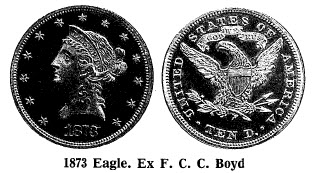
Eagle. [25] Closed 3. *B=1. Under extreme pressure from date collectors as nonproofs (800 made) are prohibitively rare. Date is a trifle below center, approximately equidistant between stars; left base of 1 about over center of denticle, no other notable peculiarities except that some of the proofs are not as well struck up on curls above ear as are those of earlier dates. Genuine nonproofs (B-2) have low date, left base of 1 slightly r. of left edge of dentil; d. Miles: 693. Beware alterations from 1878, and - more often -coins with removed S mintmarks being offered as "VF-EF, former proof." The area beneath eagle should be carefully scrutinized, and the numeral 3 should be identical (as in fact is the entire logotype) with that on the half dollar, no arrows. Proper logotype will exclude possible alterations from 1878; freedom from traces of monkey business below eagle may exclude alterations from 1873 S. There is also the more sinister possibility that here - as on the half eagle and double eagle -copper proofs may be gilt, inserted into elaborate plastic holders, and offered by strangers in poorly lit convention bourse rooms. Here die evidence fails as the identical dies were used as on gold. Who carries scales to every bourse? Who would insist on having the coin removed from its plastic holder before buying? The seller probably would object to either proceeding - and if he does, don't accept the coin. For genuine proofs at least the following records are unimpeachable enough: (1) Smithsonian. (2) ANS. (3) Lansing, Michigan cornerstone. (4) That in the Government of India proof set. (Will some collector in the Calcutta area make an investigation to see if the set is still around? It may have been seized during the riots of 1930, 1946-7 or 1950, or destroyed by Japanese air raids of 1942-43.) (5) Wolfson: 709. (6) Davis-Graves: 953, ex H. P. Graves, ex Menjou: 1614. (7) "Gilhousen": 706, impaired. (8) Amon Carter. It is unlikely that as many as nine survive.