Walter Breen's Encyclopedia of United States and Colonial Proof Coins 1722-1989
Walter Breen
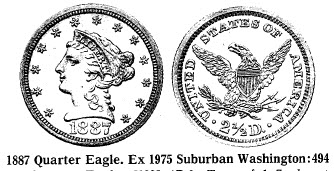
Quarter Eagle. [122] *B-1. Tops of 1 7 almost touch bust. Left base of 1 slightly r. of left edge. (In the deceptive B-2 business strikes, date is lower, left base of 1 above r. edge.) Garrett:504 (three minute nicks) brought $2,500, trailed by the "Groves" sale example at $2,000. Still undervalued; date collectors are largely taking up the remainder of the 6,160 business strikes.
Mintage: March, 45, of which apparently 25 were for the initial sets; second quarter, 34, third, 3; fourth, 40, total 122. Of these 22 had been delivered in the second quarter. 15 in third, 40 in fourth.
Three Dollars. [160] *B-1. RICA normal, not doubled. Rev. Tops of wreath join; leaves normal, traces of usual recutting in large 3, left part of right bow only outlined, both bows clear; r. edge of 1 minutely left of tip of L, r. tip of 7 slightly left of r. tip of foot of R. (The 6000 business strikes - including some deceptive prooflike coins - are B-2; RICA doubled, B-RTY doubled, all over letters heavy. Rev, Date slightly below center, r. edge of 1 slightly beyond tip of L, tip of 7 in line with tip of R.) Over 30 survivors. Garrett's realized $5250. A few exist with dies alned 1971 CSNS (RARCOA) :433.
This year is remarkable for an extraordinary anomaly amounting to a blue chip mint error among blue chip mint errors. In Lester Merkin's November 1965 auction, lot 346 at a very reasonable $1,225 (later Russell Heim estate, S 6/72:825) was a gem proof 1887 three which had first been given an impression or two with dies aligned or 1800 from normal. After which occurrence, the press operator or someone discovered the error, realigned the dies in the press, replaced the struck coin therein, gave it two or three more blows - about 5° away from what would have been normal alignment - and passed the resulting mishmash as a coin suitable for inclusion in proof sets. As a result, obverse shows weak extra lettering about 5° away from normal position, especially plain around TES OF AMER, and reverse shows the original date, inverted and somewhat slanted, joining OLLAR and large 3, a second DOLLARS between final DOLLARS and date (naturally also inverted), and large 3 at ribbon bow, as well as traces of wreath at appropriate parts of field. An excellent enlarged illustration of this coin is in the Lester Merkin catalogue; there has been very slight retouching on the print to make sure that the faint extra impressions show up, but the retouching is correctly positioned, not misrepresenting the appearance. I spotted that some kind of odd double striking was present with the naked eye when I began cataloguing that group of threes, but naturally did have to use a glass to find out what had happened. Since then, Lester and I have been examining every proof 1887 three-dollar piece on which we could lay our hands to discover if any others had been made in similar error and similarly corrected. In the ensuing eleven years to date we have found two others, one of them ex Leo A. Young. One was in LM 9/68:541, 10/69:420, 6/71 :847, choice, lint mark left of 3; the other LM 10/73: 479, nicked, Breen I: 132. All three specimens differ minutely in the amount and direction of misalignment in press (3° to 5°) but the general effect is the same. Nineteen other 1887 proofs seen in private hands since 1965 have proved normal, including the Wolfson, Grant Pierce, Garrett and Ullmer coins, the latter at $8,000. Eliasberg's is normal, as I would have noticed the double striking when I was examining his threes for die variety information. ANS's is also normal and I am informed that so is Sl's. Unfortunately, illustrations of proof 1887's in auction catalogues are generally not clear enough to permit guesses as to whether any show the double striking. Probably very few were made.
Mintage: March, 55, of which 25 were for initial sets; all delivered that month. June, 42, of which only 30 were delivered. September, 3 (the error coins?), these and the remaining 12 from the June coinage being delivered together. December, 60 proofs plus the 6,000 business strikes.
*Half Eagle. [87] Only one variety of the genuine. Date slants a little up to right; left base of 1 quite close to dentil (about center), base of 7 well away, top of 7 close to corner of truncation. Rev. Almost no polish in stripes. Beware forgeries made by removing mintmarks from the common 1887 S and buffing fields (using the technique devised in the 1960's for making jewelry out of Peace dollars). Probably between 20 and 30 survivors, of which at least a half dozen have been cleaned or otherwise impaired. (1) SI. (2) ANS. (3) Eliasberg. (4) Norweb. (5) Garrett: 502, $14,500. (6) Amon Carter Sr. & Jr. (7) Ullmer:460, $18,000. (8) Breen I: 192, hairlined, at $13,505 on $15,000 limit. (9) Schulman, ca. 1943, Eliasberg, NN 49:478. (10) Melish:2212, Kagin. (11) Baldenhofer: 1364, badly cleaned, believed reappearing in Kagin Fall '73 sale, $15,000. (12) Wolfson :544, impaired. (13) Bell II: 765, impaired. These two are believed to have reappeared as "Alto": 263 and Miles: 529, but photographs forbid positive identification. (14) "Alto" :262, same as no. 7, 9 or 10? The following records are believed to include some earlier appearances of the above plus possibly six others: (a) Dunham:2166, (b) WGC, (c) "Memorable":388, (d) Bell I, "H. R. Lee": 1310, (e) Flanagan, (f) Atwater, (g) Dr. Green, (h) Menjou, (i) Kern, (j) Hydeman: 665.
Mintage: First quarter, 25 for the March sets; second, 27, of which 17 were delivered then and 10 in third quarter; fourth, 35 struck and delivered, total 87.
Eagle. [80] *B-1. Date slants up, 7 much farther from border than 1, left base of 1 about over left edge; four stripes thin, feathers attenuated below second. (On business strikes date is centered and level.) Much rarer than smaller denominations. (1) S1. (2) ANS. (3) Eliasberg, (4) Garrett: 501, $5,000. (5) 1976 ANA:3113. (6) Phila. Estate. (7) Amon Carter Sr. & Jr. (8) Ullmer;499, $6,250. (9) Melish: 2517. (10) DiBello:ll08. Either of these may have reappeared above. Do a dozen survive?
Mintage: First, second and fourth quarters, respectively 25, 25 and 30, the first group for March sets. Of the second quarter group, 15 (for sets?) were delivered then, the rest in the third quarter.