Walter Breen's Encyclopedia of United States and Colonial Proof Coins 1722-1989
Walter Breen
Trade Dollar. [700] No special peculiarities. Some 100 each struck in January, March, April and June; 200 in February, and 50 each in September and December. Note that this works out to the same figures quarterly as for proof set deliveries; presumably the proof trade dollars were made only for the sets.
Silver-minor proof sets. [700] Delivery dates as for trade dollars. Some original sets survive, but the majority auctioned appear to have been assembled. The reason for earlier breakup would seem to have been the popularity of the coins with arrows - and, to a lesser extent, the desire of some collectors for trade dollars.
Gold Dollar. [20] LIBERTY on coronet. Rev. Date low and placed to left. Extremely rare, probably a dozen or less survivors, though some first strikes are deceptive enough to cause trouble. These normally have granularity at border dentils. Some have, but a greater number lack, LIBERTY on coronet (lapped dies; the hub had to be strengthened).
Quarter Eagle. [20] *B-1. Date somewhat to left, 1 close to bust and border, 4 farther from bust. No rust pit at earlobe. Date collector pressure is only beginning on this one as people begin to realize that there are few business strikes available. Possibly 12 to 15 survivors, of which at least three are impaired. (1) S1. (2) ANS. (3) Eliasberg. (4) "Memorable": 130, probably ex Boyd, WGC. (5) Col. Green, J. G. MacAllister, T. L. Gaskill, NN 48:326, R.P. for an unidentified buyer. (6) Davis-Graves: 725. (7) Melish:1282. (8) Wolfson:211, Ullmer: 374, $10,500. One of the above is possibly ex Bell I; another ex Atwater:1978. No.8 may possibly be the same as no. 4, 5, 6 or 7.
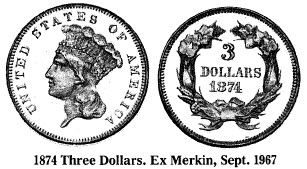
Three Dollars. [20] *B-1. Obv. earlier described, with the die scratch from left upper serif of F leftwards to border still visible, bases of F weaker, light crumbling below middle part of first S in STATES, filling within lower trapezoid of A in STATES, and in A R of AMERICA. Rev. Strong date, upright of 1 and 4 centered below 0 and A. LM 9/67:399. Later state, rusted on obv. device, LM 10/66:323. Ex. rare, in a class with the dollar and quarter eagle. Of maybe a dozen survivors, 3 or 4 are impaired (e.g. Grant Pierce: 1261). Greatly unappreciated even in comparison with 1877-78, probably because date collectors have plenty of business strikes to content them.
Half Eagle. [20] *B-1. No doubling on UNITED STATES. Exceedingly rare, no auction records in recent years. Probably under 10 survivors, of which SI and ANS have two. Almost a forgotten rarity.
Eagle. [20] Date about centered, base of 4 not recut. Same comment as to last; about of equal rarity. Same dies were used on copper and aluminum impressions.
Double Eagles. [20] Date very low, close to border, 1 nearer border than bust, left base of 1 left of center of dentil, r. base of 1 nearly over r. edge. Exceedingly rare, probably under eight survivors. (1) S1. (2) ANS. (3) Eliasberg. (4) Amon Carter Sr. & Jr. (5) Boyd, WGC: 877, same as one of last two? (6) Baldenhofer:1541, Wolfson:908, same comment? (7) Jay:328, Dines:896, ditto?
Gold proof sets. [20] Reported out Feb. 14. None traced except as below. Complete proof sets. One from. Coiner to Mint Cabinet, Feb. 10, for $48.78 in currency (face value $43.44, specie price presumably $43.52). ANS's similar set, ex Brock, Morgan, also came from the Mint in 1874. Others were broken up long since.
1875
One of the most famous dates in American numismatic history, partly because of low reported mintages in most gold denominations; but it should be even more famous because of type changes in the silver, not to mention introduction of the 20-cent piece.
Cent. [700+] Two varieties. The commoner one has normal date, without recutting; rev. as in 1872-74, as mentioned in LM 11/65. Many show more or less rounding on digits; some also have rounded rims, a few are carelessly struck. Nevertheless, the surface establishes satisfactorily that they were from proof dies and on planchets given the usual proofing treatment. Color often exceptionally high or light golden.
- The other and Parer variety shows the thin, shorter top of an extra 5 just above top of 5 in date, but ordinarily no other signs of blundered logotyping. Compare NN 57:74, and the piece in ANS. Which one came first might be established by checking the coin in the Smithsonian, obtained January 30, 1875.
Three Cents Nickel. [700+] Two varieties. One has normal date, placed low, left base of 1 about over left edge. Spine from throat into field. Right ribbon end attenuated, many outer leaves almost gone. Hirt: 1076, others.
- The other (ANS and some others) shows fairly strong recutting at right of upright of 5, and a small dot within upper part of loop, apparently representing part of 5 cut first to right (obliquely and erroneously positioned logotype). This may be rarer.
Often found on granular flans with imperfectly struck borders.
Five Cents Nickel. [700+] Date often fairly shallow, left arrow butt attenuated; sometimes almost perfect, date higher. Borders often narrow and sometimes weak, rims (outside dentils) not always on planchet (flans narrower than usual), edges sometimes rounded. Planchets often granular. Proofs are often of below average quality in everything save striking quality of devices. Beware early strikes masquerading as proofs.
This very popular year is extremely troublesome because of the shiny business strikes mislabeled "Proof." Reason for popularity of 1875 proof or uncirculated nickels is unknown; mintage of regulars is lower than 1874 or 1876 but much higher than 1879-81, 1883 which have listed much lower. The proofs are always available for a price, but top quality proofs are not always available.
Minor proof sets. As in 1874. Mostly broken up.
Dime. [700] Only one pair of dies seen for proofs, but more may exist differing microscopically in date position. Logotype as on cent. Comes without and with faint cracks at top of wreath. Cf. LM 4/66:203. Also at least one has been seen with obv. proof, rev. unc. and frosty though with striking quality of proofs; LM 11/65:268, LM 6/68:244. All 700 proofs were struck during the first quarter of the year. There were some 300 1874's remaining on hand at the beginning of the year; 500, not broken down by date, were released with proof sets at the end of March, 200 more in sets at the end of September, leaving 300 on hand at the beginning of 1876. Quite possibly the 500 sets of the first quarter were all dated 1875, struck in January and March, and the 300 1874's were held over till 1876 for melting.