Walter Breen's Encyclopedia of United States and Colonial Proof Coins 1722-1989
Walter Breen
1867
Cent. [625+] Normal date, rather thin. This has been seen with very thin obverse letters (Lester Merkin auction, November 1965), but it appears far more often with normal letters. I do not know if these are two different dies or the former is a heavily lapped or repolished state of the normal die.
Two Cents. [625+] Date nearer ball than border, left base of lover center. Rev. D minus left top, die of 1866. Readily available for a price, like the cent.
Three Cents Nickel. [625+] First variety: 7 almost touches curl, recut at right (fades), left base of 1 slightly r. of left edge. Garrett set.
- Second variety: 7 far from curl. Normal rev. on both; which is scarcer is not yet known.
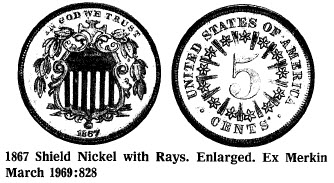
Five Cents Nickel. Type of 1866, with rays. [25+] Now known to have been issued only with the initial or February 5, 1867 delivery of silver proofs, with possibly at most a few more in minor proof sets at that time. Exceedingly rare, not over about a dozen survivors traceable, though other claimants have been offered -generally with surfaces so much inferior to 1867's without rays as to give rise to justified doubts of their proof status. The nickels without rays in proof were made as early as March 1867 per evidence presented below, i.e. the cased proof set coming from the mint in that year.
Obv. has outer leaf below U hollow; roughness at bases of all white stripes except first; rev. dentils from 2: 30 to 5: 00 weaker than remainder. Borders are wider at left obverse than at right. None seen from other dies to date qualify as proofs. Deceptive first strikes abound. Compare the illustration!
Reason for early changeover to the type without rays (and thus extreme rarity of the proofs with rays) is an order from the Treasury Secretary, Hugh McCullough, January 21, 1867, reproduced in NSM 11/61, p.2906. He gave no reason, but I suspect that the striking qualities of the coins with rays may be responsible - many of them are very weak on parts of shield and wreath, directly opposite stars and rays. We need not credit the silly rumors equating stars and rays with the ConfederateStars and Bars.
The estimate of a dozen includes (1) Eliasberg. (2) That in the Hydeman: 690 set. (3) S 5/68: 1098 ex Gardner: 1452 at $4,800. (4) Lohr: 301, not impossibly same as either of foregoing, reappearing in Golden II: 2533, spotty. (5)Philip Straus estate to NN 53:298 to H. J. F.; cleaned. (6) Straus's other one, in the 1959 N.Y. Metropolitan Convention auction: 573, reappearing as Wolfson: 312; spots between tops of D S, S O. (7) Garrett set. Compare also WGC: 72; KS 3/64:2802; LM 3/69: 828; Kagin's Nov. 1973 MANA sale; Delp: 243, ex Jay: 468; Miles: 492; Rothert: 721, ex Marks: 250. Of the others unmentioned, I can testify that at least two have been poorly cleaned.
- Type of 1868, without rays. [600+] Several die varieties of obverse; normal date and very faintly recut date. Reverse from the first hub of 1868: S's in STATES high, stars distant from 5. (This hub is also found on a very small number of nonproofs dated 1869 and not afterwards.) Some have spectacularly high knife-rims or "wire edges". The 1867 nickel without rays in proof is readily available for a price; the plus mark might cover an extra few dozen or even more.
Minor proof sets. As in 1866, none seen.
Trime. [625] Three minor varieties. *B-l. Recut date: earliest state, recutting visible faintly at left of all four digits, later only at left sides of 67. Compare ANS's and those in NN 53: 422, 54: 176 (is it the same die?), 54: 1294, and 57: 342.
- *B-2. Double date, high, extra outlines at right of all four digits, plainest at 1 7. Rev. Three die file marks from near top of C towards border, between 1:00 and 2:00. "Gilhousen": 127.
- *B-3. Normal date, without any trace of recutting, minutely differently placed with respect to star from first die; hook-shaped raised line just below shield, r. of its base. Probably rarer. Cf. NN 53: 421. Even though the coin as a date is always available for a price, it is under considerable pressure from type collectors inasmuch as the business strikes are hardly ever encountered in any condition, being much rarer than the proofs.
Half Dime. [625] *V-1. Date a little above center of exergual space; shield point left of tip of 1; skirt pendant above inner left curve of 6. Rev.: Both ribbon ends clear. Last ones show IME clashed on drapery, reground die (to remove clash marks); crack, rim to final S to drapery. This is very rare, extremely So with the crack. Ruby I: 878, Neil 2 (in 1927 list).
- V-2. Date a little below center of space, shield point over tip of serif of 1, skirt pendant almost over knob of 6. Rev.: Ribbon ends touch wreath. ANS and compare NN 51: 566. The majority variety. Garrett set.
- *B-4. Same obv., rev. ribbon ends free.
- *B-3. Date lower than last, close to border; shield point above upright of 1; skirt pendant central over 6. Landau, NN 52: 404 to F. S. C.
Dime. [625] *B-1. Double punching shows on bases of 1 and 7 and sometimes also just within bottom of lower loop of 8; rev. ribbon ends touch. Always available at a price, though under considerable pressure from date collectors as business strikes are very seldom available. It is not impossible that the normal date die used on uncirculated coins (struck January 29) might also have been used on the earliest proofs. See illustrations, Gobrecht Journal v3n7:15-17 (11/76).
Quarter. [625] B-1. Date a little above center, shield point minutely r. of upright, left base of 1 slightly r. of left edge. Rev.: Fold of scroll incomplete left of IN. Garrett set.
- B-2. Same obv., relapped; incomplete drapery and stripes. Rev.: Scroll normal, but contains diagonal line in fold left of IN, pointing to near base of I (N). Which is rarer?
Half Dollar. [625] First variety. Mostly full drapery, high date, slants up slightly, shield point over r. upright, left base of 1 about over left edge, most stars with extra outlines. Rev.: Arrowheads and R I apart, two slanting dashes near top of 5th white stripe. 1974 GENA: 1601. Garrett set.
- Second variety. One thin broken line of drapery; level, high date, shield point minutely left of r. upright, left base of lover space; tops of several white stripes rounded, many imperfect feathers. Often with crack through 2nd to 4th and last 4 stars, and through MERICA. "Gilhousen": 1046. Available for a price. Which is rarer?