Walter Breen's Encyclopedia of United States and Colonial Proof Coins 1722-1989
Walter Breen
Deliveries:
February 14 200
March 2 100
March 25 100
April 28 100
July 9 100
For the large cent proofs (type of 1857) see Restrikes and Fantasy Pieces.
Note also the duplicate proof set in Parmelee: 1364, containing "a pattern 3 cent nickel instead of the regular type" (not otherwise described), unlocated. Considering the relative unpopularity at the time of the overpriced 1868-9 nickel patterns, one may legitimately ask if some of the proof sets of the year were spaced out with these just the way others were with uncirculated coins?
Gold Dollar. [25] Small straight date similar to those on trimes and nickel 5¢ pieces. *B-1. Date rather low, level, 6 wholly below L; terminal tassels attenuated. Probably about 15-18 survive, several impaired. Unappreciated; not often touted, and enough business strikes - and deceptive counterfeits - are around to relieve date collector pressure. Dies often aligned 1800 from normal.
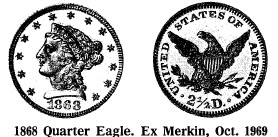
Quarter Eagle. [25] Date from dime punches. *B-1. Date high, to left, 8 away from border; left base of 1 r. of center; no rust pits. Rev. of 1866-67. Those showing two rust pits on neck are early impressions from B-2 dies (business strikes). Very rare, possibly 15 to 17 survive, several badly impaired. Cf. Dunham (unverified); G. H. Hall (ditto); WGC: Atwater:l119; NN 47:1487; LM 10/69:404, "Gilhousen;" and Garrett: 426 at $5,000.
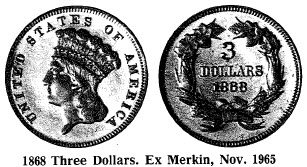
Three Dollars. [25] Obv. different from business strikes, and from earlier proofs except for the 1867 proof in ANS. Small rust marks develop in D R. Rev. Leaf left of date very thin, irregular; traces of recutting within 8's, possible fragments of 7 in final 8 (will the earliest impressions show plainer overdate?). Very rare. Dies often though not always aligned 1800 from normal. Cf. LM 11/65: 330, which sale also included a cent with the same head-to-head alignment, which is also found on the aluminum threes - a clue to the date of manufacture? Of possibly 15 to 17 gold survivors, at least four are impaired, e.g. Kern - Grant Pierce: 1255. Garrett:425 brought $9,000. Aluminum strikings came with both alignments: LM 9/67:511; LM 3/68:348.
Half Eagle. [25] *B-2. Date to left. Rust above truncation; reversed C-shaped mark in hair r. of ear. Rarer than the lower denominations, doubtful if as many as a dozen survive. (1) S1. (2) ANS. (3) Garrett:424, $5,500. (4) KS 2/61:1203. (5) Ullmer:452 at $8,000, possibly same as last. (6) Amon Carter Sr. and Jr. (7) 1976 ANA: 2991. (8) 69 ANA: 1973.
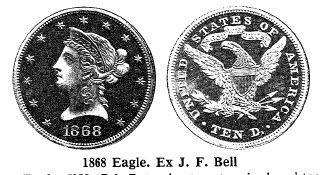
Eagle. [25] *B-1. Date about centered, placed too far to left. Rev. Top of second stripe thin. Extremely rare, doubtful if more than eight survive. (1) S1. (2) ANS. (3) Garrett:423, only $9,500 (cleaned). (4) Ullmer:492 (few hairlines), $21,000. (5) Pvt. coll., impaired. (6) Amon Carter Sr. and Jr. On the B-2 business strikes, date is very high, close to device, slanting down.
Double eagle. [25] Large date from silver dollar logotype, filling up space between device and border. B-2. Top of 1 nearer to bust than base is to border; left baseof 1 left of center of dentil. Rev. As on some uncs., dentils plainly clash-marked left and right of tail to scrolls. Extremely rare, in the same rarity class as the eagle. (1) S1. (2) ANS. (3) Amon Carter Sr. & Jr. (4) Garrett: 422, $12,500. (5) Menjou I: 1806. (6) Impaired, Gilhousen: 890. (7) Impaired, Nicholson Family - Scanlon:2647. (8) Mocatta Metals - is it ex (4)?
Gold proof sets. [25] All delivered Feb. 20. Garrett's was broken up and totalled only $43,700.
Complete proof sets. [25] One of the gold sets was immediately added to a silver-minor set and delivered (for $65.50 in greenbacks, equivalent to $43.54 specie) from the Coiner to the Curator of the Mint Cabinet. It is now in the Smithsonian. A second complete set is in ANS. I would becurious to know if the complete aluminum set in original presentation case, offered in the Numismatic Gallery Monthly, May 1950, page 3, at $850, is still intact and whether the coins are from the earliest dies. This particular set appears to have originated in the William Fewsmith collection: 1381 (1870), Fewsmith having obtained it by God only knows what kind of political influence or chicanery from Henry R. Linderman, directly or indirectly. There was also a similar aluminum set in the Woodside auction of 1892, lot 217, supposedly one of only two so made, having the pattern eagle with the 3¢ head rather than the regular eagle. I do not know if this set remains intact either.