Walter Breen's Encyclopedia of United States and Colonial Proof Coins 1722-1989
Walter Breen
*Five Cents. [2350] Only one variety seen; rare earliest state ("Gilhousen": 81, Garrett set) has shaft of 7 in lower loop of last 8. Borders often very narrow as on the 1877; physical qualities very similar to that issue but a somewhat larger number are sufficiently brilliant. Auction records in the $600 to $750 range. Date larger than on 1873 - see comment to 3¢.
Minor proof sets. [2350] The report of 2350 minted of the 3¢ and 5¢ together with common knowledge that these pieces were sold in sets spells out the probable mintage figure of 2350 for cents and sets. Most of these have been long since broken up, owing largely to date collector demands for the nickel coins.
Dime. [750] Type II only: E in ONE far from leaf, from now on. All proofs were struck in the first quarter. The report of 800 each of dimes, quarters and halves comes from this transaction: 380 dimes of 1877 on hand at the beginning of 1878, 750 proof dimes of 1878 struck, 600 sets delivered during the first quarter and 200 more during the second quarter (total 800, some of them doubtless dated 1877), leaving 300 (mixed dates?) on hand at the beginning of 1879. Some of these were probably among the 1130 dimes melted at the beginning of 1880.
*Twenty Cents. [760 less an unknown meltage] Date very slightly below center. Rev. Counting from left, second, 4th and 5th leaves stemless and detached. Few incomplete feathers in wing at left and crotch. Some 290 1877's (or possibly mixed dates 1876-77) were on hand at the beginning of the year. Some 760 were made in the first quarter; 600 were delivered with the sets (mixed dates?). The remaining 450, evidently mixed dates, were melted June 29, 1878 on abolition of the denomination. It would be over-optimistic to guess that all the 600 delivered were dated 1878. If they were, then the 450 melted in June 1878 would have consisted of the remaining 160 1878's and 290 mostly of 1877's. If all the 290 had been 1877's, that would mean that only 60 1877's survived the meltings - which is manifestly less than the truth. More probably about 300 of the 1877's escaped the melting pot and the 600 delivered in 1878 included some of these. The ratio of known 1877's to 1878's is not far from 3 to 5, so we may speculate that about 500 1878's might have been issued - possibly a few less.
Quarter Dollar. [1232 minted, an unknown quantity melted] Shield point over r. foot; left base of lover left edge; low date, 1 nearer border than 8, extensions from all 3 arrow points, rust pits in 3rd, 4th white stripes, no polish in any, rust in azure above 3rd red stripe. All the proofs weremade in the first quarter. Some 750 1877's were left over in Jan. 1878, and 800 sets were delivered as above, leaving 1152 (mixed dates?) on hand Jan. 1879. Some were evidently melted early in 1880. The date is not too scarce.
Half Dollar. [820] Two varieties, both with Type II rev. (pointed berry above H), though I have a vague recollection of seeing a single example with the old 1876 split berry or Type I die.
- Beistle 1-A. Lowdate, left base of 1 over left edge of dentil; shield point almost over 8. Rev. Normal. Garrett set, others.
- B. 1a-Aa (actually different dies). Low date, left base of 1 left of center, shield point between 18. Rev. of 1877, minor "shift" or doubling, thin line closes final A. Hirt: 1228, others. Which is scarcer?
As SI obtained its proof set from the Mint Cabinet, originally from the Coiner, Jan. 9, 1878, probably its half dollar would represent the earlier variety of these two. Some 460 halves (1877 or 1876-77?) remained on hand in Jan. 1878; all 820 proof halves were struck during the first quarter, 800 sets were delivered as described under Dimes, leaving 480 on hand in Jan. 1879. These all seem to have been sold during that year, none recorded as melted. The 1878 half dollar has begun to rise in popularity for unknown reasons, evidently not date collector pressure; recent auction records have exceeded some lower mintage dates 1879-91.
Standard Silver Dollar. Morgan design. Two major types, three minor.
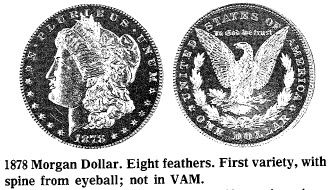
Eight tail feathers. [500] Some 100 struck each onMarch 12 and 15, 300 more March 18, though two we returned over by the Coiner to the Mint Cabinet March 7! First hub: VAM type combination I-AI (ear folds evenly divided, blunt beak, one group of 6 leaves (rather than 5) inleft wreath. Two minor varieties:
(1) Small spine out from eyeball; doubling on bases of I UN. Rev. Some doubling on wreath and much of legend; die file marks at border near AR. Not in VAM, rev. like VAM 14-3.
(2) No spine from eyeball. Obvious doubling at base of M, less obviously also on most of legend. No rev. die file marks, no other data. This is probably scarcer.
The 500 were delivered in sets during the second quarter.
-Seven tail feathers. Two types. Total [500] of which many must have been melted in 1880. Many times rarer than mintage suggests; fewer than 15 seen in all despite extensive search. However, probably over 5,000 prooflike early business strikes survive. Real proofs have broad rims completely distinct from dentils, with sharp inner and outer edges; sharpness on central curls and feathers exceeds that business strikes. Even when cleaned as usual, fields have more mirror quality than business strikes; compare with any later proof dollars.
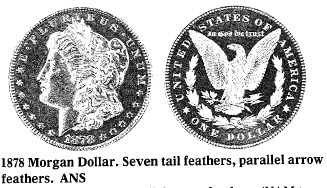
Seven feathers, parallel arrow feathers (VAM type H-B1: Van Allen believes [200] March 26). The ANS example has 4th from bottom right star imperfect (one point much too short), I free of wreath (die defect joins it to wreath on some others), M filled, left base of lover space, lower loop of 8 filled, top of r. serif of E recut; many dentils joined at upper r. Rev. short arrow stem end. Left star repunched. showing some inner detail; ribbon bows filled or space within unpolished, with light die file marks left and right; A firmly joins wing; top left berry joined by bar to adjacent leaf; obv. type of VAM II-2, rev. Bld (?). Garrett set, others.