Walter Breen's Encyclopedia of United States and Colonial Proof Coins 1722-1989
Walter Breen
Mintage: 30 in sets Jan. 19, 8 on Feb. 29, 8 on June 28, 1 each in September and December for deliveries in Oct. and Jan. 10, 1885, total 48. Source of the old (1949-65) published figures of 18 minted unknown, but significantly it is the exactremainder after omission of the 30 sets of Jan. 19, exactly as with the eagle and and double eagle. Were these 30 sets another holdover dated 1883? It does not appear so from the Coiner's records in the National Archives.
Eagle. [45] Low date slanting up, incomplete curls behind neck. Left base of 1 left of center, r. base of 4 about over r. edge. Exceedingly rare, much more so than the mintage would suggest; probably fewer than ten survivors. (1) SI, (2) ANS. (3) Eliasberg. (4) "Memorable": 580. (5) Garrett: 483 (nicked at eyebrow), opening at $7,000, bid up to $15,000. (6) Amon Carter Sr. & Jr. (7) Geiss: 1906, same coin? One of the few lacking from both WGC and Bell I.
Mintage: 30 for sets Jan. 19, 4 on Feb. 29, 4 on June 28, 1 in September, 1 in December, for deliveries respectively in October and on Jan. 10, 1885, total 45; see comment to half eagles.
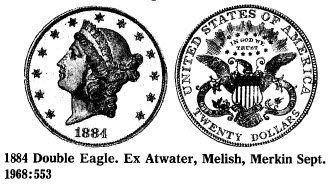
*Double Eagle. [71] Date rather low, to left; 4 somewhat farther from border than is 1; left base of lover left edge of dentil, r. base of 4 almost over r. edge; peculiar color discontinuity on neck before hair, on face before ear. Reverse die possibly that of 1883. This date has been subject to hysterical trumpetings of rarity since the fact came out in 1946 that the extraordinary F. C. C. Boyd collection lacked an 1884. There are fewer around than of 1883, to be sure. (1) SI. (2) ANS. (3) Eliasberg. (4) Amon Carter Jr., hairlined, ex Bell I, Dr. Green:753 and Amon Carter Sr. (5) Garrett: 482, at $72,500. (6) C. David Pierce-47 ANA, possibly "Memorable": 704, Menjou: 1823. (7) Wolfson:937, field nick r. of date. (8) Atwater: 1276 -Melish:997, Eliasberg, "H. R. Lee":1927, believed reappearing as LM 9/68:553. Minuscule rev. rim nick below rightmost serif of W. Atwater's twenties in this period mostly were ex D. S. Wilson (1907). (9) Norweb. (10) SI ex Lilly, possibly same as (6) or (7). (11) Ex Shuford. (12) Ullmer: 528 at $110,000, ex Miles: 912.
Mintage: 30 sets January 19, 12 each Feb. 29 and June 28, 5 in September and 12 in December for deliveries respectively in October and Jan. 10, 1885, total 71. We have read claims in auction catalogues that thirty or forty of the 71 were business strikes; these claims may now be consigned to the same trash pile as testimonials to the therapeutic value of Dr. Fagin's Patent Elixir of Snake Oil.
Gold proof sets. No 6-piece sets are now traced aside from the two complete sets (below). The rest were doubtless broken up, mostly for inclusion in denomination sets, owing to collector demand for all the higher denominations. Garrett's set, from the mint as of Feb. 7, 1884, totalled $100,750. This particular set is the reason why we are unwilling to guess that the 30 sets delivered Jan. 19 were dated 1883. It is, nevertheless, unknown if more than those original 30 sets were made as such though some could certainly have been assembled at the mint late in the year - and probably were.
Complete proof sets. Smithsonian, from Mint, from Coiner, February 6 (no trade dollar); ANS, from Mint, Brock, Morgan. Others appear to have been broken up for the higher silver and gold denominations. A most frustrating year to collect. There was something realized as unusual about the date very early. Two copper proof sets, from cent through $20 including the trade dollar, were clandestinely made. One of these was presented by the Mint Superintendent (at Philadelphia) to A. M. Smith, veteran publicity agent for that institution, author and publisher of many annual Visitors' Guides, in that year, and offered at auction in Feb. 1936 by M. H. Bolender as part of the Smith estate. Mr. Bolender told me that the set remained intact, going to a collector. I know that at least one other set must have been made and later broken up as I have seen individual coins from it. It is barely possible that others may exist, perhaps gilt, but they have not turned up. The cent and nickel in copper from the sets appear to be unknown to Judd; all were unknown to Adams, Woodin, Newcomer or other early specialists.
1885
Cent. [3790] Often with traces of die crumbling within 5; these are not evidence of an overdate. Same interesting color varieties as for 1884, and same source.
Three Cents. [3790] No peculiarities. Fabric much like that of 1884. Subject to some date collector pressure because almost none of the 1000 business strikes have survived -I have seen one uncirculated piece from the Brand hoard, twenty years ago, and two worn pieces since then, which may give you some idea. A. M. Smith had 41 proofs outside his sets.
Five Cents. [3790] Normal date only. Much hoarded and speculated in. One of the most overrated of all 19th century coins. For some odd reason, despite a mintage of almost 1 1/2 million business strikes (which should supply most of the collectors with specimens in some grade or other), the 1885 has long been hysterically touted as a great rarity. In terms of its actual frequency of appearance at auction, this date is less rare than several in the 1890s in proof state, and it is often hoarded in quantity. The A. M. Smith estate contained 31 proofs aside from the 45 in his minor sets! WayteRaymond and A. C. Gies had other hoards, mostly proofs with some business strikes.
Another hoard exists - or did into the 1960's -in the south and still another in the West Coast, these also being a mixture of proofs and business strikes. Mint state business strikes are scarcer than proofs, accounting for date collector pressure; many of the proofs are spotty or cleaned, many are carelessly made.
Minor proof sets. [3790] Apparently 2,660 outside the silver sets. Some 45 were in the A. M. Smith hoard. Formerly often enough offered, now almost all broken up because of collector demands for the 5¢ nickel.
Dime. [930] Mediocre strikes are frequent. Always available but all too often found badly cleaned.
Mintage: 460 first quarter, 625 second, total 1085, of which 930 went with the sets, leaving 155 to be melted at year's end.
Quarter. [940] Shield point over r. upright, left base of 1 about over center. Stars often flat. Rev. Rough at feather ends nearest upper leaves; often no polish in first white stripe or bases of 4th, 5th or 6th. Dull ones now masquerade as rare business strikes. Very much like the 1883 and 1884, though date collector pressure is not quite as great and hoarding far less. Odd what a slightlyhigher reported mintage of business strikes [13,600] will do, even when most survivors are cleaned or nicked coins long masquerading as proofs. They have shield point over r. foot, left base of 1 almost over r. edge.
Mintage: 440, 170, 40 and 300 in the four quarters, total 950, of which 930 went with the sets, leaving 20 for melting at year's end.