Walter Breen's Encyclopedia of United States and Colonial Proof Coins 1722-1989
Walter Breen
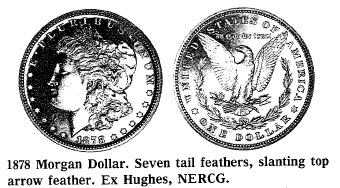
Seven feathers, slanting arrow feather (VAM type IIIl-C3). [300 struck between June 28 and 30, mostly melted.] Obv. Recut within both 8's below tops; doubling on second and fourth stars on r. from bottom, Rev. Doubling below top D of DOLLAR and on bases of MER CA; middle of s in trust broken. This type combination not in VAM, both working dies unlisted. Exceedingly rare. (1) LM 4/70:599. (2) Herstal:599, $4,600. (3) Hughes, NERCG, possibly same as one of first two? Also reported: VAM 215, unseen.
*Trade Dollar. [900 reported] Only one variety noticed. Supposedly 300 struck in January, 200 each in February, March and May. Rarer than the mintage suggests; many may have been melted in 1879. Many of the survivors have been poorly cleaned.
Silver proof sets. The usual figure of 800 struck was explained under Dime. Probably [700] would be a liberal estimate, the earliest 500+ with 8-feather dollars, only the last few with 7-feather dollars. Unbroken sets are now very rare: cf. Garrett's at $5,750, Bartlett: 1003 (Sfeather dollars. Trades). Others offered are likely to have been assembled. Reason for breakup of original sets: date collector pressure on 20¢, to a lesser extent also the Trade; more recently also, silver dollar (first year) and nickel coins.
Gold Dollar. [20] *B-3. Normal date, final 8 usually not filled, extra outlines on DOLLAR. Extremely rare, under 15 survivors, which still makes this the least rare gold proof of the year. Garrett: 463 (final 8 filled) brought $2,190; Scanlon: 1993, $1,700. Several others are impaired, e.g. "Memorable": 35 (rim nick).
Quarter Eagle. [20] *B-1. Date slants slightly up to r., left base of lover r. edge. Rev. Dentils well spaced apart. Rarer than the $1 but undervalued by comparison. No perfect specimen offered recently enough to afford a reasonable basis for valuation and not many doggy ones. Wolfson's was impaired: the Col. Green - MacAllister -Gaskill specimen cleaned, Garrett's (at $3,500) hairlined.
Three Dollars. [20] *B-1 (not in original monograph, later called B-3, but precedes the rest). Obv. of 1877, rust pits as described there. Rev. Date slightly below center of space, level; no rust marks. As rare as the $2 1/2but grossly undervalued - no date collector pressure. Garrett's realized $12,500.
Half Eagle. [20] Low date, open mouth, polish in ERT, chip below E. Rev. Hollows below I WE ST on scroll. Exceedingly rare, more so than the lower denominations. (1) S1. (2) ANS. (3) Eliasberg. (4) Garrett:460, $4,750. (5) Philip G. Straus estate -1959 NY Metropolitan: 2444. (6) Mocatta Metals - possibly ex (4). Probably less than nine survive.
Eagle. [20] B-1. Date low, close to border. Left base of 1 slightly r. of center. Rev. Repolished die of 1876-77 proofs. Top of second stripe thin, hollow at IN, left scroll end fragmented. Same comment as to the half eagle. (1) S1. (2) ANS. (3) Eliasberg. (4) Garrett:459, nicked, $8,000. (5) "Memorable":576. (6) Straus estate (S 5/59) :2505, later 1976 ANA: 3101, $6500. About equal in rarity to the half eagle, but will bring more.
Double Eagle. [20] Low date, left base of 1 almost over r. edge. Same comment as to the half eagle and eagle. Apparently under ten survive. (1) S1. (2) ANS. (3) Eliasberg. (4) Garrett:458 (spotty), $12,500. (5) Bell II :907 (impaired). (6) WGC: 881. (7) "Memorable": 576.
Gold proof sets. [20] All were delivered as of Feb. 9 despite the Jan. 9 date of the transaction between Coiner and Mint Cabinet Curator, earlier cited, which set (cent to double eagle, minus dollars) is now in SI, the other coins being added later in the year as above mentioned. All 20 gold sets were sold, none held over into 1879. Garrett's was broken up, totalling $43,350. One is in Texas pvt. coll.
Complete proof sets. [20] SI (as above) and ANS, ex Mint, Brock, Morgan. No others now traced.
1879
Cent. [3200] At least two varieties. First die: Date left, serif of 1 nearly in line with bust point·polish around eye, below ear, and at bases of all feathers. Rev. E of CENT almost closed. The var. usually encountered.
*Second die: Date repunched. Base of 1 slightly double, part of another 8 within loops of 8, part of another 9 within 9. NN 57:81, others. Rare.
The cents of this date often come dark red or iridescent; a minority have brilliance similar to that found on some 1874-75 coins.
Three Cents. [3200] Three varieties. First die: Filling in both 8 and 9. Scarce. Pvt. calls.
Second die: Heavy date, filling in 9 (not 8), earlier states with recutting on 9, extra outlines on UNITED ST and final A. Left base of lover left of center of dentil. Rev. Normal leaves, not fragmented. ANS, others.
Third die: Thin numerals, clear 8 and 9, date higher and to right, left base of 1 above space; letters thin except for TES O. Rev. Die of 1880, fragmented ribbon and leaves. ANS, others.
It is not known which of these is rarer. Examination of that in the Smithsonian set (obtained in January) might establish which is earliest. More proofs are around than business strikes. Some are granular or not well made. The A.M. Smith estate included 40 aside from those in sets.
Five Cents. [3200] Date collector pressure has been brought to bear on this issue as business strikes are hardly ever seen. Hoards exist; the A. M. Smith estate had 27 outside of his sets. Several die varieties, some decidedly odd.