Walter Breen's Encyclopedia of United States and Colonial Proof Coins 1722-1989
Walter Breen
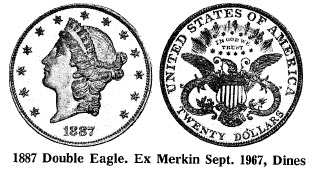
*Double Eagle. [121] Date below center, to r., left base of 1 almost over r.edge. Rev. possibly of 1886; tiny break in r. tail feathers just below arrow, less than in some other dates; left leaf of lys below beak disconnected. Possibly thirty survivors. (1) SI. (2) ANS. (3) Eliasberg. (4) Garrett: 500, $22,000. Is this the Mocatta Metals piece? (5) Merkin 9/67:449, Dines:927, few small spots. (6) Melish:1005, obv. field nick. (7) KS 2/60:2902, rev. field nick. (8) Miles:919, hairlined, possibly ex Dr. Green: 756. (9) Dr. Bolt: 1349, S 5/68:997, cleaned to death. (10) LM 6/72:486, obv. (only) hairlined. The following records are believed to include some duplications and possibly 7 other examples: (a) Dunham:2330. (b) Bell I, to a dealer. (c) WGC:889. (d) Atwater: 1279. (e) "Memorable":707. (f) Menjou:1826. (g) Eliasberg, NN 49:148, DiBello:1271, choice. (h) Wolfson:943. (i) "Alto":455. (j) Gilhousen:938. (k) Ullmer: 530.
Mintage: Quarterly, 26, 28, 10, 57, total 121. Some 25 of the first quarter delivery were intended forthe sets assembled in March. They were, however, struck in January.
Gold proof sets. Though these were reported in March, apparently they were made up not later than Jan. 25, as that was the date on the invoice for the Garrett set, directly from the mint; it was dispersed, totalling $50,600. Other sets may have followed later in the year, possibly as many as 75 to 80 in all. Little can be learned from the reference in the 1887 Director's Report to 35 sold between July 1886 and June 1887, as some of these were surely dated 1886.
Complete proof sets. Only two as usual: SI, from Mint, from Coiner as of Jan. 25 (coincidentally: see above), at face value; ANS, from Mint, Brock, Morgan.
1888
Cent. [4582] Often with the same peculiarities as the 1887. One in Merkin 11 /65 was of the carelessly made persuasion, showing evidence of only one blow from the dies. Many of the other survivors are, or were, dull -the past tense refers to those which became victims of the scrub brush, the cyanide jar, or the commercial dipping solution. In Boston and Minneapolis are at least two establishments – there are almost certainly others elsewhere - making a quantity business out of turning honestly toned brown coins into unnatural red ones, too often resold without mention of the treatment, for which their proprietors ought to spend some time turning big ones into little ones.
Three Cents. [4582] At least two varieties, possibly three.
- Final 8 filled or partly filled, two horizontal marks within lower loop. 1975 ANA: 123-4, others.
- Second 8 repunched, final 8 normal. HR 11/69:919, others. Which is rarer?
Some of these are so dull as to be almost indistinguishable from business strikes; and conversely, some business strikes have attractive proof surfaces. The series is enough in the doldrums that nobody particularly cares.
Five Cents. [4582] Without or with double date, latter rare (LM 11/68:218). The majority of survivors of this date and 1889 can only be obtained in very dull state. This appears to bea peculiarity of the nickel alloy available from the mint's suppliers in this year. No explanation is known, and no cure; even the most efficient detarnishing agents have no effect on this particular dullness. Under a microscope the metal is alternately granular and pebbled, taking polish only locally; its crystalline structure is anomalous and entirely unlike that of 1887 or 1890. Possibly some trace element is responsible, though this speculation has not yet been investigated. Really brilliant nickels, like those of 1887, are scarce. The dull proofs are sometimes mistakenly sold as business strikes, but they can be readily identified by having the usual broader rims sharp on both inner and outer edges. Many have been cleaned to death in a vain attempt to cure the dullness, which admittedly has deterred potential buyers.
Minor proof sets. [4582] Mostly assembled.
Original sets are now very scarce.
Dime. [800] *B-2. Lapped die, shield above drapery incomplete, UNITED thin. Merkin 4/66:229, others. May also exist from normal dies. Same comment as to 1887.
Mintage: First, second and fourth quarters, 400, 100 and 300, respectively, in sets, all delivered at the time. No explanation exists for the figure 832 commonly published -assay pieces?
Quarter. [800] Date slightly low, shield point slightly r. of upright, left base of 1 just r. of left edge. Same comment as to 1887 though this time more frosty unc. pieces survive of the business strikes - putting less date collector pressure on the proofs and for some reason not encouraging speculator activity.
Mintage: As with dimes. The figure of 832 proofs usually seen possibly includes assay pieces; no explanation is in any Archives documents seen by me.
Half Dollar. [800] Only one variety seen; date about centered, shield point over r. tip, left base of 1 over r. edge; rev. shield unpolished, left end of scroll broken away. Same comment as to quarter dollars.
Mintage: As with dimes. The usual 832 figure possibly includes assay pieces, as with dimes and quarters. Business strikes have date slightly below center, shield point over r. foot, left base of 1 r. of center; heavy clash marks; scroll normal.
Silver Dollar. [800] First variety: Normal date slants up. VAM 1. Garrett set.
Second variety: Double Date, first punched to left, partly effaced, repunched. Top and base of extra 1 shows at left of 1, traces of extra 8's at lower left or below base. Not in VAM. Ex. rare. "Dupont":2586; 1973 GENA:605. Same comment as to the 1885's, regrettably.
Mintage: As with lower silver denominations; same comment.
Silver proof sets. [800] Original sets used to be shown around even in the early 1950's; these had dull nickels. Most have probably been broken up, some possibly reassembled. Garrett's, ex Mint 2/17/1888, brought $2,600.