Walter Breen's Encyclopedia of United States and Colonial Proof Coins 1722-1989
Walter Breen
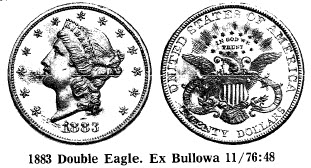
*Double Eagle. [92] Numeral 1 centered between bust and border, left base of lover r. edge; date to right, r. side of 3 about in line with r. side of lowest curl. Rev. Back of neck has a rough appearance; lys below beak fragmented. Extremely famous, long erroneously believed the rarest of all double eagles because mint reports included only the 40 with the proof sets. Nevertheless, less rare than the smaller denominations, or than the 1884. There may be as many as twenty survivors. (1) SI, ex Mint. (2) SI, ex Lilly, possibly same as one to follow. (3) ANS. (4) Eliasberg. (5) Garrett: 476, $72,500. (6) Davis-Graves :884, from the set. (7) Ben 1, Dr. Green:752. (8) Amon Carter Sr. & Jr., possibly same as last. (9) Golden 1 :2829, nicked on cheek and between 4th and 5th stars, believed reappearing as S 5/68:988, Dines:919. (10) Wolfson: 934. (11) Bell II:921. (12) WGC :886, believed same as "Memorable": 703. (13) Atwater: 1275, Eliasberg "H. R. Lee":1726. (14) Menjou: 1822, possibly same as last. (15) Melish: 992. (16) QS 9/73: 1296, $42,000, possibly same as one ofabove. (17) Bullowa 11/76:48, no previous auction history.
Mintage: Feb. 10, 40 with sets; 3 more before March 30, 15, 13 and 21 in the last three quarters, total 92.
Gold proof sets. [40] All minted Feb. 10. One was dispersed as Davis-Graves 884-889, another as Garrett :476-481, totalling $91,400. Two more form part of the two complete sets below. Most others have been long since broken up owing to demand for the $3 and double eagle.
Complete sets. That in SI went from the Coiner to the Mint cabinet as of Feb. 13, at $44.49 face; the other is in ANS, ex Mint, Brock, Morgan. Others were long since broken up. The SI's set composition is odd: all three nickels are present, yet there is no mention when the third nickel was obtained, nor any indication of any other nickel without CENTS being issued as early as February! Note that references to 4-piece minor sets are lacking, yet one must somehow have been included here. Was the Mint's No CENTS nickel a prototype? To quote the King of Siam, "It's a puzzlement! "
1884
Cent. [3942] Date normal or occasionally with very faint traces of recutting. Often strangely and wonderfully iridescent. Many of the iridescent ones - featuring greens and lilacs and mauves - came from Wayte Raymond's stock before 1953. They got their toning from the mint wrappers, which must have differed in chemical composition from the earlier ones.
Three Cents. [3942] Heavy date. No peculiarities.
Often comes toned gray to iridescent blue or gunmetal, sometimes spotted. Date collector pressure exists on these as only 1,700 business strikes were minted and almost all vanished long ago. Regrettably, dull or carelessly made proofs are now being touted as rare business strikes. The A. M. Smith hoard contained some 154 proofs, outside his sets.
Five Cents. [3942] Normal date. Always available for a price, often hoarded (A. M. Smith had 34) and for some unknown reason often believed rare. Date collector pressure is acute despite a mintage of over eleven million regulars. Whoever promoted it was remarkably quiet and remarkably successful.
- Normal date. Positional varieties exist: cf. NN 51:460-61.
- Double punched 1. Rare. The earliest state, with doubling on base of 1 very obvious even to the naked eye, is especially rare; cf. NN 51: 462. This die either wore down or was repolished as later impressions show the misplaced 1 only very faintly (ANS and others). Seen about once for every 20 to 30 normal dates.
Minor proof sets. [3942] Apparently 2667 separately from silver sets. Few original sets survive now, though A. M. Smith had 59 and Wayte Raymond had more than that. They appear to have been broken up for the nickel coins. Other have been assembled recently as part of silver sets.
Dime [875] All lately seen are from *B-2 dies: rust pit on r. side of lower half of 8 between right curves; this increases in size. LM 11/65:271; 4/66:221 to H. W: May also exist from normal dies.
Quarter. [875] Shield point over r. foot of 1, left base of lover left edge, r. base of 4 over r. edge, 84 touch; polish in stripes and drapery. Rev. Minute scattered dots (rust pits?) in upper parts of white stripes. Under immense date collector and speculator pressure owing to the low mintage of business strikes (8000), comparatively few of which have survived aside from deceptive early impressions mostly masquerading as proofs (though more recently carelessly made proofs are masquerading as rare business strikes). The situation here is almost the same as with proof-only mintages. Once again, the first strikes I have seen have mostly shown inferior surfaces (often peppered with tiny nicks), poor borders and shallow relief details compared with any proofs of the period; unfortunately, date is identically placed to that on proof obverse.
Mintage: First quarter 570, second 240, fourth 133, total 943, of which 875 went with the proof sets, leaving 68 to be melted.
Half Dollar. [875] First die: bases of 84 faintly recut, left base of lover r. edge, rev. of 1883 proofs. 1974 GENA: 1629; Garrett set (from Mint, 2/7/84). Also on business strikes, alas!