Walter Breen's Encyclopedia of United States and Colonial Proof Coins 1722-1989
Walter Breen
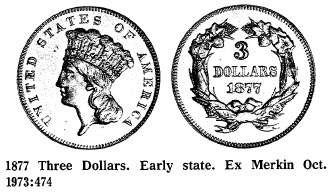
Three Dollars. [20] Low date, only one reverse die. *B-1: Obv. shows less than half of JBL on truncation, S's free of filling, striae pointing northeast most prominently at ME, filling in most of first A in AMERICA, right upper part of M, part of loop and part of space below in R; a light line joins bases of final A. The 10 coined February 24 appear to be those without any rust pits on neck; the 10 coined May 31 appear to bethose showing first one, then two or more rust pits on neck, one being just in front of second protruding curl, the second just below jaw; as this die continues in use through 1879 and on restrikes dated 1873, other rust pits develop: on curls on a line that would join E of UNITED and final C, on cheek before upper part of earlobe, just below and to left of eye, etc. The striae fade out. Extremely rare, especially in the earlier state. Earlier state: Lester Merkin auction, October 1966, at a reasonable $1,700. Compare also those in Smithsonian, ANS, Eliasberg, Wolfson: 305 at $2,200, Jay: 289 ex Grant Pierce: 1264 at $2,000; Holmes: 3382; Dunham: 2049, "Memorable": 263; LM 10/66:325; LM 10/69:418. I have seen at least three different nicked-up ones and one EF ex-proof the latter NN 51 :961. One in the 1964 ANA Convention auction, which I did not have a chance to examine, is reported as bringing a then incredible $4,500. Nonproofs are prohibitively rare and have a different obverse die lacking the named stigmata.
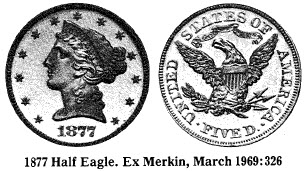
Half Eagle. [20] *B-1. Rust pits on chin, date a little low, leftbase of 1 r. of left edge of dentil. Extreme rarity. Proofs are rarer than of the smaller denominations, it being doubtful if as many as a dozen survive. At least one of these (Wolfson: 516) is impaired, though perfect ones survive in Smithsonian and ANS.No auction records recent enough to be meaningful. Cf. LM 3/69:326. On the extremely rare nonproofs (B-2), date is centered, rust pits are on neck, left base of lover left edge.
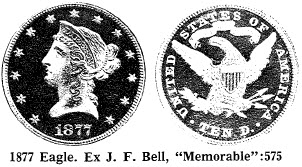
*B-1. Low date, close to border, left base of 1 about over left edge of denticle. Rev.: Die of 1876 proofs, polish above space between IN. (On the extremely rare B-2 business strikes, date is about centered, left base of 1 r. of center of denticle, scroll has weak outlines, IN ST in field.) Exceedingly rare and under extreme date collector pressure; less than a dozen survive. (1) Smithsonian. (2) ANS. (3) Wolfson: 718, two small rim stains. (4) 1964 ANA Convention sale, $2,500. (5) "Memorable": 575. (6) Impaired, Davis-Graves: 957. It is possible that some of the coins in circulated condition believed to be nonproofs may have originated as proofs; die identity should decide that when the coins show up again.
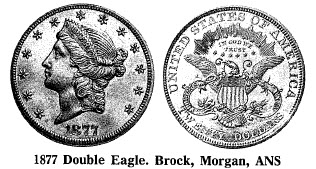
Double Eagle. [20] New design. Head higher, dividing first 6 from last 7 stars; TWENTY DOLLARS spelled out. Low date near border. Proofs are of the highest rarity. No recent auction records, aside from WGC:880 and/or Ullmer:525 (tiny black spots lower r. obv.), at $22,000.
Gold proof sets. [20] Delivered to the amount of 10 on February 24, 10 on May 31, released June 2.
Complete proof sets. Two survive. There is no record of when one of them went from the Coiner to the Curator of the Mint Cabinet, nor of when R. C. W. Brock bought the other from the Mint; they are now in the Smithsonian and ANS.
1878
Cent. [2350] Heavy date, to left, tip of 1 almost in line with bust point; left base of 1 central. Rev. E of CENT lightly closed, ribbon clear. Deeper red color on many of this year than formerly. Some have the reverse die used on coins of 1872-73, with recutting on T of CENT, or if it is not the identical working die it is indistinguishable therefrom. Rounded borders also occur on this date.
- *Base of 1 recut, small rust spot before ear. Rare. LM 10/66:214.
*Three Cents. [2350] Some have second 8 filled (ANS; Lester Merkin auction, November 1965, Garrett set, others). Those with both 8's clear may be from a repolished or more worn state of the same die. Very popular; sometimes with weak or rounded borders or on granular flans. Date larger than on 1873's which have sometimes been mistaken for 1878's. Both 8's identical in size and shape.