Walter Breen's Encyclopedia of United States and Colonial Proof Coins 1722-1989
Walter Breen
First die: Top of 1 below G. Left base of 1 slightly r. of center of dentil. "Gilhousen": 1479, others.
Second die: Top of 1 below GO. Left base of 1 slightly r. of left edge of dentil. Same reverse. "Gilhousen": 1480, 1974 GENA: 1182, others. Which is scarcer?
Silver proof sets. [1355] Deliveries as under Dimes above. Original proof sets exist but they are quite rare; many sets today extant appear to have been assembled. Compare also Bartlett: 1004 at $900 (cent to trade dollar).
Gold Dollar. [36] The coins of this date are enough to give a conscientious cataloguer or authenticator nightmares, ulcer attacks and premature gray hair. Proofs and many business strikes come from the same dies, and most of the extant business strikes come from brilliantly polished dies on polished blanks! It follows that anything from mediocre eyesight to poor lighting to sheer venality or unscrupulousness - or a heavy tax bill - can suffice to induce a dealer or collector to offer his shiny 1880 as a brilliant proof without stopping to ask himself if it was intentionally made that way. And it will usually sell so. Auction records are no help, and I do believe that the very rare proofs werefor many years kept down in price because the first strikes have increased the apparent number around (as with the 1879 quarters). To a certain very small extent the problem has been mitigated in that many business strikes have been kept off the market by hoarders, but there are still enough around to make trouble. I see no reason to withhold further the names of the departed hoarders of 1880's: Lammot duPont owned hundreds of them, proofs and prooflike first strikes together; Horace Louis Philip Brand and Charles E. Green had similar holdings. These two, I understand, have been only partly dispersed. Real proofs (B-4) have no die file marks at ATES; upper serif of 1 below adjacent leaf tip; wreath tops join; but other varieties are possible. Auction record $1,600 for one which may have been a real proof; I did not see the piece and cannot therefore swear to it. (I would more probably swear at it instead. . .)
Quarter Eagle. [36] Very rare, but probably at least two dozen survive, some impaired (e.g. Holmes: 3291). There are also several deceptive first strikes, but the problem here is not nearly so severe as with the gold dollar. Ullmer's brought $3,250.
Three Dollars. [36] *B-1. Line in dentils above O; rust marks as in 1877-79. Rev. Centered date, almost no extra outlines on 3. May also exist from the B-2 (business strike) dies, with lower date slanting down. Very rare, though the surviving proofs may seem a little more frequent in appearance than they actually are, because of deceptive early business strikes from the B-2 dies. Business strikes have faint die file marks above RICA and at bottom rev.; all three obv. A's and E partly filled. Fortunately there are fewer of these deceivers around than with the gold dollars. Several proofs are impaired, e.g. Wolfson: 380, Neil-Grant Pierce: 1267 - Jay: 291. Ullmer: 425 brought $10,500.
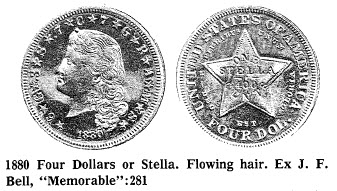
*Four Dollars or Stella. Flowing Hair. Said to be 15 struck. All are on the same kind of centrally striated blanks as the 1879 - dated dies. Full weight, 7 grams. (1) Mint, S1. (2) Eliasberg. (3) Kern: 244, Amon Carter Sr. & Jr. (4) Johns Hopkins. (5) Part of complete set, Texas coll. ex Dr. Wilkison. (6) Neil:2604, Grant Pierce, 1976 ANA: 2920 as part of complete set ($225,000). (7) Dr. Conway Bolt at private sale, Merkin 9/68: 543. (8) 1974 ANA: 873, $40,000. (9) "Rio Rancho": 134, $35,000. In addition to these nine, probably at least six and possibly as many as a dozen more are represented by over 20 auction records, impossible to disentangle here because of the quality of illustrations.
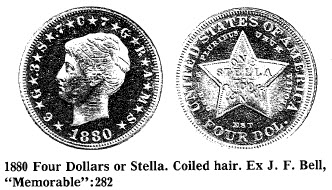
-*Coiled hair. Said to be 10 struck. All are on the same kind of centrally striated blanks as on the 1880 strikings from 1879 -dated dies. Popularly supposed to be somewhat rarer than the 1879 Coiled Hair type, and prices reflect the belief. (1) Mint, SI. (2) Lilly, SI. (3) Eliasberg. (4) Johns Hopkins. (5) Texas coll., ex Dr. Wilkison. (6) Kern: 245, Amon Carter Sr. & Jr. (7) Neil: 2605, Grant Pierce, 1976 ANA:2920 in complete set ($225,000). (8) Delp:792, $35,000. (9) Davies-Niewoehner:547, $67,500. The Neil piece is thought to be ex Grinnell or Olsen; the J. F. Bell piece in the "Memorable" sale has not been identified, nor has that in the Farouk sale, which may well account for one or two more.
Half Eagle. [36] Exceedingly rare, no recent records. Melish: 2166 went to New Netherlands, not later traced. Do as many as nine survive?
Eagle. [36] If anything, slightly rarer. Ullmer:495 (small rubbed spot on chin) brought $5,500, possibly ex Melish:2477.
Double Eagle. [36] About as rare as the eagle. Many gold proofs of this period were spent during the panicof 1893. (1) Mint, S1. (2) Brock, Morgan, ANS. (3) Eliasberg. (4) Amon Carter Sr. & Jr. (5) Boyd, WGC. (6) J. F. Bell, "Memorable": 700. (7) "Memorable" :932, possibly same as (5). (8) S 9/30/66: 17 (in Wilson S. Rise catalogue).
Gold proof sets. Some 20 coined Feb. 14, and 16 more late in September (delivered Oct. 2), $1 to $20. Director's Report specified that 31 were sold as of the end of June 1880, obviously mixed 1879's and 1880's. No stella included.
Complete proof sets. Despite the date specified for release of the gold, that in S1 was bought from Coiner as of Jan. 10, at face value ($44.44) in currency, quoted at par; no proofing charge. No Stella. Only two original sets traced: Mint, S1; Brock, Morgan, ANS.
1881
Cent. [3575] All known proofs and uncirculated coins have 81 out of line, evidently from use of an 1880 logotype with last two digits filed off to make the 1881 logotype, an attempt to produce a curved date. No special peculiarities for proofs. Color tends to be paler than on some earlier years; many survivors, 1881 to about 1905, come spotty or poorly cleaned.
Three Cents. [3575] Several varieties. First die: Normal date, no filling, no recutting. Not rare. Is this a later state of following?
Second die: Filled 8's; final 1 very close to curl. Rev. Normal or with crack from rim to wreath at 11:00. ANS, "Durham": 155, many others.