Walter Breen's Encyclopedia of United States and Colonial Proof Coins 1722-1989
Walter Breen
1866
Cent. [725+] Normal date. Generally available for a price; not much scarcer than later dates in the sixties, if at all, but very popular.
Two Cents. [725+] Date rather high, ball above 8 (left edge slightly left of 8), left base of 1 slightly r. of center; die file marks around shield and near lower r. border, which fade. Rev.: Top serif of D off (also on business strikes).
Another die: left edge of ball above inner r. curve of 8.
Three Cents Nickel. [725+] Often shows tops of 6's more or less filled, loop of second 6 recut though this is not constant; hold 1 vertical and its left base is over center. Rev.: Fragmented leaves, incomplete ribbons; later relapped, bows also incomplete. Readily available though now priced much higher than later dates - possibly because of the influence of the five-cent piece?
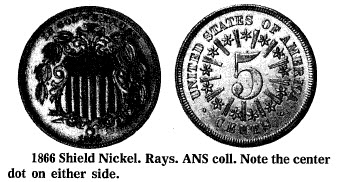
Five Cents Nickel. [125+] Shield design, obv. similar to the 2¢ but with motto in field; shield surmounted by the Cross of the Order of Calatrava (or something enough like it to make no difference).Crossed arrows at base, not in saltire. Rev. 5 within circle of stars, rays between stars. Proofs are all from a single pair of dies: *Obv. Plain center dot. Rev.: Plain center dot, minute recutting on upright of 5 at left. This reverse die is the identical one used in the prototype pieces dated 1865 of the design adopted. Coinage began around June 10, 1866, per Act of Congress of May 16, 1866, authorizing this denomination to replace the 5¢ notes portraying Spencer M. Clark of the Currency Bureau. Extras were probably made for minor sets (below), and surely the 50 silver-minor sets of June 11, 50 of July 25, and 25 of Sept. 17, included this denomination. The actual number made is possibly nearer to 175 than to 125, but the smaller figure would be a very liberal guess for the number of survivors. Rare and of late highly prized, several recent auction records in the neighborhood of $1,500. Many show rounded borders. I authenticated one that somehow managed to pass mint inspection despite being struck on a slightly clipped planchet - die identity and surface were unequivocal. Many have been drastically cleaned to the point of dullness or roughness.
Minor proof sets. Said to contain cent, 2¢, nickel 3¢ and 5¢. None seen.
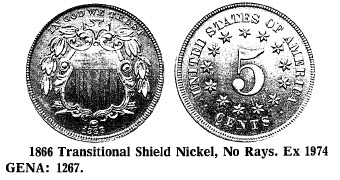
Transitional Five Cents. Regular obv., with center dot. Rev. Prototype die without rays, recut 5, two center dots. Probably less than a dozen known. (1) S 10/50:69, W. C. Blaisdell, 1971 ANA: 346. (2) 1974 GENA: 1267. The other (rarer??) variety, with an 1868 reverse die (no center dots, stars differently placed) is believed a restrike - LM 9/68:431.
Trime. [725] At least two obv. dies, both with D open (hub worn down or chipped).
-*B-1. Very light repunching at top second 6. Less rare than following.
- *B-2. "Overdate," second 6 heavily punched over something else, not identifiable with certainty even at 90x stereo magnification. Much rarer. NN 51:349; Landau:335. This obv. die was later used on business strikes (rarer than proofs); they often show rim break over F, cracks from rim to star r. of date.
Half Dime. [725] V-I. Shield point about over tip of serif of 1, skirt pendant over thickness of left curve of second 6 (date low, to left); 6 much farther from border than is 1. Letters clear. Rev. Heavy HALF DIME, both ribbon ends clear. ANS, Valentine, others. Unknown if scarcer than following.
- *(?) B-2, not in Valentine. Date more nearly in normal position -farther right. Shield point well to left of 1, skirt pendant between 66, all letters in AMERICA filled. Rev. Lapped die, thin letters in HALF DIME, both ribbon ends clear, right one distant from wreath. Eliasberg; NN 51: 565; Landau: 402; NN 54: 1279, others.
Dime. [725]. *B-1. Date begins low, slants slightly up to r.; partial extra left base to 1; dot above base of middle white stripe. Rev. of 1865, both ribbon ends clear, mark on r. leg of M. Readily available for a price; more often seen proof or impaired proof than uncirculated or nearly unc. Compare that in Lester Merkin auction, April 1966. There may have been fewer than the full 725 actually made as proofs, as I have seen an uncirculated piece included in an 1866 proof set (cent through dollar) obtained from the mint in that year and still in the original brownish (aged) wrappers. This uncirculated coin was from clashed dies. See NN 57: 491.
Quarter. [725] First regular year with motto. Date nearly centered; shield point over left edge of upright, left base of lover left edge of dentil. Same comment as to the dime, the uncirculated piece from the proof set being in NN 57: 658.
Half Dollar. [725] First regular year with motto. First variety (Beistle I-A): date begins slightly above center, slants slightly down; 6's not recut; one full and two partial drapery lines. Shield point minutely r. of upright, left base of 1 almost over r. edge; extra outlines on 1st, 3rd, 4th, 5th and 7th stars. Rev.: RI joined as are two lower arrowheads; irregularities in final A; 2nd and 3rd red stripes thin; some wing and body feathers partially lapped off.
Second variety: date minutely lower, slants down, minute recutting atop final 6. Rev.: Possibly same as above.
There is as yet insufficient evidence to tell which is scarcer. The date is readily available for a price, but has become popular as a type coin. Same comment as to the dime; the unc. piece from the proof set was in NN 57: 965.
Silver Dollar. [725] First regular year with motto. Three varieties. B-l. Recut base of 1. "Gilhousen": 1330, ex Mehl, Dr. Ruby. (Also in copper.) [600?]. Note: The recutting on G W T (R) is in the hub. The date is very popular as a type coin, though not really rarer than others in the sixties. Same comment as to the dime; the unc. piece from the proof set was in NN 57: 1168.
- *B-3. Low date slants up r. Rev.: No doubling on IN; spine slants up to left from top of 3rd leaf. Very rare. "Gilhousen": 1331, Hirt: 1245.