Walter Breen's Encyclopedia of United States and Colonial Proof Coins 1722-1989
Walter Breen
Gold proof sets. [30] Some 20 (no stella) were made as of January 25, 10 more on November 22. The Director's Report, covering the fiscal year (July 1, 1878 to June 30, 1879), says 26 were made of which 17 had been sold: but this is not immediately reconcilable with the figures here quoted. What probably happened is that 6 of the November delivery had already come out as of the issuance of the Director's Report, and that the reference to "31 sets sold" in the 1880 Director's Report means the 20 of February 14, 1880 plus some of the remaining 1879's.
Complete proof sets. One is in ANS, ex Brock, Morgan. The other one now known is in the Smithsonian, from the Mint Cabinet, obtained from the Coiner some time in January 1879 for $44.50 currency (face $44.44).
1880
Cent. [3955] Date straight as heretofore since 1872, but this is the last occurrence of a straight logotype on cents. Two varieties: that less often seen has faint traces of recutting on upper surfaces of upper loop of second 8, the commoner one lacks them. There may be minute positional variants of the latter. Often deep red or iridescent, occasionally with rounded rims.
Three Cents. [3955] First die: Heavy date, left base of lover left edge; partly filled 8's. Rev. of 1879, fragmented leaves.
Second die: Heavy date, high, close to bust, left base of lover r. edge; minute recuttings in 8's, later visible only in upper loop of second 8. Rare earliest states show that date was first cut too low, then corrected. Rev. as preceding. Hirt:,082, others.
One of the above shows irregular narrowing of wreath stems: repolished state of regular reverse? Different die?
Always available for a price; business strikes are very seldom seen. The Virgil Brand estate contained a hoard of several hundred proofs, many carelessly made. Some of these have doubtless been resold as rare business strikes. The A. M. Smith estate had 30 proofs outside the sets.
Five Cents. [3955] First die: normal date, first 8 touches ball.
Second die: Second 8 first cut far too low, then corrected; first 8 about touches ball. "Gilhousen": 84, many others.
Same remark as to the 3¢. Often with partly rounded rims; varies from brilliant to comparatively dull and granular, carelessly made. Many of the latter quality are resold as the very rare business strikes. Often hoarded; A. M. Smith had 21 outside sets.
Minor sets. [3955] Apparently 2,600 outside silver sets; mostly long since broken up on behalf of collectors of the nickel coins. A. M. Smith had only nine sets.
Dime. [1355] The usual variety has incomplete drapery near shield, pendant over inner r. curve of 8, shield point about over peak of 1. Often carelessly made, and of late often offered as rare business strikes. (The real business strikes have low date, 0 much farther from border than 1, pendant left of center of 8.) Often hoarded; A. M. Smith had 15 outside the sets, a midwest dealer far more. Under date collector pressure owing to speculators' notice of the low business strike mintage; date collectors are usually content to buy a readily available proof rather than wait some years for an unquestioned business strike. All the proofs are from (broken) sets. Some 1000 were minted in first quarter, 355 in second, 200 in fourth, total 1555, of which 1355 were delivered in sets: 600 in first quarter, 500 in second, 255 in the fourth. The 200 leftovers were melted at year's end.
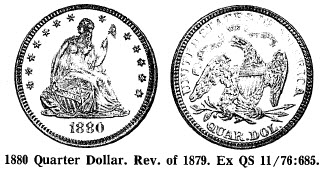
Quarter. [1355] Shield point minutely r. of upright, left base of 1 slightly r. of center, date minutely above center; polish in stripes and nearby drapery; rev. of 1878 (Ruby) or of second 1879 variety. Hoarders have also gotten to this issue, as indeed to the later low-mintage business strikes 1882-87. There are quite a few deceptive early strikes even as of 1879. They have less relief detail than the proofs; obv. different, shield point over r. foot, left base of lover left edge, centered date slanting down, rev. stripes filled (unpolished). Same remark about set deliveries as to dimes. Some 1,000 struck in first quarter, 460 in second, total 1,460 of which 1,355 were delivered in the sets, the remaining 105 melted as unsold.
Half Dollar. [1355] Several varieties. First variety: Centered date, 1 nearer border than 0, shield point over r. foot of 1, several stars with extra outlines. Rev. of 1876, Type I, split berry above H.
Second variety: Obv. as last. Rev. Type II (pointed berry above H), lump in wing in line with both Hand N, tiny rust pit in second red stripe, scroll normal. "Gilhousen": 1086.
Third variety: Beistle I-A. Obv. not described, probably same as last. Rev. Small northeast-pointing corner at left end of scroll is broken away; this die said to recur in 1881. Not identified, same as first?
Same remark about set deliveries and hoarding here as to the quarters; comparatively few survivors of the 8,400 business strikes, though alas some remain in collections or dealers' stocks mislabeled "Proof, not in full brilliancy" (or sometimes without that qualifying phrase). Adding to the confusion, now that gem business strikes are beginning to sell for more than cleaned proofs, some proofs are being sold as "Gem prooflike Unc." Some 1,000 proofs struck in first quarter, 400 in second, 1,355 delivered with the sets above, the rest melted.
Silver Dollar. [1355] VAM 13. Minutely doubled 1. Deceptive early strikes exist. Some 750 proofs coined in first quarter, 590 in second, 100 in fourth, of which total of 1,440 some 1,355 went with the sets, the rest melted. Clear-cut accounting of this kind does not long continue, regrettably: see 1882-83.
*Trade Dollar. [1987] The monthly coinage figures for proofs are in Willem. Nothing much can be learned from them or the other figures on trade dollars through 1883 inclusive, save that around Christmas time large quantities were made presumably for stocking stuffers, and the bulk of the year's coinage came in the first quarter to fill proof sets orders. From now through the clandestine 1885, the obverse hub shows increasing signs of wear: head and stars are routinely flat.