Walter Breen's Encyclopedia of United States and Colonial Proof Coins 1722-1989
Walter Breen
Harry Boosel had a real anomaly, from one of the New Netherlands auctions: obv. proof, rev. unc., with open 3 and no arrows. I have not seen a simon pure proof open 3 quarter carrying its own credentials. If any quantity was made, presumably most of them were melted down July 10, 1873. The piece in the Whitney set, presented in 1874, has closed 3.
- With Arrows. [540] Open 3 only. Reverse same as preceding. Boosel gives this mintage figure; 500 were struck with the silver sets on the dates cited for the dimes with arrows, the other 40 at some unknown time probably during the final quarter year. Same comment as to the dime with arrows.
Half Dollar. No Arrows. [600] Struck with the sets. All I have seen have closed 3, date about centered or high (scarcer), latter with few rust pits in wing above L, in line with CA. Beistle, amazingly, lists a Col. Green coin as his number 1-A, with open 3, proof. This piece has never turned up, unless indeed it was the unseen WGC: 331. As for the closed 3 coins, same comment as to the dimes without arrows. If any open 3 halves were struck in proof, most were probably melted July 10, 1873. It is doubtless significent that the no arrows half in the Whitney cased set has closed 3.
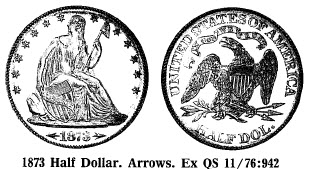
- With Arrows. [550] This mintage figure from Boosel. Some 500 of these were struck in the sets, the remainder presumably at some unknown date in the final quarter. Proofs have incomplete elbow drapery, centered date, shield point minutely r. of upright, left base of 1 almost central, triple stripes obv. and long arrows in addition to open 3's (Beistle 5-A) , rev. same as No Arrows coins. Short arrows are found on a minority of nonproofs, quadruple stripes on a single obverse die (a shift) of very great rarity, also only known as nonproofs. Same comment as to dimes and quarters with arrows.
Silver Dollar. [600] Closed 3 only. *B-1. Date about centered. Scattered rust marks on breast and neck. Rev. of 1872 B-1. Popular as final year of issue. Many of these were doubtless among the 2,258 silver dollars sent July 10, 1873 to the Melter & Refiner (together with some $2,220 in trimes, half dimes and miscellaneous now obsolete silver coins).
Trade Dollar. [865] This mintage figure from Boosel. Documents available to R. W. Julian show 40 regular trade dollars July 14 as the initial mintage, 100 proofs - initial proof mintage - on July 21, followed by 500 more on the dates named for the dimes with arrows, in the 500 sets of second type. Total 600 proofs; the extra 265 appear to have been made at some unknown dates, 200 of them between July 1 and September 30, 65 between October 1 and December 31, the 65 remaining on hand in the custody of the Superintendent, December 31,1873. (R. W. Julian says 790 in his own study; I quote from Boosel's monograph "1873-1873," 1960, p. 40). Probably most of the extra 200 were made for presentation or publicity purposes - or for sale to souvenir-hunters.
Silver-minor proof sets. First Issue: Cent, 2¢, 3¢ nickel, 5¢ nickel, trime, half dime, silver coins without arrows, standard silver dollar. [600] On January 18 and February 18, 100 sets were made, then 200 each on February 28 and March 12. A considerable quantity of these appear to have been melted July 10, 1873 as unsold. Several original sets survive together with a somewhat larger number that appear to have been assembled. Cf. Charles G. Dodd exhibit, ANS 1914, p. 69. Many of the original 600 sets were broken up owing to date collector demands for the 2¢ piece and trime. Several copper and a few aluminum sets made.
-Second Issue: Cent, 3¢ nickel, 5¢ nickel, dime, quarter and half dollar with arrows at date, trade dollar. [500+] Mintage dates as given above under dimes with arrows. Most surviving groups of this sort appear to have been assembled. The coins in the Smithsonian were obtained from the Coiner as follows: $2.25 for two proof trade dollars, July 17, 1873; 94¢ to Coiner September 12 for a set of the three silver coins with arrows (face 85¢). Note that the proof trades were obtained a week before they had been officially delivered. Cf. Charles G. Dodd exhibit, ANS 1914, p. 70.
Double sets, comprising first and second issue as above, with a single extraordinary exception, appear to be assembled in recent years. The exception is a cased double set consisting of two coins of each denomination together with two each of the arrows coins and the trade dollar, presented from the Mint to Charles A. Whitney,September 30, 1874. This is in a buckram case lined as usual with purple velvet, inscribed with the recipient's name on top as on former sets. The accompanying document, describing the coins -20 denominations and types in all, two of each to show obverse and reverse - is dated as above and signed by eight officials of the Philadelphia Mint:
O. C. Bosbyshell, Assistant Coiner; N. B. Boyd, Assistant Melter & Refiner; Jacob B(ausch) Eckfeldt, Assistant Assayer; James Pollock, Superintendent; A. Loudon Snowden, Coiner; James C. Booth, Melter & Refiner; and William Barber, Engraver. There is no doubt of the genuineness of the document as the signatures identically match those on Archives documents. The silver dollar, half dime, trime and 2¢ (closed 3) coins are marked on the document as being "one of the last struck". This cased set appeared, without intervening pedigree, as lot 2968, Schulman-Kreisberg auction, April 1959, reportedly bringing $7750. Present whereabouts unknown.
Gold Dollar. [25] Closed 3 only. Only the one pair of dies used on proofs (February 18). Feather incomplete below (A)T. Date about centered, its base (but not its top) seemingly sloping slightly up to r. Wreath tops apart. Real proofs have full mirrorlike fields, excellent definition on relief areas, typical proof borders, rims and edges, etc. There are deceptive early strikes (1800 minted, July 28) with closed 3 - and with open 3, some of them being occasionally offered as proofs. Some 1873 closed 3 proofs have been offered as "1878" - a situation also true with the 3¢ and 5¢ nickel, though the 1878's all have larger dates. (The same pair of closed 3 dies appears also on the copper and aluminum proofs.) Probably under 18 survivors, some impaired. Lint marks are usual.
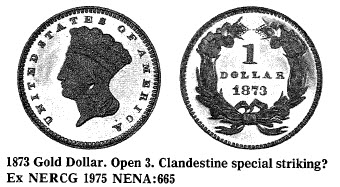
On the other hand, the open 3 coin here illustrated has the striking quality of a proof, and may be a clandestine special striking of later date. NERCG 1975 NENA: 665. It is quite extraordinary: note the drastically repolished dies.