Walter Breen's Encyclopedia of United States and Colonial Proof Coins 1722-1989
Walter Breen
B-2. Shield point slightly r. of left upright, left base of lover left edge or minutely right. Rev: Many field striae, some slanting up to r.; many die file marks along left edge of leg at (observer's) right. Hirt:1191, others.
There are many deceptive first strikes around, some of them enough even "to deceive the elect," and certainly enough to make 1876 seem less rare than it actually is. Real proofs will have reasonably broad rims, all feathers on eagle's breast clear, drapery and hair clear, and mirror-like fields without frost. As many have been cleaned, surfaces may not be too reliable a guide by themselves.
Quarter. [1410] At least some of these are from a curious reverse die with southeast-pointing dash in field just down from berry above Q. (ANS and others.) First quarter, 630 struck, second quarter 780, usual delivery figures of 1150 as in dimes. The year began with 120 leftovers from 1875 and ended with 380 on hand for the beginning of 1877. Many examples have been drastically cleaned; many first strikes exist.
Half Dollar. [1520] There are two reverse hubs, one called Type I as it is the hub used 1866-77, characterized by a split lower berry (or "opened bud") on branch (above H), the other Type II (1876-91), on which the berry is narrow and painted (sometimes called "closed bud"). Half dollars were certainly made in proof for 1876 with Type I reverse, and they may have been made with Type II, but I have not seen any. Type I proofs: low date, separate arrowheads, defect in 2nd red stripe, line slants down in 7th white stripe.
The 1520 proofs were made to the amount of 580 in the first quarter, 940 in the second only. Usual delivery figures of 1150 as for dimes. The year began with 50 leftovers from 1875 and ended with 420 leftovers (mixed dates?) at the beginning of 1877. Many examples have been poorly cleaned; many prooflike first strikes exist, some of them quite deceptive, but they uniformly lack the striking quality of proofs.
Trade Dollar. [1150 reported] Type 1. Berry under claw. Exceedingly rare. (1) 1975 GENA II: 1272. (2) Anomaly from the John Zug estate; obv. perfect proof, rev. uncirculated and frosty but with the striking qualities, borders and rims of a proof. It may have been made in error using a wrong reverse.
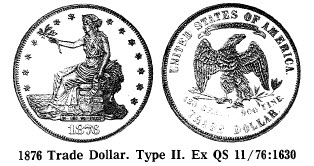
-Type II. Without berry under claw. Most regular proofs seen to date of the 1876 Trade are of this type. I have not seen the copper or aluminum proofs, Judd 1476-77, AW 1480-81, but surmise that they too would be of this type. Certainly the pattern trade dollar showing motto in cartouche above date and no stars, with reverse of regular issue, Judd 1474-75, AW 1492-93, has a Type II reverse. Minor positional varieties probable.
Silver-minor sets. It would appear that the mint report of 1150 sets includes a quantity delivered in 1876 but dated 1875. The true number made is likely to be in the neighborhood of 900 to 1000 dated 1876 with some extras of all silver denominations. If so: then the monthly reports of mintage of trade dollar proofs for this and preceding years cannot be trusted, as they apparently refer to the proofs delivered with sets. (Ex 1887 Director's report, quoted in Willem, 2nd edition.) The silver coins of 1876 in proof are certainly more often seen than those of 1875, but they are less than twice as common. I have seen quite a number of silver-minor sets, some of them probably assembled to judge from the variable quality of the coins. The larger number of sets for this year can be ascribed to the Independence Centennial celebration even as with the gold proofs, below. Some were sold in cases with the official Centennial "dollar". Kern:2022.
Gold Dollar. [45] *B-1. No rust pit on neck; some extra outlines on UNI MERICA; die file mark through base of A towards M. Date slants very slightly down to r. These dies used on proofs in gold (20, Feb. 19; 25, June 13), copper and aluminum. Probably two dozen survivors, some impounded, others dulled, badly cleaned, or impaired.
Quarter Eagle. [45] *B-1. No bar on neck. Left base of lover r. edge of dentil. Date placed far to right and slanting up with respect to device, the 6 close to r. corner of truncation. Sometimes shows very faint traces of doubling on STATES OF. About as rare as the gold dollar. (1) Smithsonian. (2) ANS. (3) Eliasberg. (4) T. L. Gaskill -NN 48: 329. (5) Grant Pierce: 1203 at $700, ex Atwater. (6) Wolfson: 214, also at $700. (7) Davis-Graves: 727, irregularly toned. (8) Scanlon: 2114. (9) "Quality Sales" 9/73. (10) Melish: 1286, J. W. Some have been playing Musical Chairs for fifteen or more years. There are also some buffed coins around which have deceived more people than they should have. Business strikes (B-2) have horizontal bar on neck (foreign matter adhering to hub when die was sunk), left base of 1 over center dentil.
*Three Dollars. [45] The earlier issue, 20 specimens struck on Feb. 19, shows perfect dies; the 25 made on June 13 have slight traces of die rust in feathers. Only the one variety seen (Harry Bass says there is another): obv. with two short parallel lines slanting down into lower part of left upright of I in LIBERTY, and a small curved line on neck paralleling second or lowest protruding curl (counting that below ear as first). Rev.: Date heavy and about centered, large knob logotype as on cents. Some 25 to 30 survive, but at least 7 or 8 are impaired. (1) Melish's, (2) NN 51, (3) Miles:295 - E. Yale Clarke:23, $14,000 (scratched before neck, chip left of 3), (4) "Memorable" (badly cleaned), (5) Golden I: 2435, (6) Golden II: 1921, (7) Baldenhofer: 1180, (8) SI ex Mint, (9) ANS, (10) Eliasberg, (11) Roach, Amon Carter Sr. & Jr., (12) Norweb, (13) "Boss" Pendergast, B. Max Mehl, LM 9/67:401,9/70:470, 6/72:421, three minute rev. marks above R, (14) Woifson:304, $7,000, (15) Bell II: 486, $8,100, (16) Grant Pierce: 1263, $7,750, Jay:288, Ullmer:422, $21,000, (17) LM 10/66:324, a beauty. One of these is in the Mocatta Metals reference collection, possibly (16). There are at least two others offered as parts of "complete" (no 1870 S) collections of threes, and still others probably survive. The coin is actually very rare in gem state, but it comes up more frequently than others of equal objective rarity.
No rumor of restrikes.
Half Eagle. [45] Similar date. *B-1. Low date, left base of lover left edge, lump on neck just below jaw, vertically above 1. (Business strikes, B-2, have lump on cheek, vertically below pupil, on level with earlobe; left base of 1 above space.) Much rarer than the lower denomination gold proofs. Very few records. (1) SI ex Mint. (2) ANS. (3) Amon Carter Sr. & Jr. (4) Boyd, WGC:430, possibly ex Parmelee, Woodin, Newcomer. (5) "Memorable" :375. (6) Menjou: 1521. (7) Amon Carter Sr. & Jr., possibly ex Atwater: 1697 and/or Dr. Green:304. (8) Dr. Clifford Smith: 1743, impaired. Probably fewer than 14 survive in all. At least two extremely deceptive B-2 prooflike business strikes survive: Straus:1443 (S 5/59), Bell II:736, unless they are the same coin. Gilt copper proofs are possible.