Walter Breen's Encyclopedia of United States and Colonial Proof Coins 1722-1989
Walter Breen
Regular design, bronze, transitional issue. [100+] Several hundred struck late in the year on order of Mint Director Pollock, for the Secretary of Treasury (Salmon P. Chase; letter of Dec. 8, 1863, cited in Judd, p. 70) and interested parties in Treasury, Senate, and House of Representatives. These were to give the lawmakers some idea of the appearance of Pollock's proposed "French bronze" alloy (adopted 1864-1942, 1946-62). Pollock's motives for proposing to replace the thick 72-grain nickel cent by the thin 48-grain bronze cent were threefold. (1) Joseph Wharton's original nickel monopoly - which had given the country nickel-alloy coinages since 1857 - had always kept the price to the mint very high; but now that Wharton's domestic sources were running out, and European sources were charging still higher rates in gold, cent coinage must stop unless some alternative could be found. (2) Bronze was far more malleable, easier to work, than the adopted nickel alloy. All nickel alloys so far tested had proved very destructive to dies, as well as very difficult to work (to make homogeneous ingots and strip for cutting blanks); the strip itself was hard enough to damage cutting presses. (3) As though to add insult to injury, private parties in many cities had begun making and Circulating small copper tokens (the well-known Civil War tokens) of about the same size and weight as Pollock's proposed cent, often with evasive inscriptions such as NOT ONE CENT, without the issuer's name or address, and with no intention of redeeming the things in greenbacks, let alone lawful coins. Millions had gone into circulation and stayed there, while the mint's own copper-nickel cents were hoarded rather than spent, providing no relief whatever to the coin shortage. Pollock thought the 1863 equivalent of "If you can't beat 'em, join 'em!" and proposed issue of bronze cents of the same size and weight, at once driving the Civil War tokens out of circulation and providing metallic currency to replace the "copperheads." His proposal was signed into law April 22, 1864.
The bronze proof cents of 1863, then, are true transitional coins. Dies are normally aligned or 1800 from normal. Standard weight 48 grains = 3.11 grams. They are from regular dies but apparently not the same ones used on regular proof copper-nickel cents.
Pure copper cents also exist with the ordinary die alignment; weights vary: 63.3 grains (1974 GENE: 1249), 65.6 grains ("Gilhousen":1498), 73.3 grains (1971 ANA:303), 76.7 grains (LM 10/72:937).
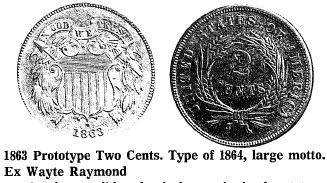
Another candidate for the honored role of prototype is the 1863 Two Cents of the identical large motto design adopted in 1864 (Judd 316, Adams-Woodin 416). These are very rare; cf. "Century": 1713. However, as they have the missing top serif on D of UNITED as on 1866-70 coins, they may date to that period rather than 1863.
Trime. [460] Normal date, thin numerals, no recutting on 3, no trace of overdate. Closed top to D of UNITED. Star point above r. curves of 8. Later, rev. clash marks. Still later, obv. bulge (die failure) between northeast part of star and TES OF; this develops, on the latest examples most of the upper field is involved as well as the star point. In the meantime, a rev. bulge has developed r. of C. ANS's coin has perfect dies, but specimens with some trace of obv. bulge are less rare. This reverse is not the same as the 1862. Under date collector pressure as business strikes are very rare.
Restrikes exist, in at least two varieties. One of these shows date logotype heavily double-punched over a lighter 1862, and open top to D; rev. is that of 1864. See Restrikes and Fantasy Pieces below.
Half Dime. [460] V-1. Bases of 18 strongly double. Closed top to D. Ribbon ends touch above. This die was also used on the rare business strikes. Under date collector pressure, like the trime.
Restrikes have date low, not repunched, polish in drapery near pole arm, shield, etc., with open top to D; rev. of some 1870 proofs and 1870-71 patterns. They come in various metals. See Restrikes and Fantasy Pieces, below.
Dime. [460] Triangle of final A filled, pendant slightly r. of center of top of 6, left base of 1 above space. Rev. Left ribbon and barely free. Other varieties may exist. Under date collector pressure.
Quarter. [460] Date high, slants up. Shield point r. of r. upright, left base of 1 r. of left edge. Rev. Two arrows joined.
- Same obv. Rev. Lowest arrowhead touches middle shaft only; E of UNITED filled; faint die file marks above NITE and RIC; line from rim to left top of last S.
- Date very slightly above center, slants minutely up. Shield point above r. upright, left base of 1 over space. Rev. Arrows free of shafts; line from rim down to left top of first T of STATES. Which variety is scarcest? All are under date collector pressure.
Those with IN GOD WE TRUST (silver, copper, aluminum) are very rare, not over five reported (I have seen three including Judd - "Ill. Hist.":271). They may have been made in 1867 or 1868 to go with the halves and dollars, which see.
Half Dollar. [460] Three varieties, like the quarter; which is scarcest?
- Not in Beistle. Centered date, closed 6 (knob touches loop), shield point above r. tip of foot of 1, left base of 1 left of center, rev. of 1862 proofs.
- Beistle I-A. Date above center of exergual space, closed 6, shield point over r. edge of upright, left base of 1 r. of left edge. Rev. Two arrowheads touch shafts. 1975 GENA: 1594-5; Garrett set.
- B.2-A. Date below center, open 6 (knob free of loop), this obv. apparently the die (re?)-used on GOD OUR TRUST patterns and those next described; no data about reverse.