Walter Breen's Encyclopedia of United States and Colonial Proof Coins 1722-1989
Walter Breen
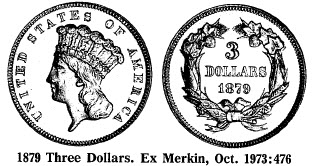
Three Dollars. [30] Obv. same as 1877-78 proofs, always with varying stages of rust pits on neck and cheek. The 20 coined on January 25 (e.g. Smithsonian, Lester Merkin, October 1966) are from an early state with not all the rust marks earlier described; the 10 of November 22 show them all. Very rare, occasionally imitated by deceptive first strikes. As uncirculated threes of 1879 are very rare, this problem has been perhaps a little less acute than it might have been. Survivors number probably 15 to 18 including several impaired pieces such as that in Lester Merkin's November 1965 sale.
Auction records are not frequent. Landau: 726, really choice, went to J. F. Lindsay. Baldenhofer's reappeared as Grant Pierce: 1266. Jay: 290 brought $1,400 (1967), Ullmer: 424 went at $6,000.
*Four Dollars or Stella. Not properly part ofthe proof sets of the year, and despite the comparatively large mintage of the 1879 Flowing Hair type properly a pattern (Judd: 1635, AW: 1575), this unique denomination is mentioned here because often collected with regular issues, because extremely famous and certain to attract plenty of public interest in an exhibit, because one of the most sought after of U.S. coins. It is one of the international coinage proposals that almost got through. The Hon. John Adam Kasson, formerly Chairman of the House Committee on Coinage, Weights and Measures, but in 1879 U.S. Minister to Austria, already remembered by the mint people because he had helped overcome Congressional opposition to the 1864 bill authorizing the bronze cent, at the beginning of 1879 sent a dispatch to the Secretary of State, John Sherman, recommending mintage of a $4 gold piece. His motive was convenience in international trade, as this coin would be within a few cents of the values of the Austrian 8 Florins, French 20 Francs, Italian 20 Lire, Spanish 20 Pesetas, and Dutch 8 Florins. The Committee on Coinage, Weights and Measures favored the proposal. Perhaps unfortunately, it in some way became tied up with the "metric" gold alloy proposed by one of the Mint's perennial eccentric hangers-on, Dr. Wheeler W. Hubbell. This called for 60 parts gold, 3 parts silver, 7 parts copper per 70 parts total composition -amounting to 5% debasement (offset by overweight) in the vain hope of stabilizing the world market ratio between gold and silver (something no coinage whatever could do, as it depends wholly on the available supplies of those metals and market manipulations thereof). The proposal might have become law had it not been conjoined to the Hubbell alloy.
*Flowing hair. By C. E. Barber. Rev. Large star. Originals, 15 to 18 struck, weight about 7 grams or 108 grains; no striations or file marks in central obv. Very rare.
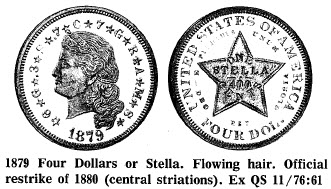
-"Restrikes, made in 1880 pursuant to joint resolution of Congress, said by Adams to number 400; byR. E. Preston of the Bureau of the Mint (April 30, 1895) "'about 500" in a memorandum accompanying Dunham: 2062; or by W. Elliott Woodward in various catalogues in the 1880's, 600. Identifiable by striations or something looking like file marks in centers, central curls weaker than on originals. Weights vary, 103 to 109 grains (6.67 to 7.06 grams), but the striations -which are constant on 1880 stellas - are decisive. Cf. Breen I: 134 at $17,000 on a $19,000 limit. Lightweight coins are much rarer than standard weight restrikes, which latter are usually offered as originals!
Many survivors are impaired, some by drastic cleaning, others by nicks or scratches, or even honest wear - being carried as pocket pieces. Several dozen have been seen with traces of solder on edges from removal of loops. These ex-jewelry items (e.g. Stack's 5/1974: 434, to mention only the most recent offering) were reported at the time, (during the 1880's) to be adorning the persons of Washington, D.C. madams who received them from congressional visitors to their bordellos. Choice proofs are now rather infrequently seen.
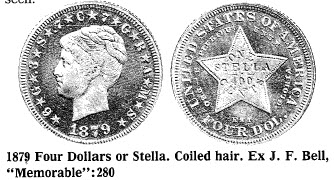
*Coiled hair. Attributed to Morgan, same star reverse by Barber (?). Judd: 1638, AW: 1578. About 10 struck, possibly a few restrikes from some dies. (1) Mint, S1. (2) Lilly, S1. (3) Eliasberg. (4) Part of complete stella set, Texas coll. ex Dr. Wilkison. (5) Part of another complete set, ex Neil: 2603, Grant Pierce, 1976 ANA:2920. (6) Kern:243, Amon Carter Sr. & Jr. (7) "Rio Rancho":I33, $105,000, said to have striations as in 1880. (8) Garrett, Johns Hopkins Univ. (9) Armand Champa:521. (10) QS 9/73:1154.
Half Eagle. [30] *B-4. Polish around ERT, eye, just below ear, and on scroll at WE ST. Traces of recutting atop 9. Exceedingly rare, seldom offered. Wolfson:522 was impaired, like several others seen. No auction records for unimpaired ones recent enough to give a fair idea of value; Ullmer:455 at $3,900 was hairlined, possibly ex Melish:2160, Garland Stephens. Survivors probably number less than a dozen, possibly less than nine.
Eagle. [30] *B-7. Date low, to left; "floating" curls behind neck. Exceedingly rare, seldom offered. Survivors number about 10.
Double Eagle. [30] Date begins about equidistant between bust and border; placed to right. Exceedingly rare, like the $5 and $10. (1) Smithsonian. (2) ANS. (3) Eliasberg. (4) Wolfson: 923. (5) Amon Carter, Jr. (6) "Memorable": 699 ex WGC: 882. Probably not more than 10 survivors.