Walter Breen's Encyclopedia of United States and Colonial Proof Coins 1722-1989
Walter Breen
What I assume to be restrikes are the coins with prominent rust marks on OL (a little above center of r. curves of 0 and near top of upright of L); lower wreath flat, lowest of three maple leaves at left flat; extra outlines not only on large 3 (outer curves) but also at r. ribbons and much of r. wreath. (1) Eliasberg. (2) Wolfson:303(?). (3) Rinaldi, "Delta" coll., Miles:294, R.P., Dr. E. Yale Clarke:22, $120,000. (?) I have not had the opportunity to examine the Kern -1951 ANA, or Dr. Emmons, or Atwater - Amon Carter examples. As most of these are choice proofs, half tone cuts inauction catalogues do not enable them to be distinguished either for pedigree or for checking die variety and/or original status.
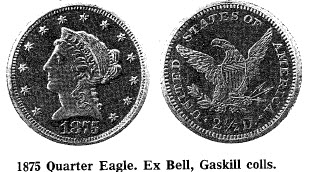
Half Eagle. [20] Feb. 13, 1875, like the other gold denominations. *B-1. Low date, left base of 1 slightly r. of center. Extremely rare, but more proofs survive than nonproofs, so that date collector pressure is very great on the rare occasions when one is offered in any quality. (1) Mint, S1. (2) Mint, Brock, Morgan, ANS. (3) Ely, Garrett: 454, opened at $65,000, bid up to $81,000. (4) H. P. Smith set, Dunham:2153, possibly source of one or more to follow. (5) Newcomer, Boyd, WGC:680, possibly from Parmelee, Woodin. (6) Clapp, Eliasberg. (7) Menjou: 1520. This and following possibly same as no. 4 or 5. (8) Amon Carter Sr. & Jr. (9) Wolfson:511, EF, ex-Proof? Date appears possibly minutely lower, but the halftone cut is not clear enough for certainty.
Beware gilt copper or aluminum impressions (Judd 1441-2, AW 1409-10). Standard weight of gold, 129 grains = 8.359 grams.
Eagle. [20] *B-1. Low date slanting very slightly down to r., left base of lover left edge. Rev. Top of second stripe weak. Equally rare with the half eagle, and the same comments apply. Standard weight 258 grains = 16.718 grams. (1) Mint, S1. (2) Mint, Brock, Morgan, ANS. (3) Ely, Garrett: 453, $91,000,. (4) H. P. Smith set, Dunham :2245, possibly source of one to follow. (5) Boyd, WGC, "Memorable" :573, possibly ex Parmelee, Woodin. (6) Clapp, Eliasberg. (7) Amon Carter Sr. & Jr., possibly same as no. 4 or 5. On business strikes date is much farther to right, stripes normal.
Double Eagle. [20] Date to left, close to border, top of 1 almost equally close to bust; left base of 1 over space. Rev. Middle arrow shaftless. Not under as much date pressure. At least one of the copper strikings from these dies is gilt. Standard weight 516 grains = 33.436 grams. Exceedingly rare. (1) S1. (2) ANS. (3) Ely, Garrett: 452, $22,000. (4) H. P. Smith set, Dunham:2317, possibly source of one to follow. (5) Boyd, WGC:696, "Memorable":696, possibly ex Parmelee, Woodin. (6) Clapp, Eliasberg. (7) Amon Carter Sr. & Jr., same as no4 or 5?
Gold proof sets. [20] Feb. 13, 1875. H. P. Smith's was broken up at the Dunham sale, 1941; Ely's, to Garrett, was dispersed and brought $320,000.
Complete proof sets. One was adjoined to a silver-minor set and delivered from the Coiner to the Curator of the Mint Cabinet as of Jan. 30 (!) for $49.84 currency (face $43.44). Another complete set, cent to double eagle, was sold from the mint in 1875 to R. C. W. Brock, thence to J. P. Morgan and ANS. Parmelee's was also broken up, but it lacked the double eagle.
1876
Cent. [1150+] Small knob to 6. Polish around eye at base of top feather, top of ribbon. Rev.: Normal, open E's. Much like the 1875 though less brilliant. No recut dates noticed.
Three Cents. [1150+] Two varieties. First Die: low date, left base of lover r. edge, extra outlines on most of legend.
Second Die. Centered date, left base of lover left part of dentil, extra outlines on U and final A, rust pit on left part of O. Much like the 1875 and often on the same kind of imperfect or granular planchets. Sometimes not too well struck up. Hirt: 1077, others.
Five Cents. [1150+] Usually, normal date, left arrow butt slightly attenuated.
-Double date, first cut to right; crack, left base of l leftwards to border. This is scarcer. "Gilhousen": 79; 1975 ANA: 128.
The majority of specimens are somewhat dull; very much like 1875 in physical qualities, and the same comments apply here as there.
Minor proof sets. As in 1874, almost all long since broken up.
Dimes. [1250] Type I reverse only: wreath almost touches E in ONE as on other dimes 1860-76. (Only copper proofs reported of Type II reverse, standard 1877-91, with E in ONE distant from wreath; LM 9/67:533.) B-1: large knob to 6 - ANS and some others. B-2: small knob to 6, not much thicker than curve of top of 6 leading into the knob. This one is much rarer. Which type came first might be determined by examining the coin in the Smithsonian set. There were 750 proof dimes struck during the first quarter, 500 more during the second quarter, none later, total 1250. Source of the usually quoted figure 1150: 450 sets delivered first quarter, 400 second quarter, 200 third, 100 fourth. There were 300 dimes of 1875 on hand at the beginning of 1876, and accordingly 400 dimes - whether 1875's, 76's or mixed dates I do not know -on hand at the beginning of 1877. Many of the survivors have been cleaned.
Twenty Cents. [1260] Two pairs of dies made for business strikes for this year; one of them -that without doubling on wings and ITED STAT – may have been also used on proofs. The report of 1150 proofs delivered comes from the same source as for the other silver coins, cited under the dimes. There were actually 590 proofs of 1875 on hand at the beginning of 1876, 360 struck in the first quarter and 900 in the second, 700 delivered in the first quarter and 700 in the fourth; 360 + 900 = 1260 struck, plus the 590 on hand January 1, 1876 making 1850, less 1400 delivered during the year, leaves 450 on hand January 1, 1877 - possibly mostly 1876's, probably mixed dates.
B-1. Shield point over left upright of 1, left base of 1 r. of center. Rev.: Scattered striae. Hollow places in wings where they join body. Hirt:1190, others.
B-2. Shield point slightly r. of left upright, left base of lover left edge or minutely right. Rev: Many field striae, some slanting up to r.; many die file marks along left edge of leg at (observer's) right. Hirt:1191, others.