Walter Breen's Encyclopedia of United States and Colonial Proof Coins 1722-1989
Walter Breen
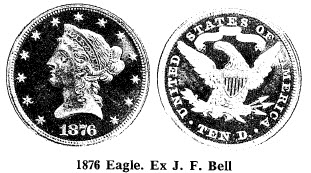
Eagle. [45] *B-1. Date very low, heavy; left base of 1 slightly r. of center of dentil; the 1 a little nearer border than the 6; rust pits on neck near jaw. Rev. Second red stripe thin at top, last white stripe filled. Survivors -proofs and ex-proofs -number 15 to 20, probably nearer the former; business strikes (B-2) are fewer still, resulting in extreme date collector pressure. They have no obv. rust pits; left base of 1 almost over r. edge; die file marks below LIB and through ERTY. (1) Mint, SI. (2) Brock, Morgan, ANS. (3) Clapp, Eliasberg. (4) Davis-Graves:956. (5) Melish:2465. (6) Breen 1:242, nicked on jaw and field. No distinction in die state noted between earlier and later proofs. Gilt copper proofs may exist.
Double Eagle. [45] Exceedingly rare, probably under ten survivors. (1) Mint, SI. (2) Brock, Morgan, ANS. (3) Amon Carter Jr. (4) Boyd, WGC:879. (5) J. F. Bell, "Memorable": 697. (6) "Alto" :438, slight field rub. (7) Ullmer: 524, "gem," $45,000. Gilt copper proofs may exist; gold ones weigh 516 grains =33.436 grams.
-First Transitional. Repositioned head as in 1877, coronet markedly divides first 6 from last 7 stars; date low, left base of 1 about over left edge, 6 away from border; regular reverse with TWENTY D. In gold, apparently unique, obv. proof, rev. unc., Judd 1488, AW 1464. Discovered in 1909 by J. W. Haseltine, either among Idler's coins or as part of the A. L. Snowden transaction; via S. K. Nagy to Woodin at $1,000, mentioned in the Adams Official Premium List and the June 1909 Numismatist; later to Newcomer, Boyd, Farouk:293, Spink's. Copper specimens exist and may come gilt.
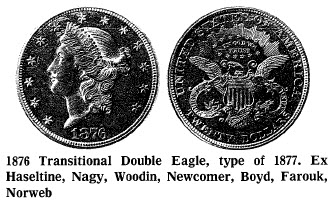
-*Second Transitional. Repositioned head, as last but date farther left, 1 and 6 close to border, left base of 1 over r. edge ; LIBERTY slightly farther from coronet beads; rev. of 1877, TWENTY DOLLARS. Discovered in 1909 by Haseltine in same group as preceding; via S. K. Nagy to Woodin at $1,000; later Newcomer, Boyd, Farouk:292, New Netherlands, Dr. Wilkison, Paramount, A-Mark. Copper proofs exist and may come gilt.
It is possible that either of the above may exist mistaken for regular 1876's.
Gold proof sets. [45] Some 20 sets delivered February 19, 25 more on June 13. Some of these, presumably the later delivery in particular, appear to have been in some way connected with the Independence Centennial celebration in Philadelphia during the summer of 1876. In the Parmelee sale of 1890, lot 1401 was the gold set, six pieces, with the comment "sharp, perfect proofs - many inquiries having been made for this centennial gold set, we therefore offer it entire." It brought $61, the corresponding prices for other gold proof sets from 1870 on being respectively $37.35, $41, $36.60, $38.65 (the 1873's already being recognized as rare), $35, and $77.60 for an 1875 set lacking the double eagle - the $3 being labeled "exceedingly rare" and realizing $51.
Complete proof sets. A complete set is in ANS, ex Brock, Morgan, and another in the Smithsonian, but no record of date of acquisition is in existence. Another complete set, shown as three sets - gold, silver and minor -though presumably obtained as one, was in the Charles G. Dodd exhibit in ANS 1914, page 70. It is not known if any of these sets still remain intact. Date collector pressure on the three-dollar piece and the eagle and half eagle may well have forced breakup.
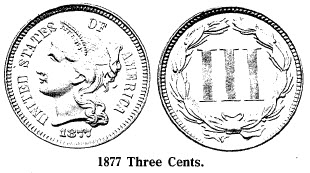
*Three Cents. [510+] Borders often weak, rounded; planchets often granular and sometimes even porous. Many of the survivors have been dipped or scrubbed to remove streaks or spots. As many of the streaks and spots on nickel coins are inclusions in the original ingot from which the strip was rolled and the planchets cut, removal is sometimes impossible and the attempts leave very unsightly results. (If a spot will not yield either to alkali or hydrochloric acid, leave it alone; any stronger agents will corrode the alloy in nickel coins.) Numerous verified auction records in the $575 to $750 range, some higher reports. This can be ascribed largely to date collector pressure.
*Five Cents. [510+] Only the one variety. Date too far r. Borders on most are narrow, often no plain rim showing outside beads. Edges often partly rounded. Some were carelessly made, only one blow from the press, or on imperfectly polished blanks, leading to attempts to sell these as "hitherto unknown business strikes." Many are poorly cleaned. Not as rare as commonly supposed, but under continuous date collector pressure, affecting the minority of perfect specimens most of all. There are a few circulated ones, probably the result of some child's grubby hands on his father's proof set. Mid 1960's auction records in the $850 - $1000 range, seldom bettered even now, with higher retail quotations.
Minor proof sets. Cent, 3¢ and 5¢. Quantity unknown, survivors, extremely rare, most long since broken up for collectors of the individual denominations. If the "discrepancy of some 962 nickel blanks" (R. W. Julian in NSM 3/66) means proofs, the true figure may be something like 962 - 510 (for silver sets) = 442.
Dime. [490] B-3. Type II rev. only - E of ONE far from wreath. Proofs examined to date show repunching on ME of DIME, a single working die being used, but other may exist from different dies. No rumor of a Type I rev. proof. Grossly undervalued. All 490 coined in the first quarter. The usual figure of 510 (silver sets) comes from the following transactions. As of Jan. 1, some 400 dimes were left on hand, presumably dated 1876, then the 490 proof dimes were struck, making 890 in all, of which 400 were delivered in sets as of March 31, and 110 more at year's end, total 510 silver sets. The remaining 380 dimes (mixed dates?) were left on hand at the beginning of 1878.