Walter Breen's Encyclopedia of United States and Colonial Proof Coins 1722-1989
Walter Breen
Half Eagle. [72] Date slants up to right; die file mark to left from base of B; left base of lover left edge; almost no polish in stripes. Very rare and seldom offered. Much rarerthan the lower denominations, rarer even than the quarter eagle, but unappreciated. Probably fewer than 20 survive in proof state, of which too many are impaired by nicks and scratches, doubtless due to the attentions of the aforementioned Medal Clerk. Ullmer:459 (obv. rim spots at 1 :30 and 3: 30) brought $3,000, which is low compared to other dates in the period; Garrett's slept at $2,900. I have not at this writing learned the prices of 1976 ANA:3003-4. Those of Melish:2206 (to N.N.), Dunham-Alto:259, Gaylord:354, Wolfson:542 (minute rim stain on either side), or KS 2/60 from the set, are too old to be relevant. I have the impression that the large mintages of business strikes of some of these dates have militated against collector - or speculator - interest in the tiny handful of surviving proofs.
Mintage: Quarterly, 32, 7, 12 and 21, of which 25 were for the sets in February; total 72.
Eagle. [60] Low date well to left, left base of 1 central. Rarest denomination of the year. (1) SI. (2) ANS. (3) Eliasberg. (4) Garrett:495, eyebrow rubbed, $5,000. (5) Amon Carter Sr. & Jr. (6) 1976 ANA:3112. (7) DiBello:1105, cleaned: (8) Ullmer: 498, obv. field rubbed, $4,750. (9) KS 2/60 set. (10) Melish:2514. The lasttwo are believed to be duplications of earlier listings. I believe that possibly 15 to 20 survive at most. Almost no private sale offerings in recent years.
Mintage: 25 with the sets in February, 2 in March, 6 in June, 7 in September, 20 before year's end, total 60.
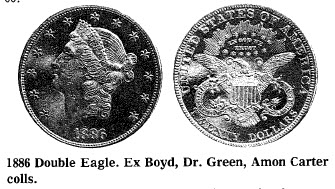
Double Eagle. [106] Extremely popular because only at Philadelphia were any double eagles made for this year; only 1,000 business strikes were coined and they are now rarer than the proofs. Low date, left base of 1 about over left edge. It is difficult to estimate the number of survivors. (1) SI. (2) ANS. (3) Eliasberg. (4) Garrett: 494, $29,000. (5) Dunham:2329, cloudy. (6) Norweb. (7) Atwater: 1278. (8) WGC: 888, Dr. Green:755, Amon Carter Sr. & Jr. (9) "Memorable": 706, possibly same as (5) or (7), not since traced. (10) Dr. Clifford Smith: 1969, possibly same as one of foregoing. (11) Amon Carter's duplicate. (12) Menjou:1825. (13) KS 2/60 from set. (14) KS 3/65:196. (15) KS 5/66:1800. (16) KS 4/67:923, gem. (17) Bell II:929, much impaired. (18) S 10/64. (19) S 6/73: 1200, $25,000. Some of the above are believed to be duplications.
There have been, by contrast, fewer offerings of business strikes, notably the unc. Dr. Bolt example, which might well some day be resold as a proof, and the impaired Walton coin.
Mintage: Quarterly, 31, 15, 15 and 45; 25 were for the Feb. sets. Total 106.
Gold proof sets. Some 25 were made in February, probably others later assembled. There might have been as many as 60 in all, no more. One 6-piece set, apparently original, appeared as KS 2/60:2975-2980; two others, of course, survive in the complete sets mentioned below. Garrett's, from the Mint Feb. 2, 1886, totalled $46,100.
Complete proof sets. Only two: Smithsonian, from Mint, from Coiner September 2 (!); ANS, from Mint, Brock, Morgan. Others may exist, but they have not been exhibited or traced.
1887
Cent. [2960] Variations are trivial. Often with oddly irregular concave areas in field and devices not perfectly struck up (carelessly made). Often toned to an odd assortment of pinks and greens, different from the 1884-5-6 group; did the mint again use a different supplier for its paper wrappers?
Three Cents. [2960] *1887/6. The earliest die state of this popular proof-only overdate is quite rare, showing plain impressions of both 8's and almost the entire 6 in addition to the final 887, respectively at bases of 8's and within them, occupying almost the entire space below arm of 7. I have seen very few of these. Dies clashed and were drastically repolished. The vast majority, struck after repolishing, show only part of left curve of 6 below arm of 7, sometimes only a small fragment, sometimes also with part of loop of 6, but always weak in this state. Probably 3/4, possibly as many as 4/5 of the extant proof 1887 3¢ nickels are from this obverse die, in its later states. Popularity as a naked-eye overdate in the proof series has given the 1887/6 a spurious claim to rarity and a not-sa-spurious group of auction records in the $260 to $335 range.
-Normal date, 7 considerably farther from curl, date low and level. Rev. Fragmented leaves at left. The die used also, apparently, on the very rare business strikes (5000 minted of those). Rare, seldom offered; not more than one out of four proof 1887's seen, possibly one out of five or six, is from this obverse, suggesting that it might have accounted for possibly the first 700 to 750 of the original proof mintage. Compare NN 51: 429, NN 53: 291. Some of the survivors are badly cleaned, some carelessly made, and some of the latter are simulated by early business strikes from dies retaining polish. No recent enough auction records to give a fair idea of value. The lower quotations reflect only relative unpopularity. Garrett's proof set, from the Mint Jan. 25, 1887, contained this variety.
Five Cents. [2960] Normal date, possibly more than one minute positional variety. ANS and others. Often dull, spotty, streaked or peculiarly mottled; still more often badly cleaned, possibly in an attempt to improve the appearance of coins that never were very brilliant. Sometimes seen with rounded rims. As a date, twice as rare as 1886 in terms of actual frequency of appearance, but brings about one third as much at auction. For this state of affairs we may credit the speculators, if we are collecting, or perhaps damn them if we have coins to sell.
- *Second 8 plainly recut. Very seldom seen; cf. that in LM 11/65:206. This is not an overdate, not a different logotype, and the explanation for recut second 8's in several years of this decade is still unknown.
- Base of 1 recut. Also. rare. Minor Proof Sets. [2960] I have in recent years seen several that are presumably original, the nickel pieces having the same sort of toning coming from the mint wrappers. Others seem to have been since broken up for date sequences or else to retrieve the overdate 3¢, and later reassembled into silver-minor sets. The image comes to mind of a crystal, say of rock candy, gradually growing in the solution which gave birth to it; some molecules dissolve back into the solution, others return to the crystal and sooner or later someone plucks the fully formed prism or rhombohedron out of the liquid and admires it, unknowing that hardly one percent of its weight then consists of the same molecules as a few days earlier. An assembled proof set may not have the historical value of an original set preserved from the Mint, but it makes just as impressive a display.