Walter Breen's Encyclopedia of United States and Colonial Proof Coins 1722-1989
Walter Breen
Quarter Eagle. [35] *B-1. High date, left base of 1 r. of left edge. Same comments as to the gold dollars. Ullmer:373 brought $4,750.
Three Dollars. [35] Only a single rev. die: low date, leaf left of it represented only by a fragment opposite upper half of 1, diagonal striae crisscrossing in field. At least some proofs have a different obv. die from that of 1869; others have apparently the identical obv. of 1869 and 1871. My own guess is that the 25 struck Feb. 3, 1870 have the repolished 1869 obv., the 10 made June 1 the different die - or vice versa? (1) SI. (2) ANS. (3) Eliasberg, obv. different from 1869. (4) Garrett: 437, $4250, planchet defect, obv. not checked. (5) Kern, Pierce: 1257, Jay:262. (6) Wolfson:296. (7) Ullmer:419, $8500, same as one of last two? (8) LM 11/65, impaired. (9) 1971 NY Metropolitan: 1347, impaired. Possibly 15 to 20 survive in all including several other impaired ones. The Newcomer-Boyd-Farouk copper striking has double outline behind head, leaf left of date intact but thin: LM 9/67:519, LM 9/74:229.
Half Eagle. [35] High date to left, slanting down, left base of 1 about over space. Rev. Neck feathers sometimes weak. Exceedingly rare. (1) SI. (2) ANS. (3) Garrett:436, $5000. (4) Amon Carter Sr. & r-. (5) Scanlon:2334, $4400, as "finest." The estimate of 12 to 15 survivors is very liberal.
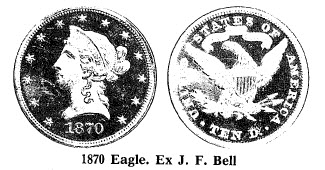
Eagle. [35] *B-1. Date very high, well to left, no recutting on 0; left base of 1 about over center. If anything, slightly rarer than the half eagle. (1) SI. (2) ANS. (3) Garrett: 435, cloudy, $9500. (4) Geiss:1896, Amon Carter Sr. & Jr. (5) Dr. Clifford Smith: 1859, DiBello: 1079, cleaned. (6) Wolfson: 700, Ullmer: 494, $9000. Possibly 10-12 exist?
Double Eagle. [35] Rather shallow date, to left; top of 1 close to bust, left base over space but favoring left edge. Rev. Middle arrow shaftless. About as rare as the eagle. (1) S1. (2) ANS. (3) Eliasberg. (4) Garrett:434, $11,000. (5) Atwater: 1262, Eliasberg, "H. R. Lee", NN 49:119, DiBello:1238, probably ex D. S. Wilson (1907). (6) Newcomer, Boyd, WGC:873, "Memorable": 692. (7) Menjou: 1808. (8) Wolfson: 896, probably one of last two.
Gold proof sets. [35] Feb. 3, 25 sets; June I, 10 more, probably from the same dies except for the $3 obverse. Garrett's, dispersed, totalled $36,850.
Complete proof sets. One of the 25 sets of Feb. 5 was joined with one of the early silver-minor sets and turned over to the Coiner for $53.55 in greenbacks to the Curator of the Mint Cabinet; now S1. Another - time of striking unknown -went to Brock, thence to Morgan and ANS. No rumor of others.
Cent. [960+] Two date logotypes, 7 1 apart or practically touching.
- 7 1 well apart. Thin letters, left base of first 1 slightly r. of left edge; r. base of last 1 just beyond r. edge, r. side of final 1 faintly recut. With or without faint line parallel border, left from arrow butt; heavy rev. letters. Garrett set.
- 71 almost touch. Left base of first 1 central, r. base of last 1 left of center. Which type is earlier, which rarer? Under continuous date collector pressure.
Two Cents. [960+] New hub: berry nearest left end of scroll elongated (not rounded as formerly), underside of left arrow butt straight; rev. less pronounced veins to leaves at left. At least two varieties. Doubling on r. arrows, motto at r. (especially TRUST), plainer on both dies than in 1872-3.
-71 about touch, date high, ball above 8 and only very tip of serif. Left base of first 1 over r. edge, r. base of last 1 left of center; faint scattered striae. NN 57:202, ANS, many others.
-71 touch, high date slanting down, left base of first 1 high and over r. edge, r. base of last 1 lower and over space, knob above r. half of 8 and serif. Garrett set, others.
Three Cents Nickel. [960+] 71 touch or about touch, date high, left base of first 1 just r. of left edge, r. base of lover r. edge; extra outlines on CA only; rev. long faint line slanting down to r. above center, r. ribbon end attenuated, second leaf above it only a tiny fragment. Other varieties possible including one with 7 1 apart. Often dull, on granular flans (especially near centers), and/or carelessly made. Under some date collector pressure, possibly because of the 1¢ and 5¢, partly because the business strike mintage is smaller than in neighboring years.
Five Cents Nickel. [960+] At least three varieties; others are possible, in particular one with 7 1 apart. Under inordinate date collector pressure, only because business strike mintage is lower than in neighboring years.
-First die. 71 nearly touch, date high to r., ball over 8 and space left and left third of 7; left base of first 1 just r. of left edge, r. base of final 1 minutely r. of center; unpolished areas at bases of white stripes, tops of red stripes incomplete at r. (especially first two). Rev. Extra outlines on all stars and many letters. Garrett set, others.
- Second die. 71 touch, date high to left, ball extendsfrom above center of top of 8 to over r. corner of 7; left base of first 1 and r. base of last 1 just left of r. edges; tops of stripes incomplete similar to preceding. "Gilhousen": 74, others. Which is rarer?
Third die. 71 about touch. Double date, placed well to r., first cut very slightly low, then corrected higher. Very rare.
Minor proof sets. As in 1870. None seen. Called "small money sets" by some dealers at the time.
Trime. [960] At least three obverses. May exist with 7 1 well apart.
- First die. 71 firmly touch. Star point above a point midway between r. curves of 8. ANS, others. - Second die. 71 barely apart, star point almost touches 8 about midway between r. curves. Garrett set, others.
- Third die. 71 barely apart, star point almost in line with r. edge of 8, well to r. of midway between r. curves. Many almost horizontal striae at lower left and r. obv. Which is rarest?
Half Dime. [960] V-I. 71 almost touch. Date begins about centrally, slants a little down; left base of first 1 and r. base of last 1 about over spaces between dentils; shield point above tip of serif, pendant approximately central over 7. Top of D open. Rev. Right ribbon end almost or quite touches wreath. Without and with various degrees of rust on seated figure. This is the variety generally seen.