Walter Breen's Encyclopedia of United States and Colonial Proof Coins 1722-1989
Walter Breen
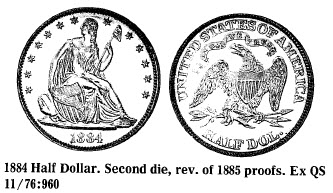
- Second die: recutting above left base of 1, which is above left edge; rev. of 1885 proofs, 1st white stripe polished, left end of scroll broken away. 1974 GENA: 1630, others. Which is rarer?
Identical comment as to quarters; the date collector pressure was stimulated by speculation during the late forties and early fifties - with the discovery that not very many could be assembled. This was to have been expected, as only 4400 business strikes were made, and most of the survivors are deceptive first strikes. They have base of 4 recut, left base of lover r. edge, hollow center punch on thigh. No polish in rev. stripes. Some have reverse "shift" on letters; e.g. "Gilhousen": 1090. In 1963 I saw a beautiful date set of uncirculated halves from 1879 through 1891, and three of them were sharp enough to make me wonder if they were not carelessly made proofs. Three such sets have sold since and the question is still open for some dates.
Mintage: First quarter 590, second 240, fourth 114, total 944, of which 875 went with the sets, leaving 69 to be melted.
Silver Dollar. [875] VAM 1. No peculiarities. None of the famous "dot" coins are known in proof state or even reliably reported. Many now around have been poorly cleaned. Same remarks otherwise as to 1883. Recently subjected to speculator pressure.
Mintage: First quarter 560, second 210, fourth 150, total 920, of which 875 went with the sets, leaving 45 to be melted.
*Trade Dollar. See Restrikes and Fantasy Pieces. Silver proof sets. [875] Some 510 of these were delivered in first quarter, 200 in second, 165 in fourth, total 875. These sets did not include the trade dollar. Most extant sets appear to have been assembled, though formerly many original sets were around. We can attribute their breakup to collector and speculator demand for the quarter and half dollar.
Gold Dollar. [1006] At least three of the five varieties come in proof state.
B-1. Normal date, no recutting, perfect dies. R-4.
B-3. Plain double outlines to letters though not to device; short line within polished area below ear. Rev. Low date. minute traces of recutting. R-5.
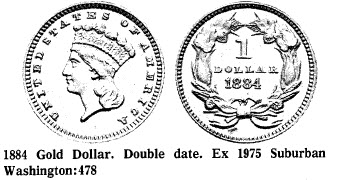
B-5. The Double Date. Obv. as B-3 but no die line below ear. Rev. Date first cut low, slanting sharply up to right, then partly effaced, repunched higher and level. Later examples show progressively less of the extra digits. The earliest die state, with all eight digits plain, is extremely rare. Eleven seen to date in all states, some impaired. Discovery coin: NN 51:813. 0.1974 GENA:1791; Garrett: 487, $1,150.
Many survivors of each variety are cleanedor impaired, some showing evidence of circulation (spent during the 1893 panic?). Some date collector pressure as only 5,230 regulars were made. Robert W. Julian has discovered one reason for the unusually large mintages of proof gold dollars 1884-89. It appears that a fad had developed about 1882-3 for use of small gold coins as jewelry (watch fobs, tie pins, cufflinks, etc.), and Mint Superintendent A. Loudon Snowden took advantage of it. Because "Silver Dick" Bland's act of Feb. 1878 required enormous coinages of Morgan dollars, fractional silver and low denomination gold coins were not being made in any quantity, and speculators were buying gold dollars for resale at a premium to jewelers and others. Snowden therefore recommended that would-be buyers purchase proof gold dollars at $1.25 apiece. Some applicants did so through local banks, mostly in blocks of 50 to 100. These facts account not only for the high mintages of proof gold dollars but also for the impaired condition of many dollars (proofs and business strikes) in this period.
Mintage: 30 in sets Jan. 19; 153 on Leap Year Day, 196 on June 28, 174 in late September (delivered Oct. 4), and 453 in December (delivered Jan. 10, 1885), total 1,006. No record of meltage, and under the circumstances it is unlikely that any were melted as unsold.
Quarter Eagle. [73] *B-1. Hollow at BER. Centered date, left base of 1 about over r. edge, r. base of 4 about over space. Very rare, probably fewer than 30 survivors. Subject to considerable date collector pressure as only 1,960 regulars were made and rather few survive. Speculators have found too few available for hoarding, though it has been tried. Auction records are really not too representative: Garrett: 486 (tiny flan chips) slept at $2,600; Ullmer:380 brought $3,750. Cf. also Holmes:3296, Golden II: 1842, Scanlon:2131 (imp.), QS 9/73: 1083.
The rare business strikes (B-2) have no hollow at B ER; r. base of 4 left of center; die file mark through MER, which fades.
Mintage: 30 in sets Jan. 19, 13 on Feb. 29, 9 on June 28, 4 in September (delivered in October), 17 in December (delivered Jan. 10, 1885), total 73.
Three Dollars. [106] "'B-1. Soft faint traces of extra outlines at RICA. Rev. Right edge of upright of 1 barely below tip of serif of L; 84 touch. Much rarer than this mintage would suggest, and subject to much date collector pressure as only a small percentage of the 1,000 business strikes remain. Some of the latter, e.g. the two in LM 11/65 and 10/66, are very deceptive. Probably less than 35 survive in proof or impaired proof state. Undervalued in comparison to 1881, 1883 and 1885, the latter three still more popular because of lower reported total mintages, but the 1884 may not remain a Cinderella. Possiblyall that will be necessary is a few offerings with trumpetings of "Excessively Rare!" Garrett: 485 made a good start at $6,500; it was one of the first 30 made (see Gold Sets below).
Mintage: 30 for sets Jan. 9, delivered Jan. 19; 42 on Feb. 29, 13 on June 28, 21 before Dec. 31 but delivered Jan. 10, 1885, total 106.