Silver Dollars & Trade Dollars of the United States - A Complete Encyclopedia
Q. David Bowers
"Approved: C.S. FAIRCHILD, Acting Secretary of the Treasury.
"Most of the dollars presented for redemption are held by banks for large business houses, and, as they were but a short time in circulation, are in very good condition. There is probably not more than one fourth of the original coinage of trade dollars still in this country; the remainder has been exported, principally to China."
The following is from Harper's Weekly, June 4, 1887:
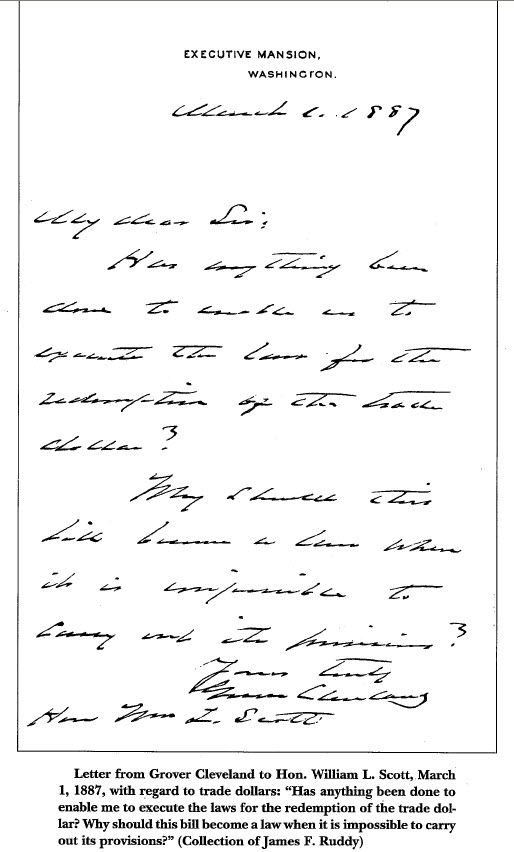
"The United States Sub-Treasury in Wall Street has been busy during the last two months with the redemption of those white-faced trade dollars which were so ignominiously dismissed from circulation several years ago. There were some seven million trade dollars in all, and by an act of the last Congress the New York Sub-Treasury was called upon to redeem the entire lot at one hundred cents apiece. The movement to redeem the trade dollars started in President Arthur's time. When the dollars were forced out of circulation by an interesting exercise of co-operative power on the part of the public, they passed into the hands of speculators, who bought them for eighty-five cents each, or less, and held them with a fine faith in what the future could be made to bring forth. At one time, under President Arthur, their speculative value ran up to ninety-five cents, and at another time, under President Cleveland, it ran down to seventy-seven cents. Their final redemption at one hundred cents leaves a fairly good profit to the holders.
"Three or four million of the outcasts have returned and have been redeemed so far. Nobody knows, of course, when the last one will have been gathered into the Sub-Treasury. Not a few are in China, where square holes have been cut into them to make them resemble Chinese money.(QDB note: I have never seen or heard of trade dollars with square holes. Presumably, the author of the article heard that certain coins had been chopmarked ("mutilated"), and guessed that this meant that they had been pierced.) These the SubTreasury will not redeem, so it would be useless for anyone to send them over here. In fact, no trade dollar is redeemed which is mutilated, and it is because mutilated specimens must be looked out for that the redemption of the outcasts is attended with so much labor. Each one of the three or four millions which have come in has been handled separately. The Sub-Treasury melts the trade dollars up for the silver which is in them-there is considerably less than a dollar's worth in each-and the government pockets the loss.
"Doubtless a good many persons wonder how many dollars there are in the Sub-Treasury. There are about one hundred and forty million, (QDB note: This hoard consisted nearly entirely of Morgan silver dollars.) Leading to the vaults in which this treasure isstored are two steel doors which have such an appearance of strength that one would think that thousand-ton trip-hammers could not prevail against them. One of these doors is behind the other, and to reach the vaults it is necessary to pass through both. It is a rule which has never been violated that the two doors shall never be opened at the same time .... The roof of the Sub-Treasury also has apparatus for the protection of the gold and silver which are below. It is armed with Gatling guns and repeating rifles."
Trade Dollar Recoinage (1890)
The Annual Report of the Director of the Mint, 1890, prepared by Edward O. Leech, contained this information:
"The stock of silver bullion derived from the redemption and melting of trade dollars on hand, at the commencement of the fiscal year, was 5,346,527.64 standard ounces, costing $6,147,700.90, of which 2,307,648.03 standard ounces, costing $2,652,167.90, were stored at the Mint at Philadelphia, and 3,038,879.61 standard ounces, costing $3,495,533, at the assay office at New York. Of the stock at Philadelphia 7,233.75 standard ounces, costing $8,313.71, were used in subsidiary coinage during the year.
"The number of trade dollars redeemed under the Act of March 3, 1887, and transferred to the mints at Philadelphia and San Francisco and the assay office at New York for storage, the amount used in subsidiary coinage to the close of the fiscal year ended June 30, 1890, and the uncoined balance on hand at that date are exhibited in the following table.
Trade Dollar Recoinage (1891)
The Annual Report of the Director of the Mint, 1891, prepared by Edward O. Leech, commented on trade dollar recoinage:
"The total number of trade dollars redeemed under the provisions of the Act of March 3, 1887 was 7,689,036, containing 6,687,690.61 standard ounces of silver, of the coining value in silver dollars of $7,782,040. From this there were coined up to the close of the fiscal year 1891, $2,889,011 in subsidiary silver coins, containing 2,322,042.62 standard ounces, costing $2,668,654.88. In addition there was transferred from trade dollars remelted at the San Francisco Mint to silver dollar bullion, 16.97 ounces, costing $19.51, makingthe total disposed of up to June 1, 1891, 2,322,059.59 standard ounces, costing $2,668,674.39, leaving on hand 4,365,631.12 standard ounces, ,costing $5,020,361.