Silver Dollars & Trade Dollars of the United States - A Complete Encyclopedia
Q. David Bowers
1874-S Trade Dollar: Summary of Characteristics
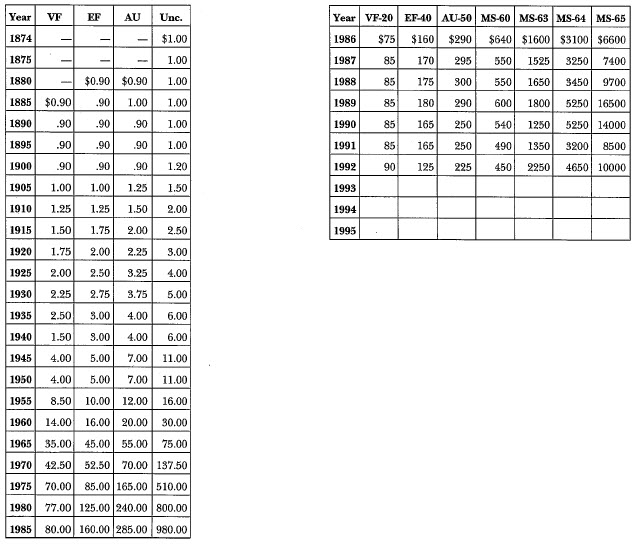
1874-S Trade Dollar: Summary of Characteristics
Business Strikes:
Enabling legislation: Act of February 12, 1873Designer: William Barber
Weight: 420 grains
Composition: .900 silver, .100 copper
Melt-down (silver value) in year minted: $1.0058
Dies prepared: Obverse: 34; Reverse: 42. According to R.W. Julian, 4 obverses and 4 reverses were ordered on February 27th (shipment date unknown); 12 obverses and 4 reverses were sent on March 17th; 6 pairs June 27th; 12 obverses and 24 reverses August 3rd; total 34 obverses, 42 reverses. Of these, 30 obverses and 27 reverses were destroyed on February 1, 1875.
Business strike mintage: 2,549,000. Delivery figures by month: January: none; February: 270,000; March: 250,000; April: 273,000; May: 366,000; June: 259,000; July: 158,000; August: 191,000; September: 271,000; October: 229,000; November: 95,000; December: 187,000. This averages out to 84,966 per die-pair.
Approximate population MS-65 or better: 0 or 1 (URS-0)
Approximate population MS-64: 20 to 40 (URS-6)
Approximate population MS-63: 30 to 50 (URS-6)
Approximate population MS-60 to 62: 400 to 800+ (URS-10)
Approximate population VF-20 to AU-58: 2,500-5,000 (URS-13)
Characteristics of striking: Some business strikes are lightly impressed on Miss Liberty's head and stars 6 and 7 and/or on the eagle's sinister claws.
Known hoards of Mint State coins: None
Rarity with original Chinese chopmark(s): Extremely plentiful. Third most common of all chopmarked trade dollars.
Proofs:
None
Commentary
Most were shipped to the Orient. Numerous chopmarked coins exist today.
Additional Information
Trade Dollars in San Francisco in 1874
The Annual Report of the Director of the Mint, 1874, informed readers that O.H. LaGrange, superintendent of the San Francisco Mint, wrote to the director of the Mint, and on September 10, 1874 noted that from January 1, 1874 through August 31, 1874 some $2,422,904.11 worth of deposits of silver bars for coinage into trade dollars had been received by the San Francisco Mint, but just $1,823,258 in trade dollars had been coined. Further:
"The amount of silver deposits awaiting conversion into trade dollars, August 31, 1874, has an assay value of $578,402.78. At no time since the commencement of the present calendar year has the mint been enabled to accumulate a surplus of trade dollars, and the public demand has not been formally met. The limited capacity of the mint and the unusually large coinage of gold, which was given precedence over silver, have materially abridged the supply of this international coin at San Francisco, but the favorable introduction of the trade dollar into China has almost effectively destroyed the use of the Mexican silver dollar as a medium of exchange between this city and ports in the Chinese Empire.
"The city banks report an excess of demand for trade dollar exchange. The coinage capacity of the new mint, shortly to be occupied, will, it is to be hoped, fully meet the requirements for all gold and silver coins. [Reference is to the new San Francisco Mint building, the cornerstone of which was laid in 1870.] Great care has been taken in the manufacture of the trade dollar to reach the closest approximate perfection in assay value, weight, and execution. The coins have successfully passed the critical test made before their adoption at various Chinese ports, and their commercial use in increasing. They have been officially adopted at Foo-Chow within a recent period, and the chief paymaster of the United States squadron on that coast will probably require this coin for his disbursements as soon as the supply can be relied upon. The complete success of this exchange coin in the future appears to depend mainly upon the commercial demand being met by the United States mints."