Silver Dollars & Trade Dollars of the United States - A Complete Encyclopedia
Q. David Bowers
1877 Trade Dollar
Coinage Context
Status of the trade dollar: By 1877 the Act of July 22, 1876 demonetizing the trade dollar was old business, trade dollars circulated within the United States only at a discount from face value, and coinage was intended solely for export to the Orient. However, generous numbers found their way into domestic commerce.
In June 1877, Secretary of the Treasury John Sherman stated that there was no further export demand for the trade dollar, an opinion that was at sharp odds with that of Mint Director Dr. Henry Linderman (see testimony reprinted under Additional Information below).
In October 1877 Sherman directed that silver deposited for coinage into trade dollars would no longer be paid in trade dollars at the coinage mints or the assay office. The Annual Report of the Director of the Mint for 1878 said that when this order reached the Philadelphia Mint and New York Assay Office in October 1877 "there was due depositors for bullion previously deposited at these institutions 590,795 trade dollars." The superintendent of the Philadelphia Mint was directed to pay for these in bars, or in trade dollars, only "upon satisfactory evidence being given that the same would be exported." Apparently, many depositors provided such evidence, as the report continues: "The bullion was accordingly coined, the settlement made with the depositors; the last coinage for this purpose [13,000 pieces] being executed at Philadelphia in the beginning of December 1877."
It later developed that this "satisfactory evidence" was in some instances fabricated, and that the recipients sold many coins at premiums above bullion value, but below face value, to domestic factory owners, mine owners, et al., who exploited their employees by paying the coins out in wages at $1 each (see details under Additional Information, 1876 above).
In the meantime, demand for trade dollars for export continued (see testimony reprinted below), and the years 1877 and 1878 were to see the largest production figures of the denomination, the majority from San Francisco.
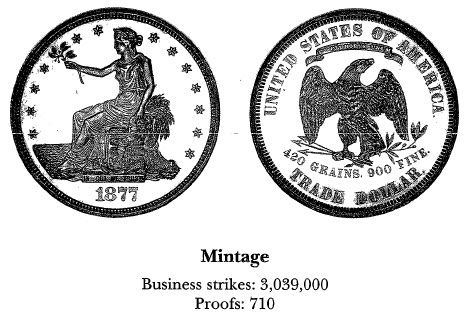
1877 business strike mintage: Due to the uncertain market for trade dollars and Secretary of the Treasury John Sherman's negative opinion concerning the denomination, relatively few were struck in the first half of the year. Of the total annual production of 3,039,000 coins, just 654,000, or only about one-fifth of the total was produced from January through June; see monthly figures under Summary of Characteristics below. Many of the remaining 2,584,000 went into domestic circulation. The production quantity was far and away a record for a Philadelphia Mint trade dollar, and was the only issue to exceed the one million mark.
Many were exported, although, as noted, some were illegally sold domestically. Quantities of the latter were distributed in Pennsylvania, New York, New Jersey, and Connecticut, among other Eastern states.
Numismatic Information
Circulated grades: The 1877 trade dollar is very common in circulated grades. I estimate that of the levels from VF-20 to AU-58, 20,000 or more exist. Chopmarked pieces are scarcer than the high mintage would suggest. This reflects lessened demand in China, or increased diversion to domestic circulation, or both.
Mint State grades: Despite its record high mintage for a Philadelphia coin of this denomination, the 1877 trade dollar is a major rarity in MS-65 grade. I estimate that just four to eight are known. Until the rarity of business strikes of Philadelphia Mint coins began to be studied in the 1970s, emerging almost as a science in the 1980s, the 1877 was dismissed as a common date. Now we all know the MS-65 1877 for the rarity it is.
A tiny difference in grade can make a big difference in rarity (and price). I estimate that 60 to 120 or more are known at the MS-64 level. As grading is not a precise science, once the rarity of the 1877 in MS-65 becomes generally known (see preceding paragraph), I would not be surprised to see many MS-64 coins resubmitted to the certification services in the hope of attaining the pinnacle MS-65 listing. Accordingly, watch for "MS-65" coins to become more common.
In MS-63 there are probably about 150 to 250 or more 1877 trade dollars known. In the MS-60 to 62 range the issue is readily available, and an estimated 450 to 900 or more are known.
Many are weakly struck: Maurice Rosen and Robert Emmer were among the first (after Willem) to study trade dollars from a numismatic viewpoint. They reported that the 1817 is almost always weakly struck around the obverse stars and head. Virtually all Uncirculated pieces show this.' Despite the large mintage, this issue is elusive in Mint State, they also noted. This almost certainly reflects the majority going into circulation.
As many die-pairs were used to strike 1877 trade dollars, the pervasive weakness of striking was caused by a general policy this year of spacing the dies too widely apart. This practice (which, among other instances, was also prevalent at the New Orleans Mint during the Morgan dollar era) prolonged die life but produced miserable coins.
Varieties: All trade dollars from 1877 onward are of the Type II obverse and reverse style.
R.W. Julian cites a Mint report of July 7, 1877 mentioning a new hub for 1877. Was one of these a Type II obverse? Did the other replace the 1876 Type II reverse? The latter had chipped at AR and all three periods. Specialists may want to check 1877s of all mints to see if the reverses differ from 1876 Type II in anyway other than serifs.
Proof figures not certain: While monthly reports of Mint production figures (see below) for Proofs suggest a total mintage of 510, some (including Walter H. Breen and me) have questioned this figure. Based upon the number of known specimens, and the 200 made in February (before any major deliveries of business strikes), a figure or 710 seems more likely. This seems to fit in well with the analysis of the availability of Proofs discussed in the introduction to the trade dollar section. Of this number, 125 were distributed at face value, probably to coin dealers, on January 11, 1878.
However, this is conjecture. Then, the question arises as to why 710 Proofs would have been struck of the trade dollar when only 510 Proofs were reportedly struck of the dime, quarter, and half dollar. This may never be resolved to everyone's satisfaction.
Availability of Proofs: Proofs, though rare in the overall context of numismatics, are not among the rarities of the 1873-1883 Proof series. The specialist will be able to acquire a piece without difficulty. The widely published (and, as noted, probably erroneous) mintage figure of 510 pieces has caused these coins to sell for an undeserved premium upon occasion. On the other hand, Walter H. Breen, writing years ago in 1977, thought the 1877 Proof was rarer than even the 510 mintage indicated." For some reason, many 1877 Proofs are brilliant (and also especially deeply mirrorlike), rather than lightly toned; this is much more observable with 1877 than, for example, with 1876.
Varieties:
OBVERSE TYPE II, RIBBON ENDS POINT DOWN, 1876-1885
REVERSE TYPE II: NO BERRY BELOW CLAW, 1875-1885
Business strikes:
1. Heavy date, bases of 18 touch: Breen-5807.
Minor positional differences in date. Common. (Do any have broken letters?) Often seen chopmarked.
2. Normal date: Thinner numerals, 1 8 apart:
Breen-.5809. Multiple die varieties exist. Common. (Do any have broken letters?) Often seen chopmarked.
Proofs:
1. Heavy date, double punched: Breen-5808.
Minute traces of double punching, particularly the 1 and 8. Only a small number of Proofs are of this variety.
2. Normal date: The variety usually seen. No Proof surface between eagle's claw and branch. (Do any have broken letters?)