Silver Dollars & Trade Dollars of the United States - A Complete Encyclopedia
Q. David Bowers
1873-CC Trade Dollar
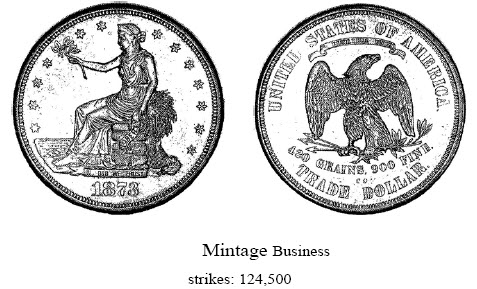
Coinage Context
First Carson City coinage: The Carson City Mint, located close to Virginia City, Nevada, site of the fabulous Comstock Lode's silver (and gold) mines, seemingly was the logical mint to strike vast quantities of trade dollars from this metal. In practice, most Comstock Lode silver was shipped to San Francisco for coinage. Contributing to the situation was political opposition to the Carson City Mint as an inferior upstart rival to the San Francisco Mint.
Nearly the entire production of 1873-CC trade dollars went to China.
Four pairs of dies made: Four pairs of trade dollar dies, made in Philadelphia (where all dies for all mints were made), were received in Carson City on July 22, 1873. It is not known if all dies were used; probably most were, as they did not last long, averaging only about 15,000 impressions per die pair. Coinage began immediately, and on the following day, 4,500 pieces were ready for shipment, and 2,580 coins were paid out to local depositors, this being the first circulation of the denomination in the West. Four more pairs followed, two sent from Philadelphia on October 18th, two more at an unknown date. All had small CC mintmarks.
Die dating and usage; general commentary: It was mint practice to discontinue the use of any dated dies once the calendar date had expired. Thus, any serviceable 1873 obverse dies on hand as of December 31, 1873 would have been canceled (the Carson City Mint did this by using a chisel to cut an X mark across the face). Serviceable reverse dies would have been kept on hand for use the following year.
Numismatic Information
None saved by collectors: So far as is known, not a single numismatist in 1873 was interested in collecting trade dollars by mintmark varieties. Nearly all coins were shipped to the Orient, although a few apparently saw domestic use. Many of the exported pieces saw heavy use and were chopmarked; the same is true of most other trade dollar issues of the 1873-1874 years.
Circulated grades: In circulated grades the 1873-CC is quite scarce. I estimate that about 1,000 to 2,000 exist in grades from VF-20 through AU-58. The issue has always been a key date, and in the 1950s shipments from the Orient to coin dealers in the United States were apt to have very few 1873-CC coins. The coin in John M. Willem's personal reference collection was AD.
Mint State grades: The 1873-CC is an extreme rarity in higher Mint State levels. I have never seen an MS-65, nor has one been certified by PCGS or NGC (as of April 1992). In MS-64 grade it is likewise an extreme rarity; I estimate that only two or three are known, and this estimate may be too liberal. Bruce Amspacher has written: "I have never seen a coin that graded above MS-63.(In his chapter in John Highfill's Encyclopedia, p. 635.) Until recent times, the rarity of 1873-CC in upper grades has not been appreciated. Now, it has emerged as a coin which in the upper echelons of Mint State outshines by far the 1893-S Morgan dollar, for example.
In MS-63 grade the 1873-CC maintains its lofty rarity status, and examples seem to be about as elusive as MS-64; which is saying that only two or three exist.
In Mint State levels of 63, 64, and 65 the 1873-CC trade dollar, indeed, is a heavyweight contender, a coin whose time seems due.
Finally, at the MS-60 to MS-62 level, coins begin to appear, but even so, I estimate the population to be on the order of only 40 to 80 pieces, which in the scheme of things numismatic is peanuts. Many of these have been cleaned; possibly including the small group of about five Mint State coins in the World-Wide Coin Investments mini-hoard mentioned by Bruce Amspacher (see introduction to the denomination).
Probably, most extant Mint State 1873-CC trade dollars represent coins returned from the Orient, which missed being chopmarked.
The Rosen study: Mint State 1873-CC trade dollars are exceedingly rare. In a 1980 study (Maurice Rosen. "The U.S. Trade Dollar Series: An In-Depth Study." Gobrecht foumal; March 1980.) Maurice Rosen stated that in years of looking he had seen only two which could be truly described as being in this grade. Most pieces described as "Uncirculated" weren't, in his opinion. He noted that in a 1977 auction a "Brilliant Uncirculated" piece, so described, was graded by him as only EF-45, heavily bagmarked, and with scratches.
Over a decade later, Maurice Rosen commented as follows:(Letter to the author,January 22, 1992.) "The 1873-CC is my favorite date and a genuine scarcity in or near Mint State. The finest I've seen auctioned, which I bought, was the piece in the Fairfield Collection ('Choice BU'). Finest I've seen anywhere is a NGC-certified MS-64, owned by a good client. This. is a largely unheralded date, much rarer than the 1889-CC Morgan silver dollar. Most of the issue was exported to China in 1873, with others pressed into hard domestic service, later melted. I doubt if a true MS-65 exists!"
Varieties:
OBVERSE TYPE I: RIBBON ENDS POINT LEFT, 1873-1876
REVERSE TYPE I: BERRY BELOW CLAW, 1873-1876
Business Strikes:
Breen-5781. Normal letters. "Do any show broken serifs?" asks Walter H. Breen. All varieties are usually seen in low grades and/or are chopmarked. Four pairs of dies were received at the Carson City Mint on July 21,1873 as noted; four more pairs were received later. Mintmark .9 mm high; spacing between C's varies from.6 mm to .75 mm. "Minute cc" compared to certain mintmarks used in later years. Three varieties have been identified to date:
1. Close CC, central.
2. Close CC, low.
3. Wide CC, over a C's width apart. Rare. Cf. Norweb specimen.