Silver Dollars & Trade Dollars of the United States - A Complete Encyclopedia
Q. David Bowers
1875 Trade Dollar
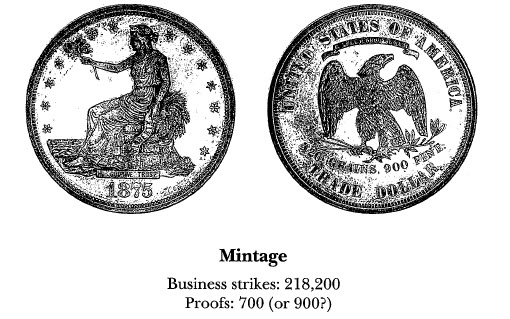
Coinage Context
Low production: By 1875 the trade dollar was firmly established in Oriental commercial circles, particularly in certain ports in China. The Philadelphia Mint production this year was low and dipped to just 218,200 business strikes, the lowest so far from that mint in the trade dollar series. The output was sporadic. From January through March none were struck. In April 200 business strikes are reported to have been made (and are so considered in this text, but there is a strong possibility that these were Proofs; if so, the figures will have to be adjusted accordingly to a total mintage of 900 Proofs), followed by 149,000 in May, none in June or July, 69,000 in August, and none for the rest of the year.
As chopmarked coins are very scarce today, it is quite possible that much of the 1875 Philadelphia Mint trade dollar coinage was used domestically in the United States.
Copycats: As the United States trade dollar became accepted in China, the Japanese government came up with its own ideas to mount a challenge. Its own current silver yen, which weighed 416 grains, .900 fine, were being increasingly rejected. In 1874 pattern Japanese trade dollars were minted, and in 1875 Japan began to coin a copycat version of the United States trade dollar, creating a Japanese coin with this inscription in English: 420 GRAINS Trade Dollar .900 FINE.
Numismatic Information
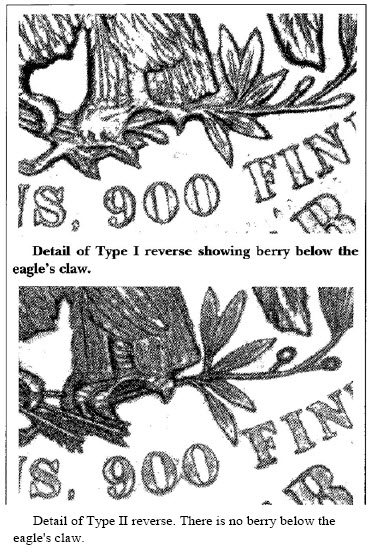
Type I and Type II issues: During 1875, to silence Coiner Archibald Loudon Snowden's complaints about striking quality, Chief Engraver William Barber put a new reverse hub ("Type II") into use. Proofs and business strikes exist from old and new hubs. The old hub, Type I (1873-1876), has a berry below the eagle's claw; the new (Type II) lacks it-a difference easily seen with the naked eye. Among 1875 trade dollars, business strikes as well as Proofs, the Type I reverse is considerably the scarcer of the two.
Type I reverse coins probably constituted all 200 business strikes made in April (if indeed these were business strikes; this is doubtful; they were probably Proofs) and a small minority of 149,000 pieces struck in May.
As noted in the introduction to the trade dollar section, beginning in the following year, 1876, there was an obverse hub change also. The Type I obverse is readily distinguished by having the ends of the ribbon (on which LIBERTY is imprinted) pointing to the left. The new Type II obverse, introduced in 1876, has the ribbon ends pointing downward. A coin with a Type I obverse and Type I reverse is referred to as Type I/I, a coin with a Type I obverse and Type II reverse is Type I/II, etc. (The obverse hub change is mentioned here because of unconfirmed rumors of 1875-dated coins with obverse Type II.)
A famous date: The business strike 1875 Philadelphia Mint trade dollar has acquired a certain halo of fame in recent decades, due no doubt to comments such as this, by John M. Willem: (The United States Trade Dollar, p. 153.)
Regarding the relative rarity of the trade dollars of the various mints, from the standpoint of the collector trying to assemble a complete collection, the most difficult to secure is the 1875 Philadelphia. The regular coinage of Philadelphia was the lowest that year of any of the years the Philadelphia Mint coined trade dollars. This coin is also most difficult to secure with a chopmark stamped upon it, indicating its actual circulation in China. With a specimen of the regular coinage of 1875 at Philadelphia hard to find, collectors compete for Proof coins to satisfy their needs for a trade dollar of this date minted at Philadelphia.