Silver Dollars & Trade Dollars of the United States - A Complete Encyclopedia
Q. David Bowers
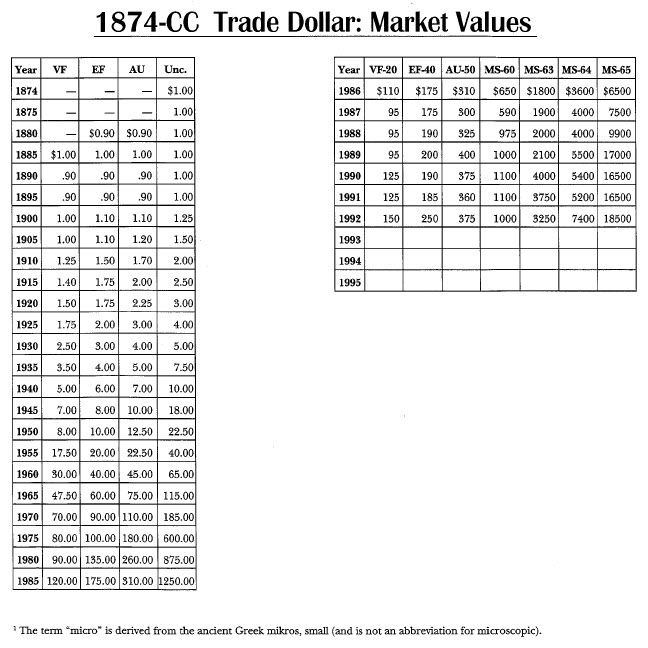
1874-CC Trade Dollar: Summary of Characteristics
Business Strikes:
Enabling legislation: Act of February 12, 1873 Designer: William Barber
Weight: 420 grains
Composition: .900 silver, .100 copper
Melt-down (silver value) in year minted: $1.0058
Dies prepared: Obverse: 17+; Reverse: 17+. According to R.W. Julian, 10 dies (five pairs?) were shipped before April, six more pairs on June 19th, and six additional pairs on July 17th. Other quantities and shipment dates are unknown. (The 18 pairs shipped on November 12, 1874 were probably for 1875-CC.)
Business strike mintage: 1,373,200. Delivery figures by month: January: 9,600; February: 38,100; March: 52,500; April: 48,500; May: 65,500; June: 71,000; July: 76,500; August: 145,500; September: 209,000; October: 201,000; November: 216,000; December: 240,000. If 17 die pairs made the total, this averages to 80,7.76 per die-pair; a big improvement over 1873-CC, consistent with later CC dates.
Approximate population MS-65: or better: 0 or 1 (URS-0)
Approximate. population MS-64: 10 to 20 (URS-5)
Approximate population MS-63: 30 to 50 (URS-6)
Approximate population MS-60 to 62: 150 to 250 (URS-9)
Approximate population VF-20 to AU-58: 2,500- 5,000 (URS-13)
Characteristics of striking: Some are lightly or irregularly struck in areas, particularly on the eagle's sinister leg and claws and at the top of the eagle's dexter wing. "Notorious for weakly struck and oddly struck examples. Usually has subdued lustre similar to the New Orleans Mint Morgan dollars of 1895-97" - Bruce Amspacher.
Known hoards of Mint State coins: In the 1970s World-Wide Coin Investments distributed a group of about 15 pieces.
Rarity with original Chinese chopmark(s): The 1874-CC is the most plentiful Carson City Mint chopmarked trade dollar, and fourth most common of all chopmarked trade dollars.
Proofs:
None
Commentary
The 1874-CC is rare in high Mint State grades. Most were shipped to the China.