Silver Dollars & Trade Dollars of the United States - A Complete Encyclopedia
Q. David Bowers
1883 Trade Dollar
Coinage Context
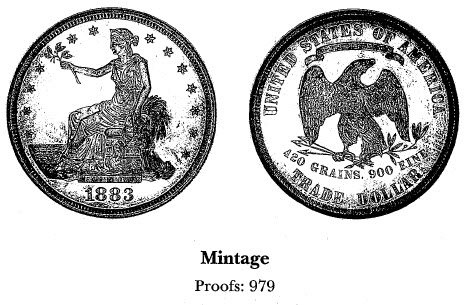
Production limited to Proofs: In this final year of public sales of trade dollars, only Proofs were made. The figure of 979 Proof trade dollars fell short of the 1,039 Proofs made of other silver denominations.
Director recommends abolition: Horatio Burchard, who had been director of the Mint since February 1879 and who had replaced Dr. Henry R. Linderman in the post, considered the trade dollar to be a nuisance and aggravation, even though business strikes were no longer being coined. In his annual report Burchard noted in part: "Probably from five to seven millions of these coins are now held in the country, mostly in the mining and manufacturing regions of Pennsylvania and contiguous states, and in the vicinity of New York, where they have been paid to workmen and laborers, and by them paid to and received from tradesmen in those localities."
Burchard recommended that the denomination be abolished. Evidently, the small demand for Proofs did not yield enough profit to offset the costs of planchets, dies, and striking. He also urged that the government set up a redemption program to give out subsidiary silver coins in exchange for trade dollars. (The text is quoted below under Additional Information.) While abolition followed quickly, redemption had to wait until 1887.
The President dislikes trade dollars: In his annual message to Congress on December 3, 1883, President Chester A. Arthur noted that trade dollars had become a disturbing element in domestic trade, they no longer circulated actively, and "they should no longer be permitted to embarrass our currency system." He recommended they be redeemed by the Treasury and Mint "as bullion in small percentage above the current market price of silver of like fineness."
This would not have protected the miners, factory workers, and others who were receiving trade dollars in their pay envelopes at face value.
By year's end, the trade dollar had hardly any friends. As John M. Willem has written, it was truly dishonored and unwanted.
Numismatic Information
Proof mintages: During the year Proof coinage amounted to 979 pieces, some of which are believed to have been melted or spent in early 1884. Those melted or spent were probably part of the December mintage (see monthly delivery totals below).
Availability of Proofs today: 1883 Proof trade dollars are somewhat scarcer than the mintage, even allowing for some melting, would indicate. This date seems to have an unusually high number of impaired survivors; perhaps as many as 25 to 50 lightly worn ones exist.
Bruce Amspacher comments concerning this date.(In his essay, "United States Trade Dollars: 1873-1885," in The Comprehensive U.S. Silver Dollar Encyclopedia, p. 635.) "Scarce in gem condition .... Slightly sub-par in overall quality (strike, depth of mirror, eye appeal) compared to issues of 1879-82."
Varieties:
OBVERSE TYPE II, RIBBON ENDS POINT DOWN, 1876-1885
REVERSE TYPE II: NO BERRY BELOW CLAW, 1875-1885
Proofs:
1.Normal issue: Breen-5829. Somewhat scarcer than the mintage would indicate. One in the Katen Sale,June 1992, Lot 132, had Proof surface between eagle's claw and branch; arrow feathers incomplete and with Proof surface between fragments; this die was also used in 1879 (and possibly in other years). Often seen flatly struck on head and stars.
1a. Some specimens seen by the author have pronounced die doubling at the bases of some of the letters in the inscription 420 GRAINS, 900 FINE, particularly evident at FI and E of FINE. This die was also used in 1882.
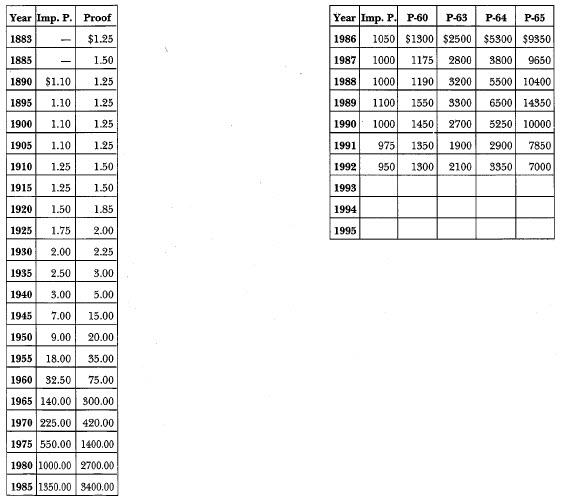
1883 Trade Dollar: Market Values