Silver Dollars & Trade Dollars of the United States - A Complete Encyclopedia
Q. David Bowers
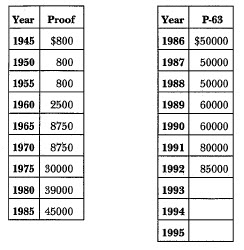
1884 Trade Dollar: Catalogue Value
Values as given in A Guide Book o/U.S. Coins 1945 (1946 prices) to date. Auction records are a better indication of value, but catalogue listings are of interest. The 1965, 1970, 1975, and 1980 prices are copies of auction records listed in the Guide Book.
Notes concerning specimens of the silver 1884 trade dollar which are undoubtedly part of the above registry, but which today cannot be specifically attributed to one of the 10 individual listings:
1. In The Numismatist; March 1914, Edgar H. Adams, New York newspaperman (The Sun), numismatic 'scholar, and rare coin dealer, offered at fixed prices Proof 1884 and 1885 trade dollars for $400 and $1,000 respectively.
2. John J. Ford, Jr., in a conversation with the author, 1 told of an 1884 trade dollar and gave the background of its discovery: Wayte Raymond took over the Scott Stamp & Coin Company, Inc. rare coin business in New York City circa 1933. Around 1936 to 1938 Leonard Kusterer was one of the main employees there. Raymond did a lot of advertising under the Scott name. He was especially concerned about what he considered to be misleading advertising by B. Max Mehl and others, who suggested that one could find classic American rare coins in "pocket change, and who derived the most profit from selling catalogues (not from buying rare coins from the public). Raymond wrote a booklet which told the truth about rare coinsan answer to B. Max Mehl's Star Rare Coin Encyclopedia. Raymond sought to buy coins himself, but on more legitimate, numismatic grounds. One day Leonard Kusterer bought over the counter an 1884 copper, nickel, and silver Proof set which contained an 1884 trade dollar which gave every appearance of having been with the set for a long timethe coins had matched toning and were all of the same quality. This Was circa 1937 or 1938. What happened to the 1884 trade dollar in the set is not known today.
3. In The Numismatist, June 1944, p. 546, the Celina Coin Company, Celina, Ohio, a firm owned by brothers Ted and Carl Brandts (who also owned a hotel in the same town), advertised a complete set of Prooftrade dollars, including these listings: "1884 Very Rare, $400.00," and "1885 Excessively Rare, $1,000.00." According to Eric P. Newman, who has the original sales invoice, these were sold by Burdette G.Johnson from the Col. E.H.R. Green estate to the Brandts brothers. Earlier Johnson had sent them on approval to George Walton of Charlotte, North Carolina, who returned them. Late~ in the 1940s, one of the Brandts brothers died suddenly, and the numismatic operations were put under the management of Robert F. Wilson, who moved the Celina Coin Company to Lima, Ohio, after which the firm faded from the scene.
4. In the early 1960s, Melvin E. Came, Dover, NH rare coin dealer, offered a set of 1873-1884 Proof trade dollars for sale as a group and displayed it in a plastic holder at an ANA convention.
Registry of Copper 1884 Trade Dollars
The following listing represents copper strikings of the 1884 trade dollar known to me. Some of the listings may duplicate others.
1. Anderson-Dupont Specimen
• A. Loudon Snowden, Philadelphia Mint.
• Unknown intermediaries.
•The 1884 trade dollar in Stack's November 1954 Anderson-Dupont Sale:2652 at $2,500 was later discovered by Jack Collins to be a silver-plated copper piece."
• It reappeared in Stack's Dr. Calvert L. Emmons Sale, September 1969, Lot 813 at $6,000.
• Stack's Winner F. Delp Sale, November 1972, Lot 761 at $15,000.
• Private collection.
• One or more dealers.
• Jerry Cohen and Abner Kreisberg, at $37,500.
• Private collector who paid $42,500.
•This coin, now correctly attributed as a copper trial piece, is in the cabinet of Edward J. Linkner, M.D. (1992).
2. Smith Specimen
• A. Loudon Snowden, Philadelphia Mint. 1884 Proof set in copper.
• Gift to A.M. Smith, author in 1881 of the Illustrated History of the u.s.Mint (published under the name of A.M. Smith; see below). "AM. Smith got [the 1884 copper trade dollar and other copper pieces] from the superintendent of the Mint in 1884, and they have remained in the Smith Collection these 50 years, and have never been offered for sale" (from Bolender's catalogue of February 8,1936; see below).
• Single coin in the Milferd H. Bolender sale of October 15, 1935, "Part III of the Famous Collection Formed by the Late A.M. Smith, of Minneapolis, Minn." Lot 245. Description: "245. 1884 Trade Dollar. Regular dies but struck in copper. Not in Adams-Woodin. Uncirculated. Excessively rare." No other 1884 copper pattern coins were in the sale. Apparently, the coin was bought in, for Bolender's sale of February 8, 1936 offered 13 copper strikings of 1882, 1883, and 1884 coins, including Lot 25 described as follows: "1884 trade dollar. Regular dies. Trial in copper. Proof." Bolender stated: "A.M. Smith got them from the superintendent of the Mint in 1884 and they have remained in the Smith Collection these 50 years and have never [sic!] been offered for sale." Interestingly, Bolender described the coin as Uncirculated the first time and Proof the second.
Born Anders Madsen Schmidt, in Knudsbol, Parish of Jordrup, Denmark, on February 4, 1841, Andrew Madsen Smith (as he came to be known) emigrated to the United States, arriving in Philadelphia on May 1, 1859. In 1861 he was in the business of selling chickens. Subsequently he served in the Union Army and Navy, and traveled extensively and lived throughout the West. In 1875 he returned to Philadelphia, and in that city was a dealer in wines and in rare coins at 6th and Chestnut streets through the year 1886, when he moved to Minneapolis. In 1885 his biography, Luck of a Wandering Dane, appeared under the nom de plume Hans Lykkejaeger. His updated biography was published in 1890 in Minneapolis, and gave 249 Hennepin Avenue as his address. Bearing the name of A.M. Smith as author, it was titled Up and Down in the World, or Paddle Your Own Canoe. In 1886 he published the Encyclopedia of Gold and Silver Coins of the World. For a number of years he operated the California Restaurant at 247 Hennepin Avenue, decorated with sets of coins and medals framed high on the walls. Smith joined the American Numismatic Association in 1901. In August of that year he advertised in The Numismatist and offered Proof trade dollars of the 1879-1883 years for $2 each. The Minneapolis Journal; December 5, 1908, printed the following:
The silver dollar of the date of 1884, that sold in Chicago [a silver 1884 trade dollar in Ben Green's auction] for $280, is what is known as the "trade dollar," and it is doubtful if more than a few hundred people have ever seen one of that date, as there were only five struck in silver and a few in copper, and these are in collections, closely guarded. A.M. Smith of Minneapolis has one of the copper Proofs in his collection of coins, others are in private collections in the East and in the United States Mint Collection. When the story of the Chicago sale appeared, hundreds of persons of Minneapolis made the mistake of thinking that it was the ordinary standard dollar of 1884 that brought the high premium, and many thought they had a small fortune in their grasp, when, in hunting through their pockets and cash registers they discovered several of that date. AM. Smith has been kept busy for the last four or five days informing people that they did not have any of the valuable coins. In one day he answered over 100 telephone inquiries on the subject.
Smith died in Minneapolis on July 20, 1915. (Mason's Monthly Illustrated Coin Collector's Magazine, June 1890, p. 7, gave the curious and incorrect information that "A.M. Smith"was really Jacob Smith, who used the name of his wife, Annie M. Smith, in his business. Smith's wife was the former Botilla Elberg. Pete Smith (no kin to A.M.S.) has written a biography of A.M. Smith; see Bibliography.)
• Private collection, apparently still with certain other 1884 copper strikings (information per Walter Breen)