Silver Dollars & Trade Dollars of the United States - A Complete Encyclopedia
Q. David Bowers
Redemption of Trade Dollars (1887)
The American Numismatist, published by C.E. Leal, Paterson, NJ., carried this article in the issue of March 1887:
"THE REDEMPTION OF TRADE DOLLARS: Since Congress passed the bill authorizing the redemption of the trade dollars, the professional examiners and counters in the Sub-Treasuries at New York and San Francisco have been kept busy receiving the large sums forwarded from all parts of the country. As the dollars can only be redeemed in these two cities, and as each piece has to be carefully scrutinized to see that it is neither defaced, mutilated, nor stamped, it will probably be five or sixmonths before the work is completed.
"It is the common belief that at the time the value of trade dollars fell to 88 cents, large quantities were bought by bullion brokers speculating on a possible raise. If anyone had bought the coins in 1883, at theirlowest price, and held them until the passage of the redemption act, he would really have lost money, as the profit on the four years investment would only be 12 cents. A larger profit than this could have been obtained by investing in government bonds.
The Treasury Department has issued the following statement to holders of trade dollars:
"TREASURY OF THE UNITED STATES,
"WASHINGTON, MARCH 7, 1887.
"Owing to the present inadequate provision for the reception and storage of trade dollars, the redemption of which is provided for under the act of Congress passed Feb. 20,1887, the following regulations will be observed, in order, so far as practicable, to comply with the terms of the law:
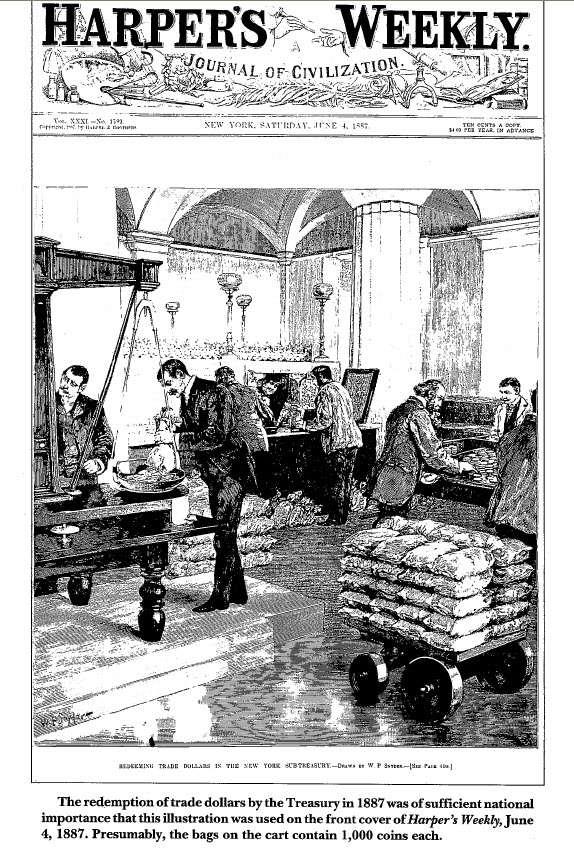
"Trade dollars, if not defaced, mutilated, or stamped, will be redeemed or exchanged at the offices of the Treasurers of the United States. Requests for the redemption of these coins stating the amount held should be forwarded to the above named officers, who will file applications and notify holders in their turn when presentation may be made and payment obtained. The notification by the holders of trade dollars to the Treasurer or Sub-Treasurers of the United States of the amounts held by them respectively will be held to be a sufficient presentation of the coins within the meaning of the law, and will entitle the holders in order of reception of such notifications to deposit such coins in the respective Sub-Treasuries when notified that such deposits can be received at those offices. Notifications must be filed with the Sub-Treasurers on or before Aug. 1, 1887. After notifying these officers, and upon receipt of notification from them, such coins may be forwarded by express or otherwise, transportation charges being prepaid, when receipts will be issued for the amounts purporting to be contained in the deposits on their reception. Upon the count and ascertainment of the amount of each deposit payment will be made therefor in standard silver dollars or in fractional silver coin at the option of the holder. Defaced, mutilated, or stamped trade dollars found in deposits will not be redeemed or exchanged by any of the Sub-Treasury officers, but they will be returned to the depositor or purchased as bullion in sums of $3 or upward by the United States mints at the option of the depositor. C.N. JORDAN, TREASURER UNITED STATES.