Silver Dollars & Trade Dollars of the United States - A Complete Encyclopedia
Q. David Bowers
1877-S Trade Dollar
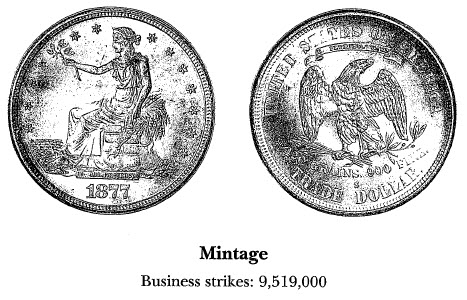
Coinage Context
Record mintage: The mintage of the 1877-S trade dollar broke all previous records, and no later mintage was ever to equal it, with the result that the production of 9,519,000 pieces stands as the high point of the denomination. In fact, the mintage of 1877-S alone was greater than all combined trade dollar mintages of the Philadelphia and Carson City mints from the first year of business strike production, 1873, until the last year 1878!
The high-water mark for monthly trade dollar deliveries in 1877 at the San Francisco Mint was August, when 1,329,000 were ready for distribution.
Most shipped to China: Although some coins were distributed within the United States to brokers who bought them at a discount from face value and sold them to industrialists and others, by far the greatest amount of 1877-S trade dollars went to China, where they were plentiful for decades afterward. Many were made for the Nevada Bank of San Francisco (see Additional Information under 1877, above).
Numismatic Information Circulated grades: In grades from VF-20 to AU-58 the 1877-S is the most common of all trade dollars. I estimate that 50,000 or more exist. Chopmarked coins are also common.
Mint State grades: By comparison to other issues in the trade dollar series, the 1877-S is relatively "common" in Mint State, particularly in lower levels. I estimate that probably 50 to 100 or more MS-65 coins exist, a rare issue in absolute terms, but a common one relative to its cousins.
I estimate that 170 to 325 or more 1877-S trade dollars survive at the MS-64 level, 300 to 600 or more at the MS-63 level, and 1,750 to 3,500 or more in grades from MS-60 to 62.
Varieties: All authentic 1877-S trade dollars known to me to be of correct statutory weight (420+/- grains) are Type II/II. (See Additional Information below for so-called 1877-S Type II/I trade dollars.)
Varieties:
OBVERSE TYPE II, RIBBON ENDS POINT DOWN, 1876-1885
REVERSE TYPE II: NO BERRY BELOW CLAW, 1875-1885
Business strikes:
1. Minute s: Breen-5814. Mintmark .84 mm high.
Date numerals light, 1 and 8 apart. "Light Date." Rare.
2. Medium S: Mintmark 1.1 mm high. Date numerals heavy, 1 and 8 touch. "Heavy Date."
3. Large S. 1 8 free: Breen-5813. Mintmark 1.17 mm high. Date numerals light, 1 and 8 apart. "Light Date." Common. Many minor date position varieties. Often seen chopmarked.
4. Large S. 18 touching: Breen-5810. Mintmark 1.17 mm high. Date numerals heavy, 1 and 8 touch. "Heavy Date." Multiple dies. Common. Many minor date position varieties. Often seen chopmarked.
5. Large S. Doubled reverse die: Breen-5812.
Doubling plain on most letters. Rare. Bill Fivaz reports another, strongest on E PLURIBUS UNUM.(Letter to the author, January 29, 1992.)
6. Large S. Blunt tail to R of DOLLAR: Breen-5811. Upturned serif broken off. At least two positional varieties: (a) mintmark leans crazily to left; (b) S upright; normal periods. Both are presently considered to be rare.
7. Large S. Blunt tail to R of DOLLAR, but no periods after E of FINE or R of DOLLAR: Not in Walter Breen's Encyclopedia. Fewerthan a dozen seen to date. Discovered by James R. Arnold (his specimen is EF and weighs 417.9 grains). The period after the final A in AMERICA is a tiny crescent. Evidently the hub was damaged. "Does this occur on 1878 trades of any mint?" asks Walter H. Breen.