Silver Dollars & Trade Dollars of the United States - A Complete Encyclopedia
Q. David Bowers
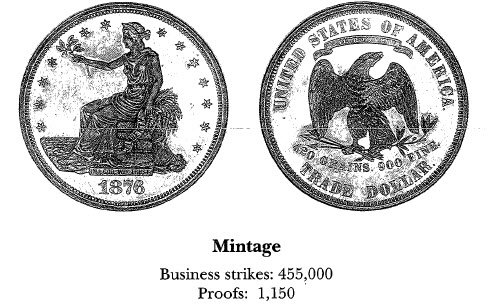
1876 Trade Dollar
Coinage Context
Silver coins in circulation: By the summer of 1876 there were vast quantities of coins stored at the mints. Under the Specie Resumption Act of January 14, 1875, they could be exchanged for Fractional Currency notes, but the public was slow in making such redemptions. As it developed, millions of dollars' worth of Fractional Currency pieces were never turned in. The Act of April 17, 1876 directed the Treasury to issue coins, but relatively little coinage circulated until after the Act of July 22, 1876, which provided that Legal Tender notes could be used to secure silver coins. The same act demonetized the trade dollar and limited its production to coinage for export. (Nearly a century later, the Coinage Act of July 23, 1965 inadvertently restored legal tender status to the trade dollar; see Additional Information under the 1885 trade dollar.)
To this point in American history there were many teenagers who had never held silver dimes, quarters, or half dollars in their hands or jingled them in their pockets. They were accustomed to Fractional Currency notes, usually referred to as "stamps," and coins of smaller denominations, the Indian cents, the bronze two-cent pieces, and the nickel three-cent coins.
Trade dollars: Carothers wrote:(Fractional Money, p. 277.) "Early in 1876 the price of silver reached the point where it was profitable to coin [trade dollars] for circulation on the Pacific coast. By the middle of that year the coins were flooding retail trade in California and shortly thereafter they were selling at a discount. Before the end of the year the rising value of greenbacks brought a similar development in the East. Trade dollars appeared in circulation all over the country."
Unadopted proposals: Director of the Mint Dr. Henry R. Linderman, a long-time friend of the silver political interests, recommended in 1875 that the trade dollar be made legal tender in amounts up to $10, a doubling of the trade dollar's current limit. In early 1876 the House of Representatives passed legislation which went beyond Linderman's hopes and provided that the coins be legal tender in amounts up to $50. However, the bill did not pass the Senate.
Linderman also proposed that a special commemorative reverse be made for 1876 trade dollars, to honor the 100th anniversary of American independence. Had this come to pass-which it didn't-it would have been the first United States silver commemorative coin. Elements of the proposed design were used in the 1876 Assay Commission medal, which has the border inscription YEAR ONE HUNDRED/OF AMERICAN INDEPENDENCE enclosing a heavy oak wreath.
Later production limited to export: While many if not most of the 1876 trade dollars minted in the first half of the year may have been used domestically (and this constituted the bulk of the coinage for the year), virtually all of the later ones were shipped to China. After the implementation of the Act of July 22, 1876, American citizens who had received trade dollars for face value could obtain no more than melt-down or bullion value for them.
A spate of legal challenges ensued. Some keen minds proposed that trade dollars minted after July 22, 1876 bear distinguishing marks. Under this suggestion, earlier trade dollars would be legal tender and later ones wouldn't. Nothing came of the idea, and the government continued to repudiate its earlier obligation. The American public was left holding the bag.
Numismatic Information
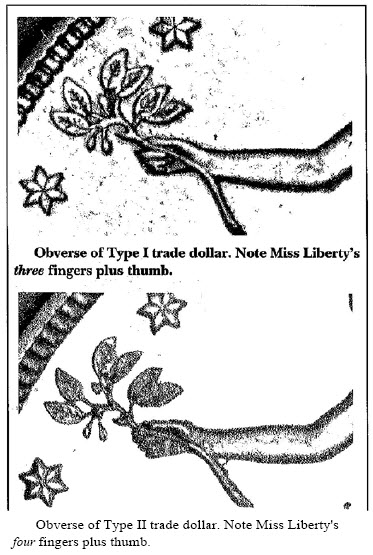
Varieties: As noted earlier, in 1876 there was an obverse hub change. The Type I obverse (in use since 1873 and continued in use in 1876) is readily distinguished by having the ends of the ribbon (on which LIBERTY is imprinted) pointing to the left. The new Type II obverse, introduced in 1876, has the ribbon ends pointing downward. A coin with a Type I obverse and Type I reverse is referred to as Type I/I, a coin with a Type I obverse and Type II reverse is Type I/II, etc.
The 1876 Philadelphia Mint trade dollar in business strike form comes in Types I/I, I/II, and II/II, the last being very rare.
Circulated grades: 1876 trade dollars are readily available in grades from VF-20 through AU-58. I estimate the population to be in the range of 2,000 to 4,000 pieces.
Most surviving 1876 trade dollars are Type I/II. However, among chopmarked coins, the Type I/I seems to be more available than the Type I/II; the explanation for this is unknown. In general, chopmarked 1876 trade dollars are rare. Perhaps after demonetization, fewer 1876 Type 1/11 trade dollars went overseas, while increasing numbers reached citizens by way of unscrupulous bosses and company stores.