Silver Dollars & Trade Dollars of the United States - A Complete Encyclopedia
Q. David Bowers
1877 Trade Dollar: Market Dollar: Market Values
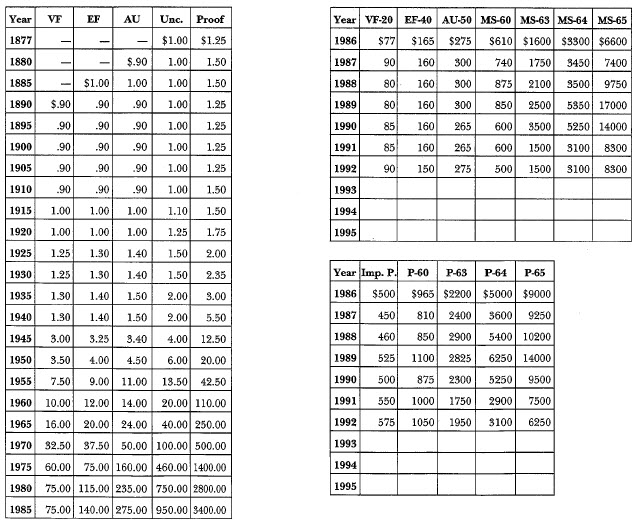
1877: Summary of Characteristics
Business Strikes:
Enabling legislation: Act of February 12, 1873
Designer: William Barber
Weight: 420 grains
Composition: .900 silver, .100 copper Melt-down (silver value) in year minted: $0.9457 Dies prepared: Obverse: 30; Reverse: 311
Business strike mintage: 3,039,000 (3,039,200 according to Mint figures). Delivery figures by month: January: none; February: 200 (these were probably Proofs; it would have been unprecedented in the trade dollar series to set up production facilities within a given month and produce just 200 business strikes; likewise, it would have been unusual to have delivered just 200 business. strikes from previously struck quantities); March: 59,000; April: 181,000; May: 291,000; June: 123,000; July: 536,000; August: 440,000; September: 402,000; October: 594,000; November: 400,000; December: 13,000. This averages out to over 116,800 per die-pair.
Approximate population MS-65 or better: 4 to 8 (URS-3)
Approximate population MS-64: 60 to 120+ (URS-7)
Approximate population MS-63: 150 to 250+ (URS-9)
Approximate population MS-60 to 62: 450 to 900+ (URS-10)
Approximate population VF-20 to AU-58: 20,000+ (URS-16)
Characteristics of striking: Typically weakly struck, with light impressions around the obverse stars and Miss Liberty's head. In particular, the stars to the right are often weak. Coins with a weak obverse can have a sharply struck reverse. In general, the 1877 Philadelphia issue is the poorest struck of all business strike trade dollars.
Known hoards of Mint State coins: None
Rarity with original Chinese chopmark(s): Somewhat scarce despite its high mintage.
Proofs:
Dies prepared: Obverse: At least 2; Reverse: 2
Proof mintage: 710 (or 510, according to Mint figures). Delivery figures by month: January: none; February: 400 (probably actually 600; the 200 business strikes listed in the Mint report figures quoted above were probably Proofs); March-September: none; October: 50; November: none; December: 60; 125 unsold Proofs were distributed for face value on January 11, 1878.
Approximate population Proof-65 or better: 44+/- (URS-7)
Approximate population Proof-64: 124+/- (URS-8)
Approximate population Proof-63: 120+/- (URS-8)
Approximate population Proof-60 to 62: 190+/- (URS-9)
Commentary
The 1877 is the most common Philadelphia Mint trade dollar in lower grades, although in MS-65 preservation it is extremely rare. Many are weakly struck.
Additional Information
1877 Testimony on Trade Dollars
The Annual Report of the Director of the Mint, 1877, noted that the biggest silver producing state was Nevada, which yielded approximately $26 million worth per year, followed by Utah at $5 million, Colorado at $4-1/2 million, California at $1 million, Montana at $750,000, Arizona and New Mexico at $500,000 each, Idaho at $250,000, Oregon at $100,000, Washington at $50,000. In addition, the Lake Superior region generated about $200,000.
Related in the same report were testimonies and comments of leading bankers and others, including Dr. Richard Henry Linderman (director of the Mint), beforethe United States Treasury Commission in relation to trade dollar coinage and other items, with the chairman (name not stated) doing the questioning. The report gives a fascinating insight:
The chairman is now asking questions of M.M. Tompkins, an agent of the Hong-Kong and Shanghai Bank:
"Question. What effect on the bullion market here has the coinage of trade dollars had, in your judgment?
"Answer. It has been of great benefit to the silver producers, in bringing silver up in this market.
"Q. It has been the means of converting a large amount of silver into a convenient form for shipping?
"A. Yes, sir.
"Q. They have, to a great measure, taken the place of the silver circulating in that country?
"A. Yes, sir: they have not thoroughly supplied it, but they are crowding it out of the market, and taking the place of it to some extent.