Silver Dollars & Trade Dollars of the United States - A Complete Encyclopedia
Q. David Bowers
1876 Trade Dollar: Market Values
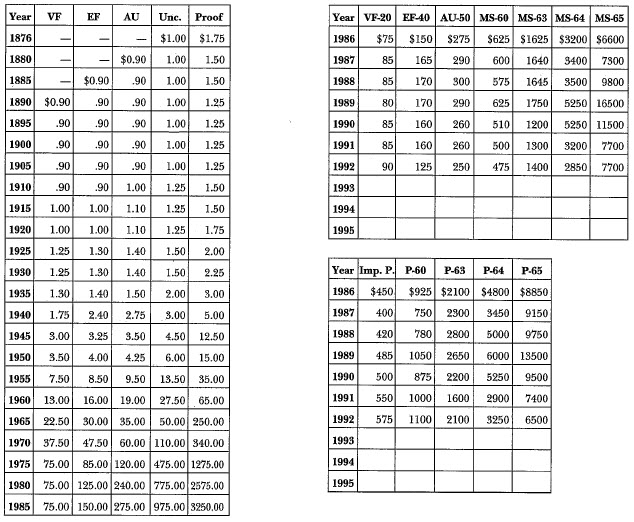
1876 Trade: Summary of Characteristics
Business Strikes:
Enabling legislation: Act of February 12, 1873
Designer: William Barber
Weight: 420 grains
Composition: .900 silver, .100 copper
Melt-down (silver value) in year minted: $0.9101 Dies prepared: Obverse: 8+; Reverse: 8+. Eight pairs were destroyed on January 3, 1877.
Business strike mintage: 455,000. Delivery figures by month: January: 81,000; February: 64,000; March-May: none; June: 65,000; July: 86,000; August: 84,000; September: 75,000; October-December: none. If all eight die-pairs were used, the average is only 56,875 per pair, fewer than at the S or CC mints. Possibly fewer die pairs were used.
Approximate population MS-65 or better: 40 to 60 (URS-7). Most are Type I/II.
Approximate population MS-64: 150 to 300 (URS-9). Most are Type I/II.
Approximate population MS-63: 200 to 400 (URS-9). Most are Type I/II.
Approximate population MS-60 to 62: 700 to 1,200 (URS-II). Most are Type I/II.
Approximate population VF-20 to AU-58: 2,000- 4,000. (URS-13) Most are I/II.
Characteristics of striking: Many are well struck, but many others are lightly struck on the eagle's dexter claws.
Known hoards of Mint State coins: None
Rarity with original Chinese chopmark(s): Type I/I, the combination usually seen; Type I/II, very scarce. Type II/II, believed to be very rare.
Proofs:
Dies prepared: Obverse: Unknown; Reverse: Unknown
Proof mintage: 1,150; Delivery figures by month: January: 200; February: 50; March: 200; April: 100; May:100; June: 200; July: none; August: 200; September: none; October: none; November: 100; December: none.
Approximate population Proof-65 or better: 34+/- (URS-7)
Approximate population Proof: 64+/- (URS-7)
Approximate population Proof-63: 117+/- (URS-8)
Approximate population Proof-60) to 62: 340+/- (URS-10)
Commentary
Despite its relatively low mintage the 1876 Philadelphia Mint trade dollar is readily available in most grades.
Additional Information
An Overview of Trade Dollars in 1876
Although it was not the intent of the drafters of the Mint Act of 1873 to have trade dollars circulate domestically in the United States, a rider attached to the legislation made the coins legal tender in domestic transactions up to $5. For this reason, trade dollars circulated within the United States. During the first two years of trade dollar production, 1873-1874, the vast majority of trade dollars were shipped to the Orient, and few were kept on our shores. In 1875 and early 1876, more trade dollars were used in the states. Early in the latter year a decline in the price of silver was the reason that millions of trade dollars, now not as popular for the China trade, were dumped into circulation, particularly in the West Coast. On July 22, 1876, the legal tender status of trade dollars was revoked.
Production of trade dollars for export continued for two more years, but in 1877 and 1878 over 8.6 million pieces went into circulation in the United States. At that time they were available for bullion value, or sometimes even less. Unscrupulous mine and factory owners, rural mercantile outlets, retailers (especially in areas in which there was little competition), and others bought the coins and put them at face value in the pay envelopes of employees. Banks and other commercial interests accepted trade dollars only at deep discounts. Aggrieved workers complained, and petitions reached Congress seeking recall of the coins or restoration of the legal tender status at $1 each. Later, this was done for just a brief period.
Decade after decade passed, and, finally, the Coinage Act of July 23, 1965 apparently restored legal tender to the trade dollar, although by then both bullion and numismatic values were so high that it was no longer relevant. No one cared. (See text of Act under Additional Information, 1885, below.)